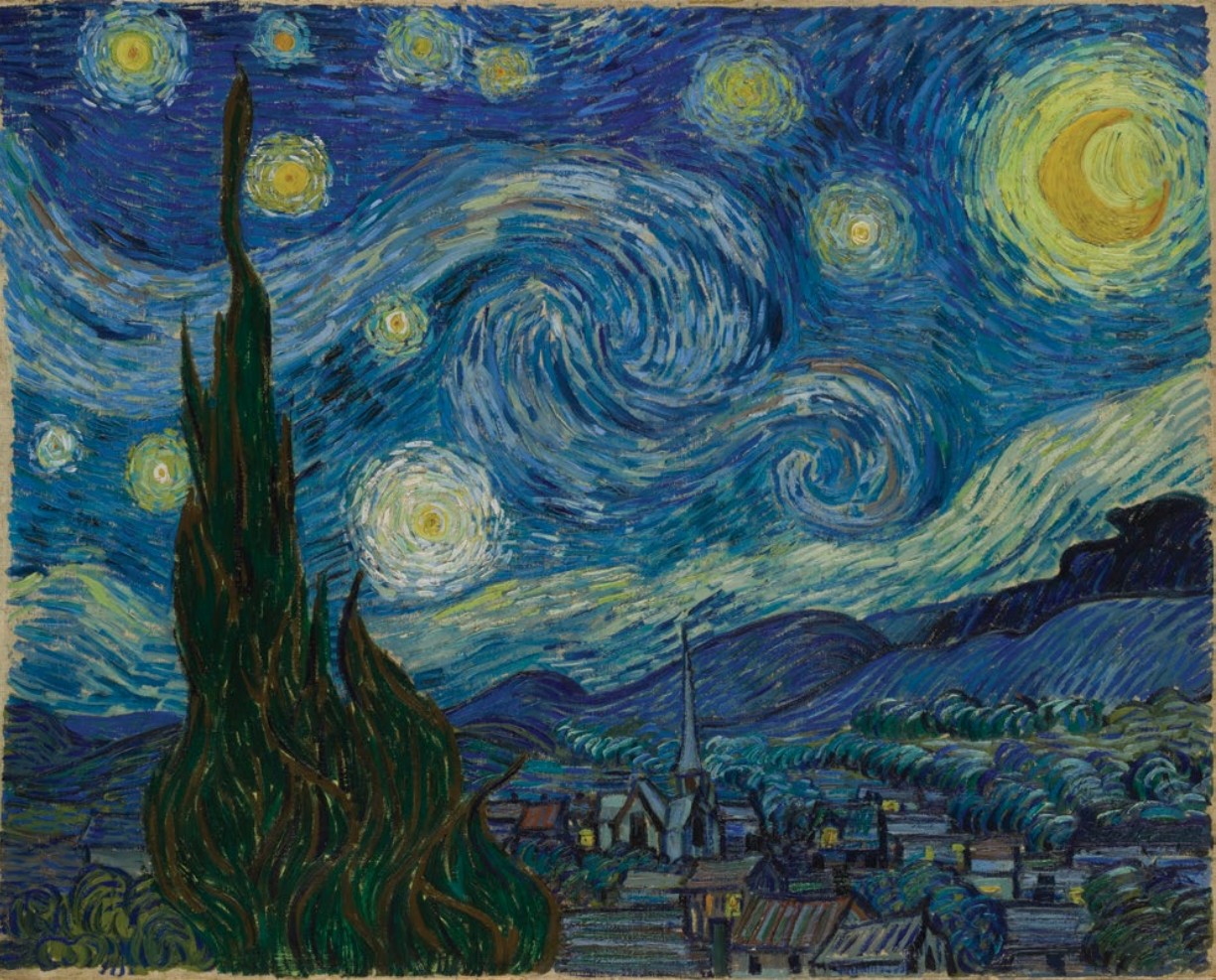
 The Starry Night Digital Image © The Museum of Modern Art/Licensed by SCALA/Art Resource, NY
The Starry Night
Vincent van Gogh. 1889 C.E. Oil on canvas.
Curator Note
"Painted from the window of his asylum room at Saint-Rémy, this is Van Gogh’s most famous work. It is an expressive, turbulent nightscape where the sky swirls with energy, overpowering the quiet village below. It represents the artist's inner emotional state and his spiritual connection to the cosmos."
Form
- Thick impasto (paint applied thickly).
- Swirling, rhythmic brushstrokes.
- Contrasting colors: Blue/Violet vs. Yellow/Orange.
- Composition dominated by the sky.
- The cypress tree provides a dark vertical anchor.
Function
- To express the artist's turbulent emotions.
- To experiment with color and form as expressive tools.
- To capture the spiritual power of nature.
- Not intended for the market (painted while institutionalized).
- To find consolation in art.
Content
- Cypress tree: symbol of death/mourning, reaching to the sky.
- Stars and Moon: radiant, exploding with light.
- The Village: peaceful, ordered (based on Dutch memories, not the French view).
- The Church spire: reaches up, but is smaller than the cypress.
- The swirls: resemble nebulae or fluid dynamics.
Context
- Van Gogh was suffering from mental illness (epilepsy/depression).
- Post-Impressionism: moving beyond realistic light to emotional truth.
- Influence of Japanese prints (flatness/graphic quality).
- The "musical" quality of color.
- Became an icon of the "tortured artist".