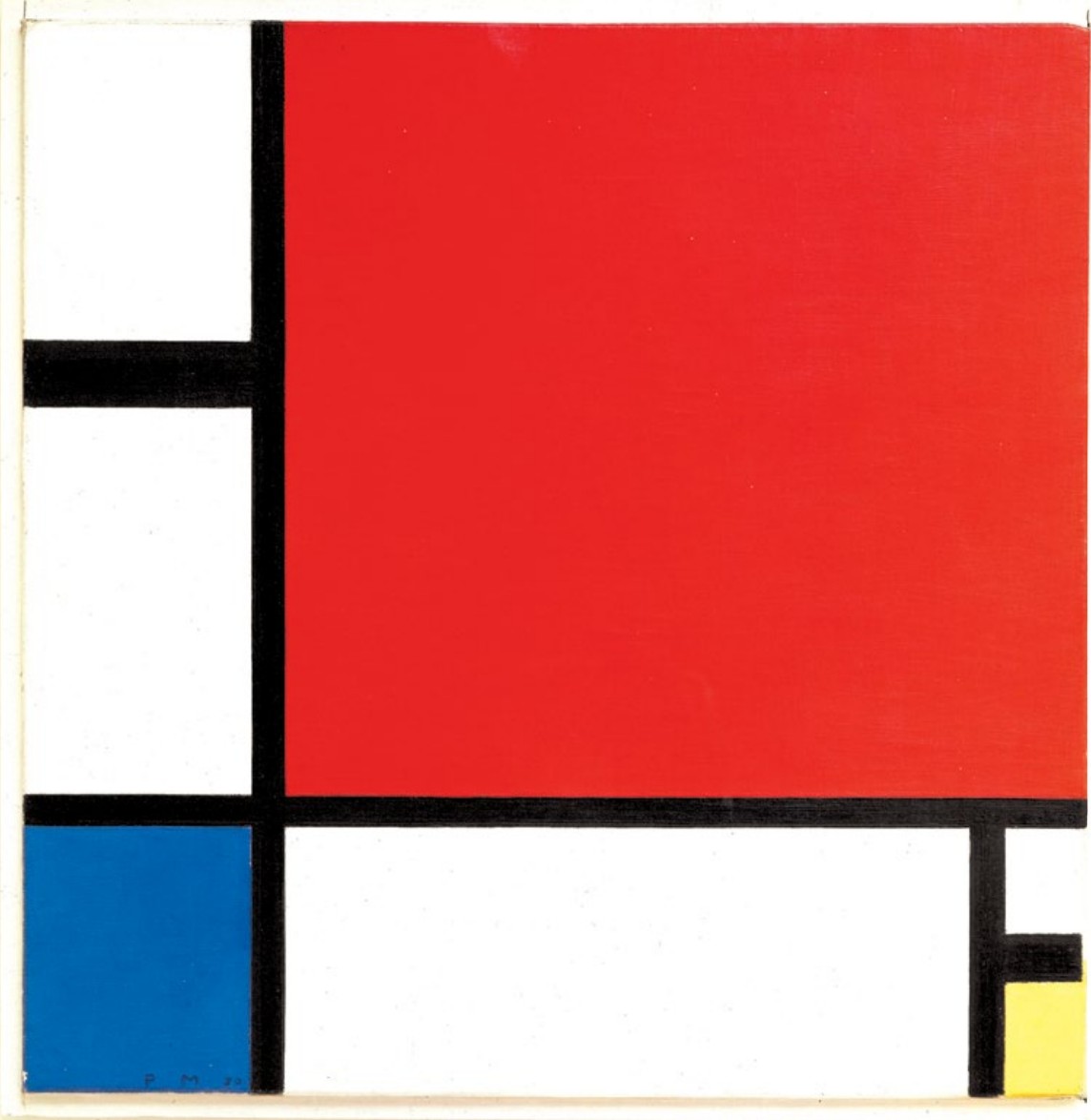
 Composition with Red, Blue and Yellow Piet Mondrian (1872–1944) Composition with Red, Blue and Yellow, 1930 © 2013 Mondrian/Holtzman Trust c/o HCR International USA/Photo © 2013 Erich Lessing/Art Resource, NY
Composition with Red, Blue and Yellow
Piet Mondrian. 1930 C.E. Oil on canvas.
Curator Note
"De Stijl ("The Style") at its purest. Mondrian sought a universal aesthetic language to bring balance and harmony to a chaotic world. He reduced art to its simplest elements: straight lines, primary colors (red, blue, yellow), and neutrals (black, white). It is a utopian vision of order using "Neo-Plasticism.""
Form
- Grid of black vertical and horizontal lines.
- Primary colors: Red, Blue, Yellow.
- Neutrals: White, Black (and gray).
- Asymmetrical balance (Dynamic Equilibrium).
- No diagonals or curves.
Function
- To express universal harmony and order.
- To show the underlying structure of reality.
- To create a utopia through design.
- To eliminate the "subjective" ego of the artist.
- To merge life and art (architecture/design).
Content
- Red: large square, dominant active force.
- Blue/Yellow: smaller counterweights.
- White: negative space or pure light.
- Lines: the immutable laws of the universe.
- No hidden meaning; "what you see is what you see".
Context
- Mondrian started as a landscape painter (trees) and slowly abstracted.
- De Stijl movement in the Netherlands.
- Influence of Theosophy (spiritual geometry).
- Reaction against the chaos of WWI.
- Influenced modern design, fashion (YSL), and architecture.