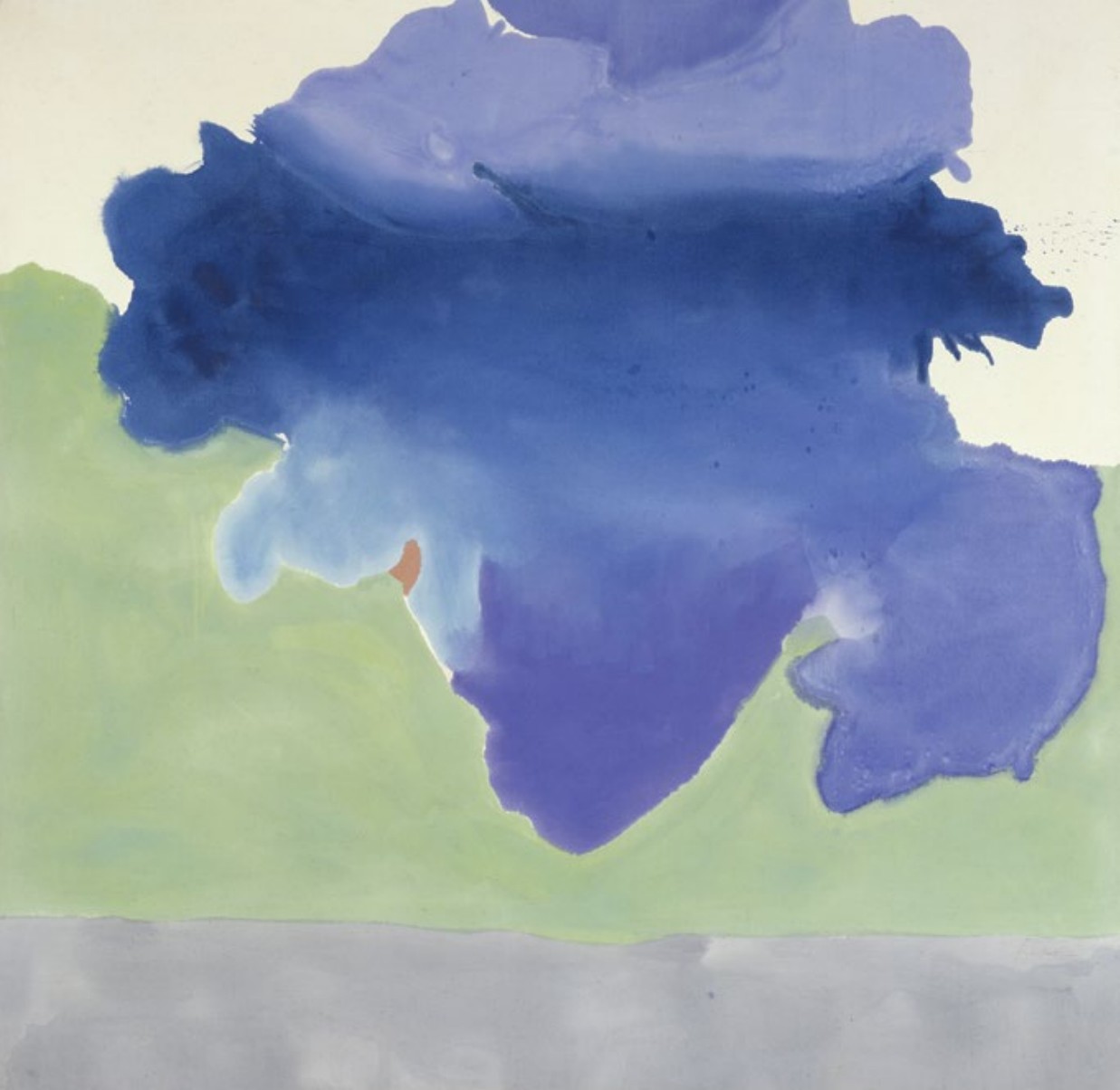
 The Bay © Estate of the Artist/2013 Artists Rights Society (ARS), Bridgeman Art Library, New York
The Bay
Helen Frankenthaler. 1963 C.E. Acrylic on canvas.
Curator Note
"Frankenthaler invented the "soak-stain" technique, pouring thinned paint directly onto unprimed canvas so it fused with the fabric. "The Bay" is a Color Field masterpiece, creating a luminous, atmospheric blue shape that hovers between landscape (water/map) and pure abstraction. It focuses on the physical nature of color."
Form
- Color Field Painting (Post-Painterly Abstraction).
- Soak-stain technique: paint soaks into the weave.
- No brushstrokes; liquid, organic edges.
- Flatness: the paint is *in* the canvas, not *on* it.
- Large zones of blue and green.
Function
- To emphasize the optical experience of color.
- To explore the properties of paint (fluidity).
- To create an immediate, unplanned image.
- To move away from the angst of Abstract Expressionism.
- To create a sense of floating or weightlessness.
Content
- Blue area: suggests a bay/water but is not literal.
- Green/Gray border: suggests land/shore.
- The "mistake" of the pour is the art.
- No narrative or deep meaning beyond the visual.
- Spontaneity.
Context
- Frankenthaler influenced Morris Louis and Kenneth Noland.
- Clement Greenberg championed this "pure" painting.
- Use of acrylic paint (Magna) allowed for this technique.
- Shift from NY School action to cool detachment.
- Landscape is the starting point, not the end.