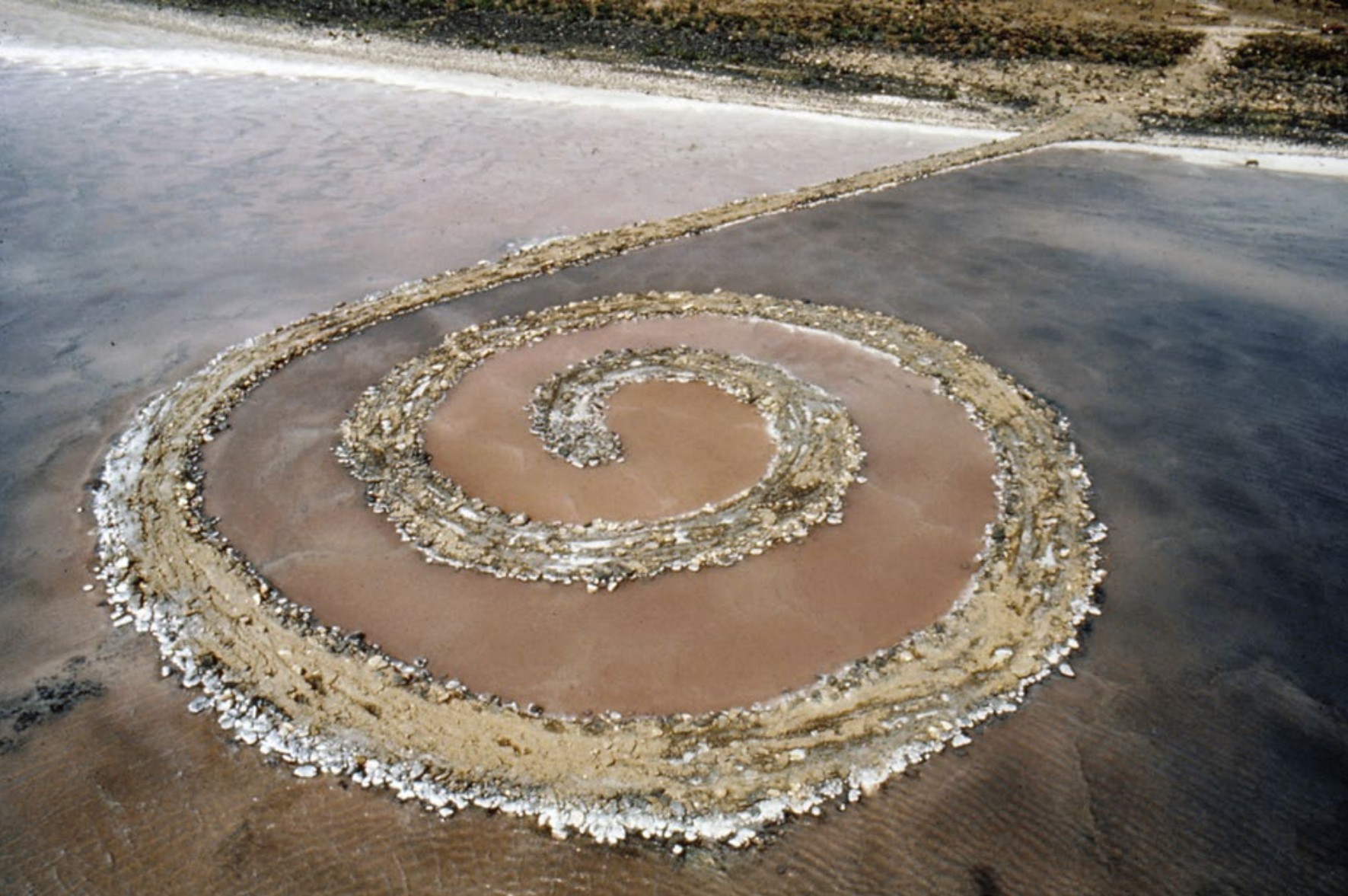
 Spiral Jetty © The Artist/Licensed by VAGA, New York, NY/Courtesy James Cohan Gallery, New York & Shanghai
Spiral Jetty
Great Salt Lake, Utah, U.S. Robert Smithson. 1970 C.E. Earthwork: mud, precipitated salt crystals, rocks, and water coil.
Curator Note
"The most famous Earthwork (Land Art). Smithson bulldozed 6,000 tons of black basalt and earth into a giant spiral in the red waters of the Great Salt Lake. The work is subject to entropy—it disappears when water rises and re-emerges white with salt when it recedes. It rejects the gallery system and engages with the geological time scale."
Form
- Earthwork/Land Art.
- Spiral shape (1,500 feet long).
- Made of natural materials: basalt, mud, salt.
- Site-specific (cannot be moved).
- Changes with the environment (entropy).
Function
- To escape the commercial gallery system.
- To explore the concept of "Entropy" (degradation/change).
- To reconnect art with the primal forces of nature.
- To create a dialogue between the Constructive and Destructive.
- To emphasize the journey (pilgrimage) to see it.
Content
- Spiral: ancient symbol (petroglyphs, galaxies, whirlpools).
- Red water: algae/bacteria (primordial soup).
- Black rocks: industrial/heavy.
- Salt crystals: the work "growing".
- Man making a mark on the vast landscape.
Context
- Smithson was interested in industrial ruins and geology.
- The lake is a "dead sea".
- Environmental movement (1970 was first Earth Day).
- Smithson died in a plane crash surveying another site.
- The work was submerged for decades, creating a myth.