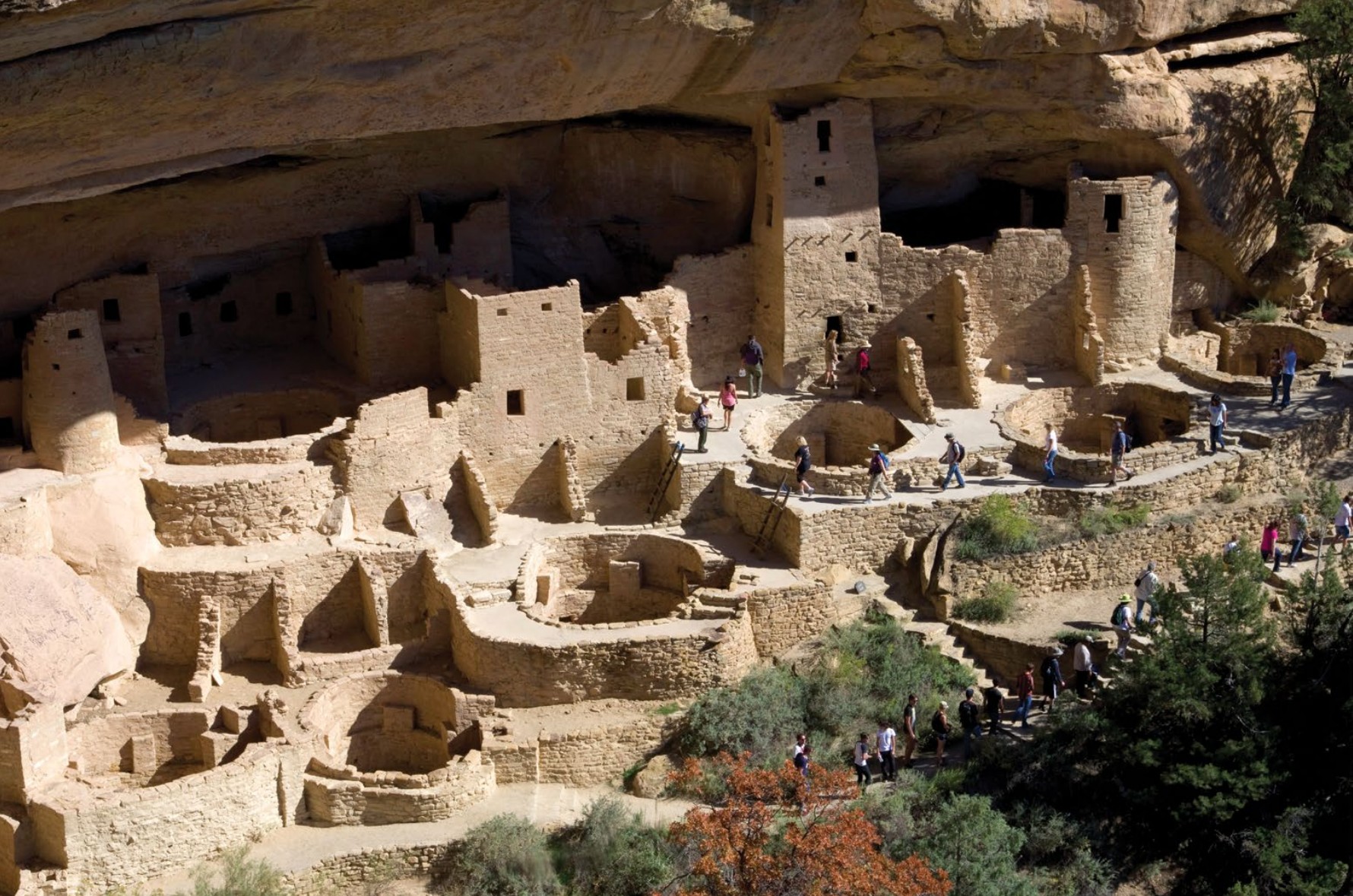
 Mesa Verde © Kerrick James/Corbis
Mesa Verde Cliff Dwellings
Montezuma County, Colorado. Ancestral Puebloan (Anasazi). 450–1300 C.E. Sandstone.
Curator Note
"Built directly into the sheer face of a cliff, these "apartments" housed hundreds of people. They were accessible only by retractable ladders, offering protection from enemies and the elements."
Form
- Built directly into the natural curve of a sandstone cave overhang (cliff face).
- Construction: Sandstone blocks shaped and cemented with mud/clay mortar.
- Kivas: Circular, subterranean rooms with a wood-beamed roof (cribbed roof).
- Multi-story dwelling: "Apartment" style stepped housing with retractable ladders.
- Plaza areas: Open courtyards in front of the structures for communal activity.
Function
- Residential: Housed approximately 125 people (a close-knit clan or community).
- Defensive: Inaccessible location protected against enemies and extreme weather.
- Ceremonial: Kivas functioned as spiritual centers for male councils and rituals.
- Solar heating: The cave lip blocks high summer sun but welcomes low winter sun.
- Storage: Upper levels were often used to store dried corn for lean years.
Content
- Cliff Palace: The largest complex, containing 150 rooms and 23 kivas.
- Sipapu: Small hole in the floor of the Kiva representing the "navel of the earth" (emergence point).
- Deflector screen: Stone wall in the Kiva to block drafts from the ventilation shaft.
- Farming occurred on the "mesa verde" (green table) top above the cliffs.
- Murals (painted walls) inside the towers depicted geometric designs and animals.
Context
- Created by the Ancestral Puebloans (formerly called Anasazi) c. 450–1300 C.E.
- Located in the Four Corners region of the US Southwest (Colorado).
- Abandoned suddenly around 1300 C.E. likely due to the "Great Drought" and social unrest.
- T-shaped doorways are unique to this culture.
- Illustrates a society perfectly adapted to a harsh, arid environment.