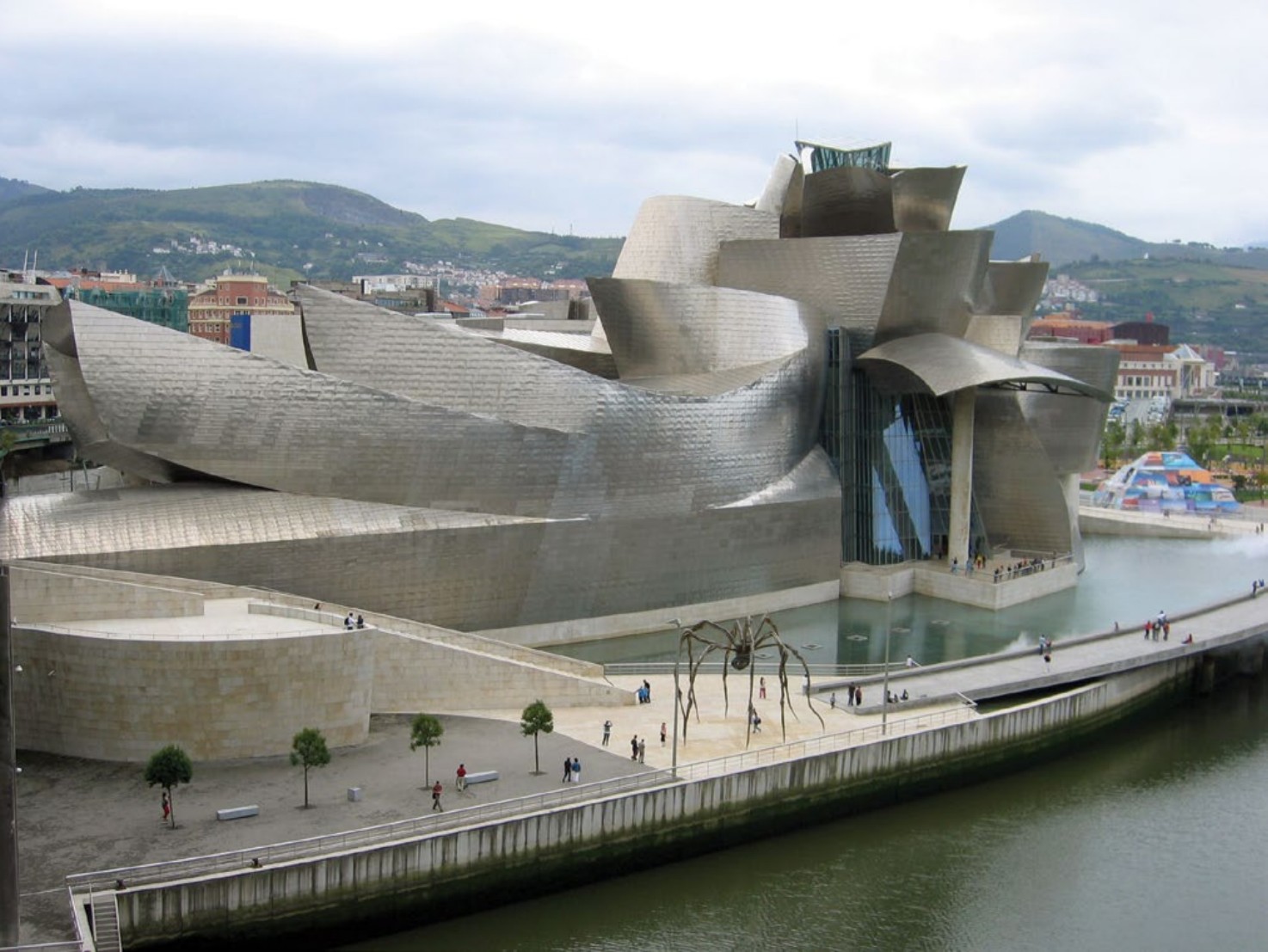
 Guggenheim Museum Bilbao © Rolf Haid/dpa/Corbis
Guggenheim Museum Bilbao
Spain. Frank Gehry (architect). 1997 C.E. Titanium, glass, and limestone
Curator Note
"A masterpiece of Deconstructivist architecture that revitalized the industrial city of Bilbao ("The Bilbao Effect"). Gehry used advanced aerospace computer software (CATIA) to design the complex, swirling titanium curves that resemble a ship or a fish. The building itself is a sculpture, breaking away from the rectilinear boxes of modernism."
Form
- Complex, curvilinear masses with no flat surfaces or right angles.
- Clad in shimmering titanium tiles that change color with the light.
- Limestone base anchors it to the traditional city; titanium curves reach out to the river.
- Central atrium serves as the circulation hub, filled with light from glass walls.
- Designed using CATIA software to calculate the structural stress of the curves.
Function
- Museum of modern and contemporary art.
- To revitalize the decaying industrial port city of Bilbao (urban regeneration).
- To create a tourist destination ("destination architecture").
- To challenge traditional museum architecture.
- To visually connect the city grid to the Nervion River.
Content
- Resembles a ship, referencing Bilbao’s shipbuilding history.
- Resembles a fish with shimmering scales (Gehry’s personal motif).
- The chaotic forms reflect the complexity of the contemporary world.
- The "flower" shape from above.
- Celebrates the potential of technology and industrial materials.
Context
- Commissioned by the Basque government to transform the city's image.
- Example of Deconstructivism: fragmenting and distorting architectural elements.
- Marks the shift to computer-aided design (CAD) in architecture.
- Critiqued for overshadowing the art inside vs. praised as a masterpiece.
- Global franchise model of museums (Guggenheim NY, Venice, Bilbao, Abu Dhabi).