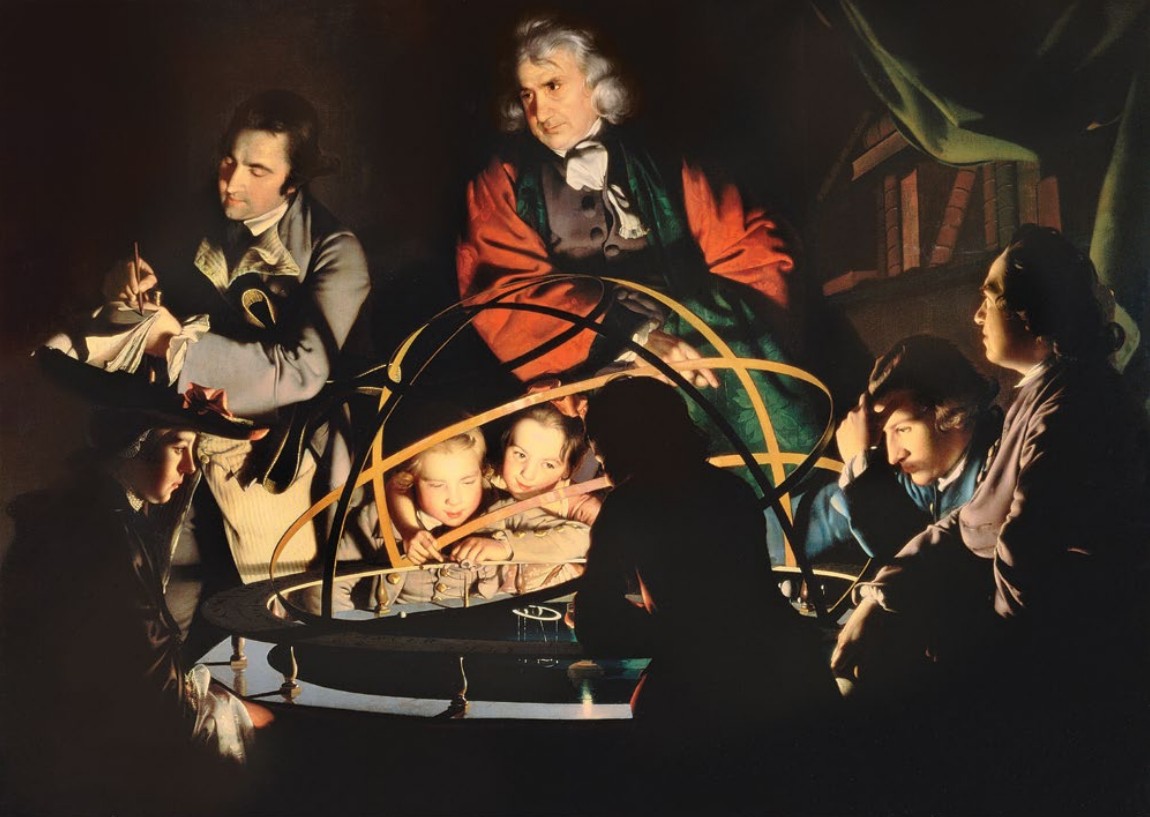
 A Philosopher Giving a Lecture on the Orrery © The Bridgeman Art Library
A Philosopher Giving a Lecture on the Orrery
Joseph Wright of Derby. c. 1763–1765 C.E. Oil on canvas.
Curator Note
"A dramatic scene showing a scholar demonstrating a mechanical model of the solar system (an orrery) to a small audience. Wright of Derby uses Tenebrism (dramatic contrast of light and dark) usually reserved for religious scenes to elevate scientific discovery to a spiritual level. This reflects the Enlightenment era's shift towards reason and observation."
Form
- Use of Chiaroscuro (Tenebrism) to create dramatic lighting.
- Circular composition centered on the orrery.
- Realistic, detailed rendering of faces and fabrics.
- Single light source (the "sun") illuminates the faces.
- Figures represent different ages and genders.
Function
- To celebrate the Age of Enlightenment and the pursuit of knowledge.
- To elevate scientific subjects to the status of history painting.
- To capture the awe and wonder of understanding the universe.
- To depict the democratization of knowledge (children and women present).
- To showcase the artist's skill with light and shadow.
Content
- The philosopher (modeled on Isaac Newton?) explains the solar system.
- The orrery: a mechanical model showing planetary motion.
- The light represents the sun but also the "light of knowledge".
- The note-taker represents the diligent recording of facts.
- The children represent the future generation of learners.
Context
- Created during the Industrial Revolution in England.
- Wright was associated with the Lunar Society, a group of intellectuals and industrialists.
- Reflects the shift from religious to scientific explanation of the world.
- Science was becoming a popular public spectacle.
- Challenges the hierarchy of genres by making a genre scene monumental.