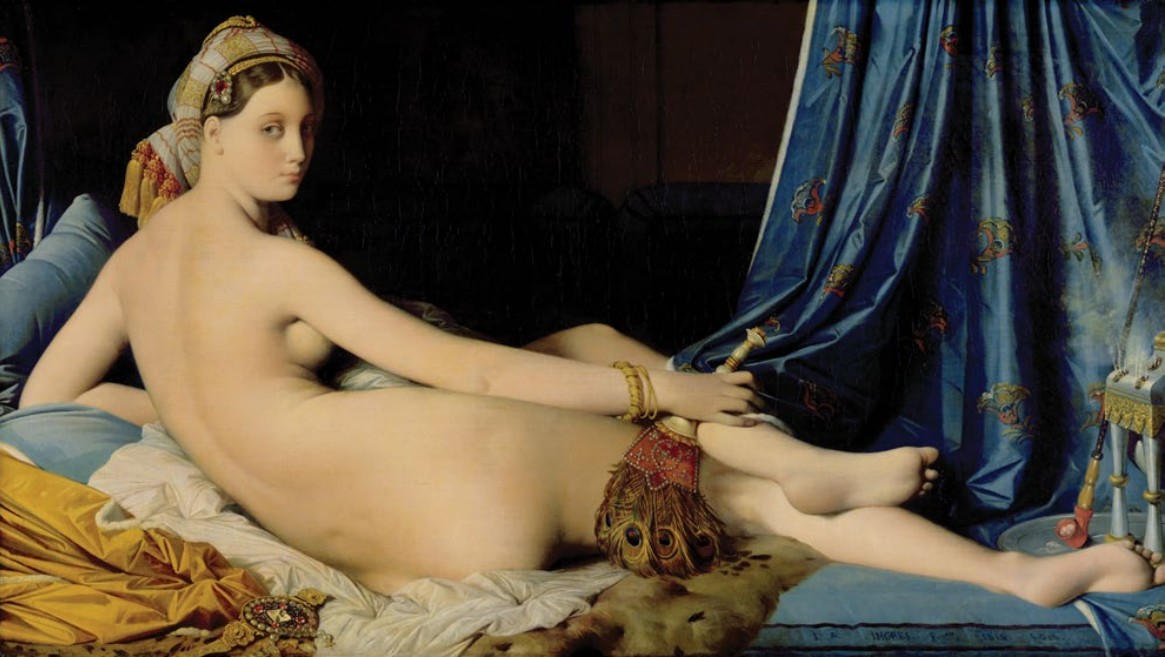
 La Grande Odalisque © Giraudon/The Bridgeman Art Library
La Grande Odalisque
Jean-Auguste-Dominique Ingres. 1814 C.E. Oil on canvas.
Curator Note
"An exoticized nude of a harem woman (odalisque), bridging Neoclassicism (smooth finish) and Romanticism (exotic subject). Ingres distorted the figure’s anatomy—adding extra vertebrae to elongate the back—to increase elegance and sensuality, prioritizing aesthetic line over anatomical correctness."
Form
- Extremely smooth, polished surface (invisible brushstrokes).
- Elongated, serpentine line of the body.
- Cool, icy color palette (blues and creamy skin tones).
- Distorted anatomy: extra vertebrae, displaced leg.
- Sumptuous textures: velvet, silk, fur, peacock feathers.
Function
- To create an image of ideal, exotic beauty.
- To appeal to the male gaze and fascination with the "Orient".
- To showcase Ingres' mastery of line and finish.
- To break from strict Neoclassical realism for expressive effect.
- To decorate a private collection.
Content
- Odalisque: a concubine in a Turkish harem.
- Peacock feather fan, turban, hookah: exotic props.
- Direct, cool gaze over the shoulder.
- The body is presented for the viewer's pleasure.
- Curtains reveal the private space.
Context
- Commissioned by Napoleon's sister, Queen of Naples.
- Reflects 19th-century Orientalism (Western fascination with the East).
- Criticized at the Salon for anatomical errors.
- Ingres was a student of David but moved towards Mannerist elegance.
- Influenced by Raphael and Titian.