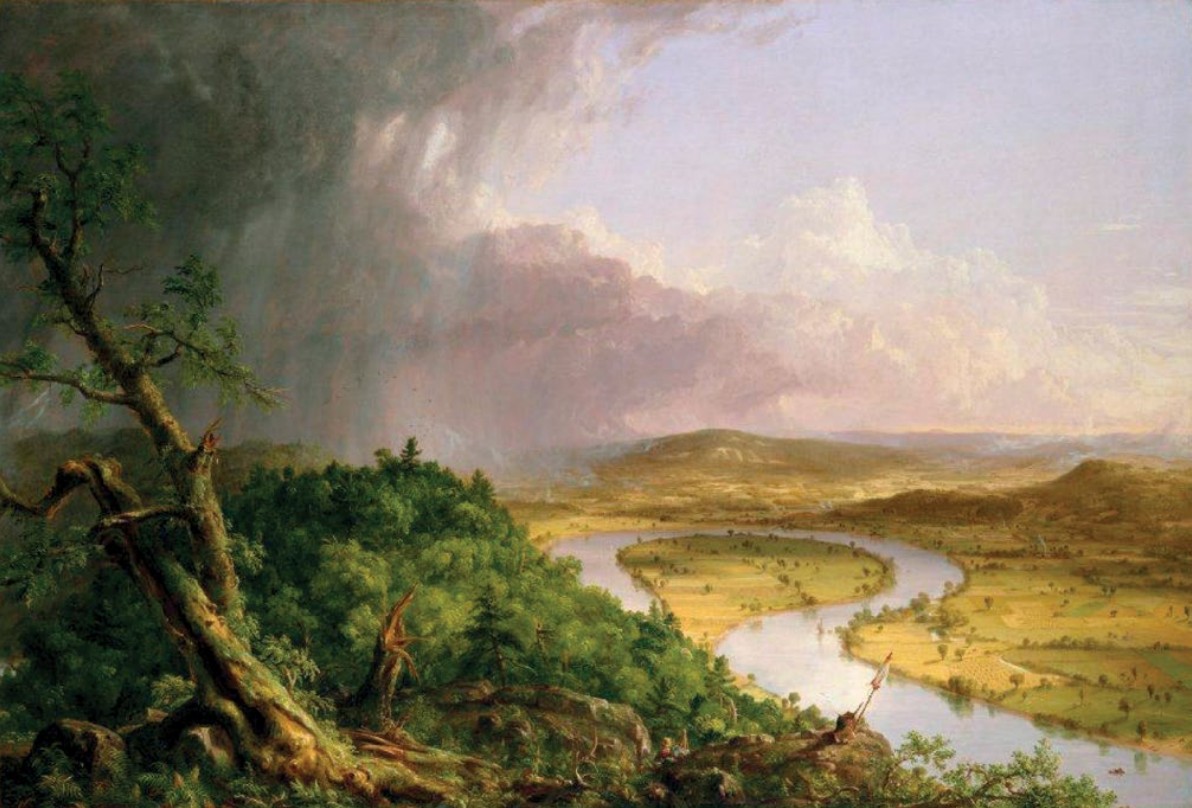
 The Oxbow (View from Mount Holyoke, Northampton, Massachusetts, after a Thunderstorm)© Private Collection/Index/The Bridgeman Art Library Image © The Metropolitan Museum of Art/Image source © Art Resource, NY
The Oxbow
Thomas Cole. 1836 C.E. Oil on canvas.
Curator Note
"A seminal landscape painting by the founder of the Hudson River School. It contrasts the wild, untamed wilderness (left) with the cultivated, pastoral settlement (right). Cole embeds a question about the future of the American landscape: is it "Manifest Destiny" to tame the land, or should its sublime beauty be preserved?"
Form
- Divided composition: diagonal line separates storm (left) from sun (right).
- Detailed, realistic rendering of vegetation.
- Panoramic view from a high vantage point.
- Dramatic lighting: storm clouds vs. golden sunlight.
- Tiny artist self-portrait hidden in the brush.
Function
- To celebrate the unique beauty of the American landscape.
- To explore the tension between wilderness and civilization.
- To express the concept of Manifest Destiny.
- To elevate landscape painting to a high art form.
- To warn against the destruction of nature.
Content
- Left side: Blasted tree, storm, wild nature (The Sublime).
- Right side: Farms, cleared land, calm river ( The Beautiful/Pastoral).
- The Oxbow: a bend in the Connecticut River.
- Hebrew letters on the hill: interpreted as "The Almighty" or "Noah".
- Artist with umbrella: observer of nature.
Context
- Cole founded the Hudson River School.
- US was expanding westward; industrialization was beginning.
- Reflects Romanticism’s awe of nature.
- Used as propaganda for American national identity.
- Responds to European critiques that America had no history.