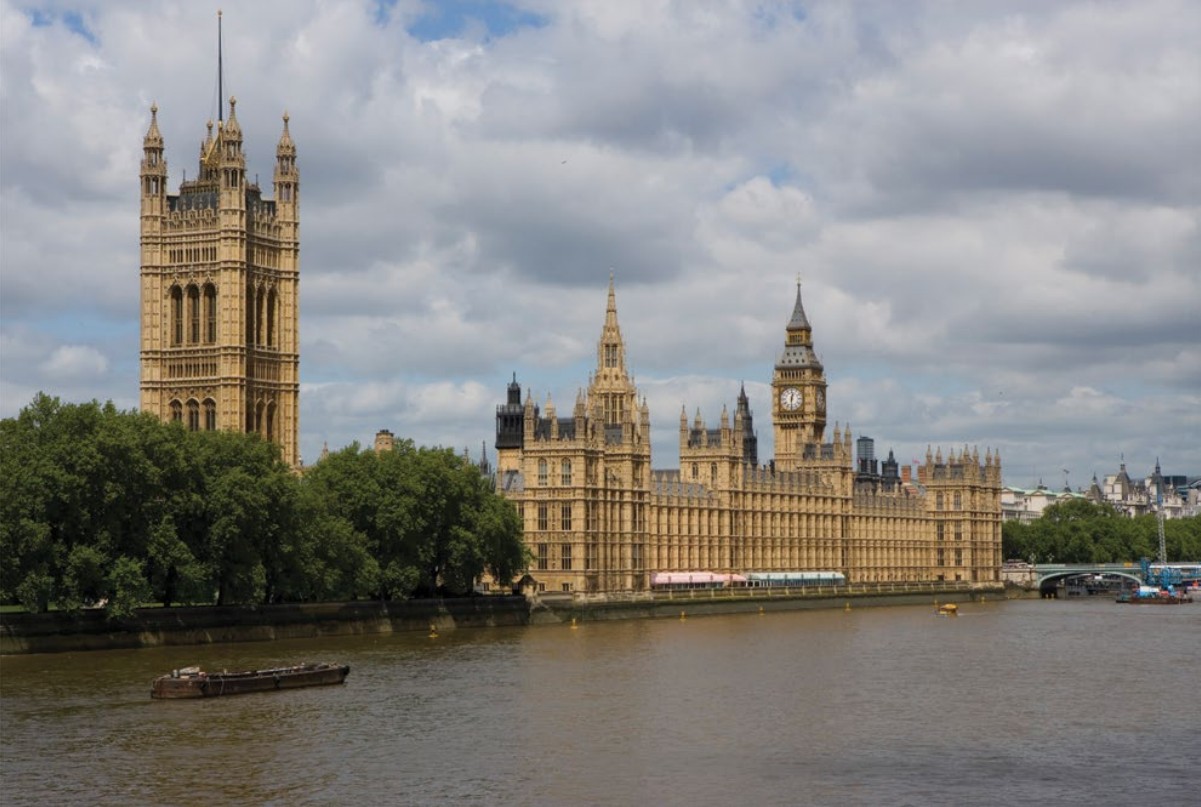
 Palace of Westminster © Vanni Archive/Art Resource, NY
Palace of Westminster
London, England. Charles Barry and Augustus W. N. Pugin (architects). 1840–1870 C.E. Limestone masonry and glass.
Curator Note
"The seat of the British Parliament, rebuilt in the Gothic Revival style after a fire. The style was chosen to represent "Englishness" and conservative values (referencing the medieval period) in contrast to the Neoclassicism associated with republican revolutions (US/France). It combines Pugin’s obsession with medieval detail and Barry’s rational, classical layout."
Form
- Perpendicular Gothic style: vertical lines, tracery, pinnacles.
- Asymmetrical skyline with towers (Big Ben, Victoria Tower).
- Symmetrical, rational plan underneath the Gothic skin.
- Use of sand-colored limestone.
- Detailed interior decoration (tiles, stained glass).
Function
- Seat of the British government (House of Commons/Lords).
- To symbolize the stability and tradition of the British monarchy.
- To define the London skyline.
- To accommodate modern legislative needs.
- To showcase British craftsmanship.
Content
- Big Ben (Clock Tower): symbol of London/Time.
- Victoria Tower: holds the archives.
- Westminster Hall: the only surviving medieval part.
- Central Lobby: meeting place of the constituents.
- Throne Room: for the monarch.
Context
- The old palace burned down in 1834.
- Gothic Revival was championed by Pugin as the only "moral" Christian architecture.
- Victorian era: peak of the British Empire.
- Industrial production was used for the decoration (ironwork, tiles).
- Response to the ugliness of the Industrial Revolution.