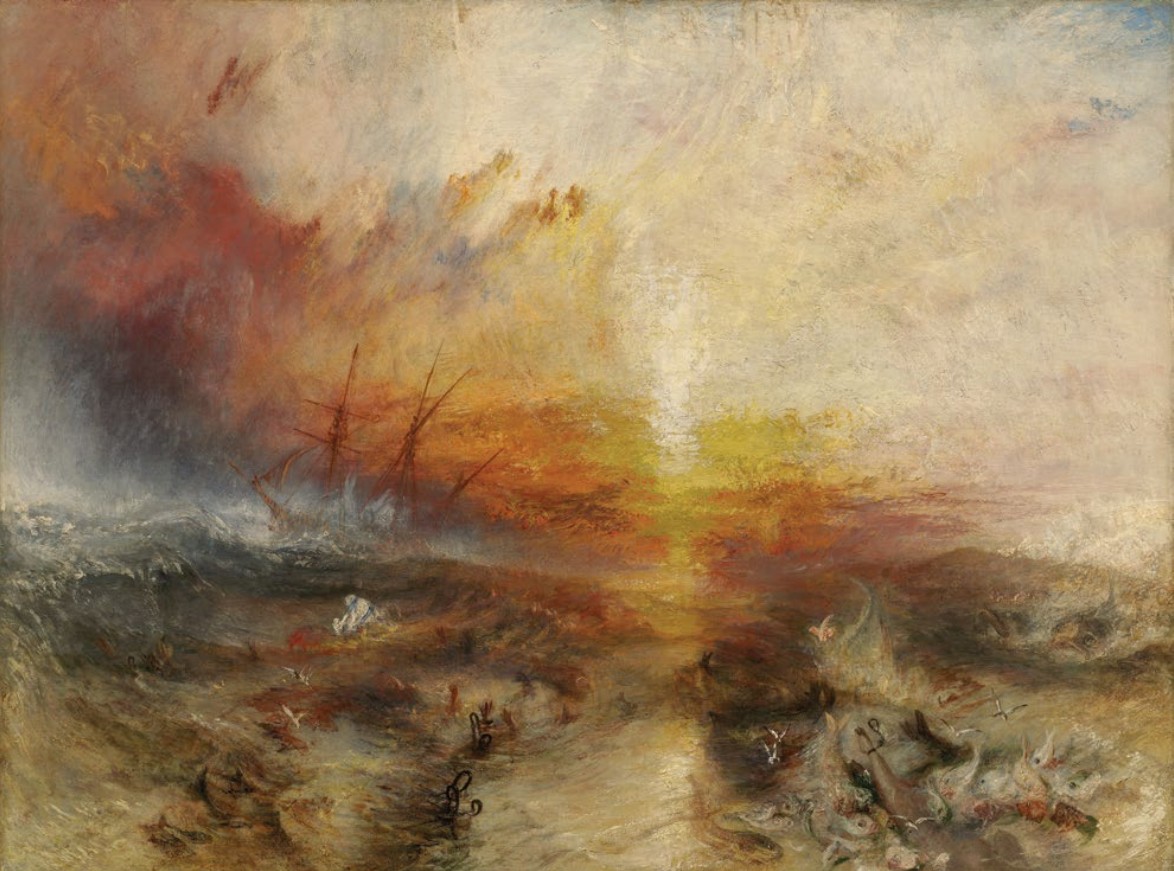
 Slave Ship (Slavers Throwing Overboard the Dead and Dying, Typhoon Coming On) Photograph © 2013 Museum of Fine Arts, Boston
Slave Ship
Joseph Mallord William Turner. 1840 C.E. Oil on canvas.
Curator Note
"A swirling, chaotic seascape depicting a horrific historical event: a captain throwing sick enslaved people overboard to collect insurance money. Turner uses the power of nature (the typhoon) and intense, fiery colors to express the moral horror of slavery. The beauty of the sunset contrasts disturbingly with the brutality in the water."
Form
- Loose, expressive brushwork (almost abstract).
- Intense, fiery colors (reds, oranges, yellows).
- Turbulent composition; the horizon is lost in the storm.
- Impasto texture (thick paint).
- The sun is a blazing focal point.
Function
- To condemn the transatlantic slave trade.
- To evoke an emotional, sublime response (terror/awe).
- To illustrate the "sublime" power of nature.
- To criticize the greed of the shipping industry.
- To coincide with the anti-slavery conference in London.
Content
- Ship in background heading into the storm.
- Foreground: shackled hands and legs reaching out of water.
- Fish and birds devouring the victims.
- The "Typhoon coming on": divine retribution?
- Blood-red sky reflects the violence.
Context
- Based on the Zong Massacre (1781).
- Turner was an abolitionist.
- Exhibited at the Royal Academy with a poem.
- Shocked critics who thought it was unfinished or too chaotic.
- John Ruskin owned it and declared it Turner's masterpiece.