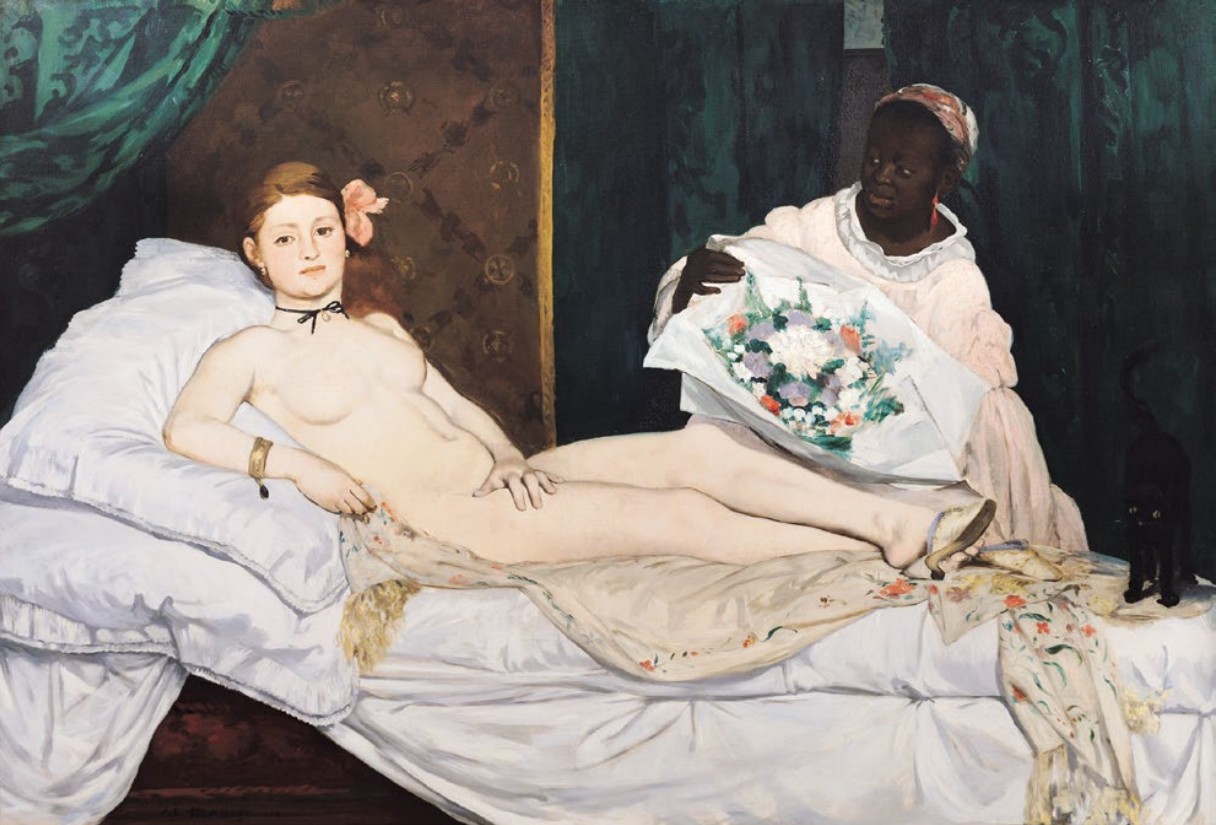
 Olympia © The Gallery Collection/Corbis
Olympia
Édouard Manet. 1863 C.E. Oil on canvas.
Curator Note
"One of the most controversial paintings of the 19th century. Manet painted a nude reclining woman, referencing Titian’s "Venus of Urbino," but replaced the goddess with a contemporary Parisian prostitute ("Olympia"). Her bold, confronting glare and the realistic, un-idealized depiction of her body shocked the public and marked the birth of modern art."
Form
- Flatness of the figure; lack of traditional modeling (chiaroscuro).
- Stark contrast between the pale skin and dark background.
- Rough, visible brushstrokes.
- Composition mimics Titian but flattens it.
- Cool, "dirty" colors (not the golden glow of the academy).
Function
- To modernize the classical nude tradition.
- To challenge the hypocrisy of the bourgeois viewer.
- To depict the reality of modern Paris (prostitution).
- To focus on the act of painting itself (flatness/color).
- To provoke the Academy.
Content
- Olympia: a common name for prostitutes.
- Direct stare: she is in control, not submissive.
- Black cat: symbol of sexuality/independence (vs. Titian's dog/loyalty).
- Black maid: presents flowers (a gift from a client).
- Orchid, bracelet, choker: symbols of her trade.
- Hand placement: firm, blocking access (vs. Titian’s inviting hand).
Context
- Rejected by the traditional Salon moralists.
- Manet is the father of Impressionism.
- Reflects the gritty reality of urban life.
- The model was Victorine Meurent, also a painter.
- Critique of the male gaze.