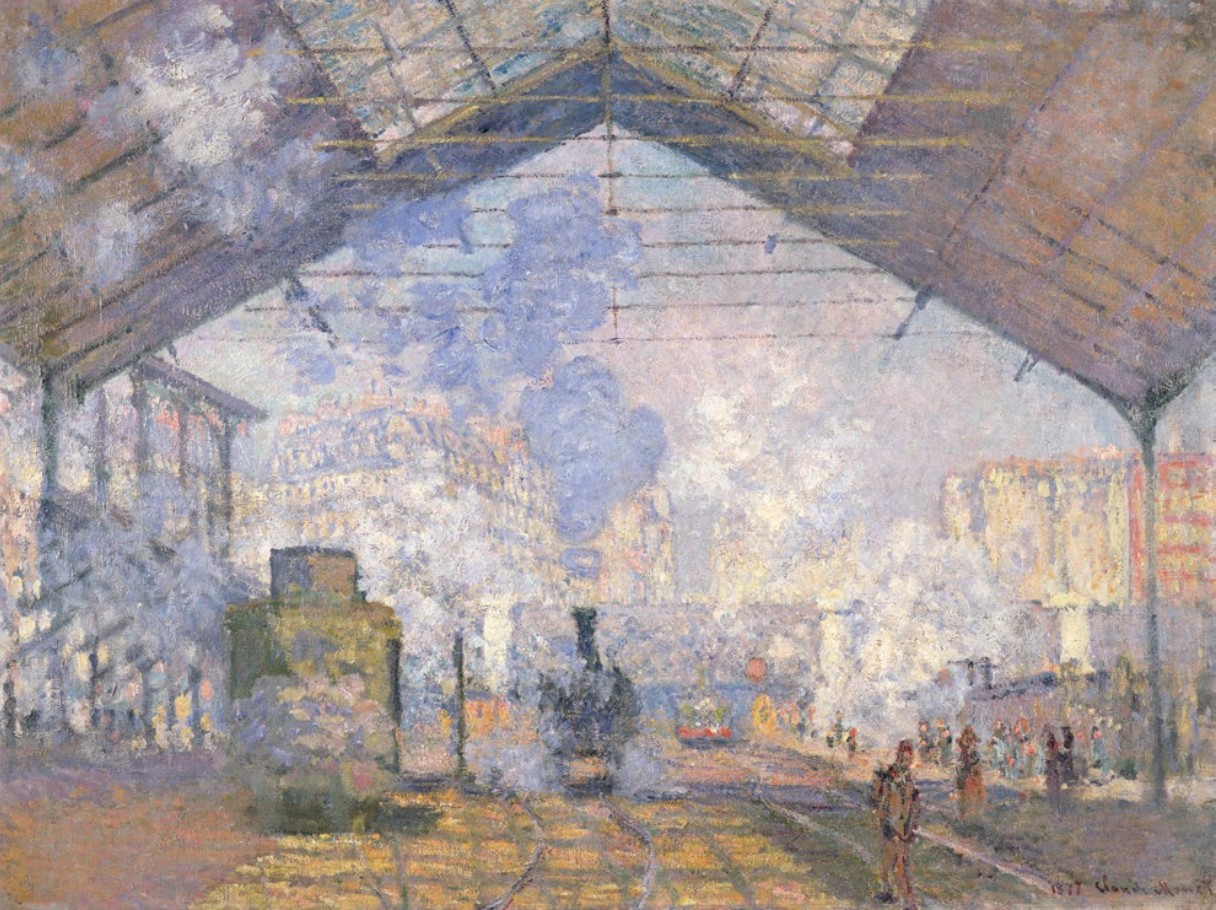
 The Saint-Lazare Station © Musée d’Orsay, Paris, France/The Bridgeman Art Library
The Saint-Lazare Station
Claude Monet. 1877 C.E. Oil on canvas.
Curator Note
"A classic Impressionist work capturing the modern industrial landscape of a train station. Monet isn’t interested in the train as a machine, but in the visual effect of the steam, smoke, and light filtering through the glass roof. It represents the "fleeting moment" of modern life."
Form
- Loose, choppy brushstrokes (taches).
- Pastel and blurred colors (blues, pinks, grays) for the steam.
- Emphasis on atmospheric effects over solid form.
- Light filtering through the grid of the roof.
- Urban, industrial subject matter.
Function
- To capture the "impression" of light and atmosphere.
- To paint "en plein air" (or sketching on site).
- To depict the modernity of Paris.
- To explore color theory.
- To move away from narrative painting.
Content
- Locomotive: symbol of industrial power.
- Steam/Smoke: dissolves the solidity of the city.
- Apartment buildings in background: Haussmann’s Paris.
- Small figures: anonymous passengers.
- The interplay of structure (iron) and air.
Context
- Monet convinced the station master to hold the trains so he could paint.
- Part of a series of 12 paintings of the station.
- Impressionists were interested in the changing urban environment.
- Coincided with the rise of rail travel.
- Critics called it "wallpaper" or "unfinished".