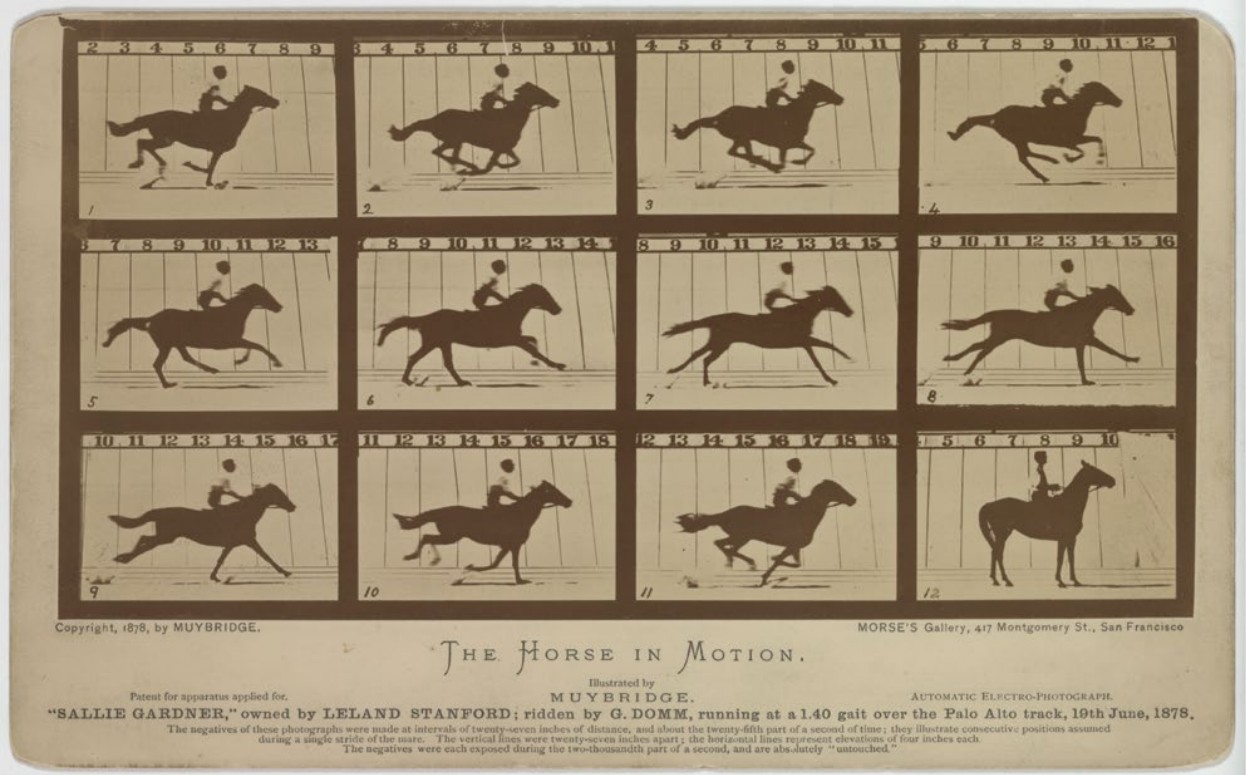
 The Horse in Motion Courtesy of the Library of Congress # LC-USZ62-58070
The Horse in Motion
Eadweard Muybridge. 1878 C.E. Albumen print.
Curator Note
"A scientific experiment that became art. Hired by Leland Stanford to settle a bet about whether a galloping horse ever has all four feet off the ground, Muybridge used a battery of 12 cameras with tripwires. The result proved the horse does "fly," but not in the way artists had painted it (legs splayed). It paved the way for motion pictures."
Form
- Grid of sequential photographs (chronophotography).
- Black and white albumen prints.
- Stop-motion clarity.
- Repetitive, grid-like composition.
- Scientific aesthetic.
Function
- To analyze motion too fast for the human eye.
- To settle a bet about horse gaits.
- To advance photographic technology (shutter speed).
- To serve as a reference for artists.
- Precursor to cinema.
Content
- A jockey riding a horse galloping.
- Frame 3 shows all hooves off the ground (gathered under the belly).
- Numbers on the background measure distance/speed.
- Reveals the "truth" of optics vs. convention.
- Deconstructs time.
Context
- Images were published in "Scientific American".
- Influenced Degas and other artists to change how they painted horses.
- Muybridge invented the Zoopraxiscope to project these as moving images.
- Intersection of science, technology, and art.
- Led to the "persistence of vision" theory.