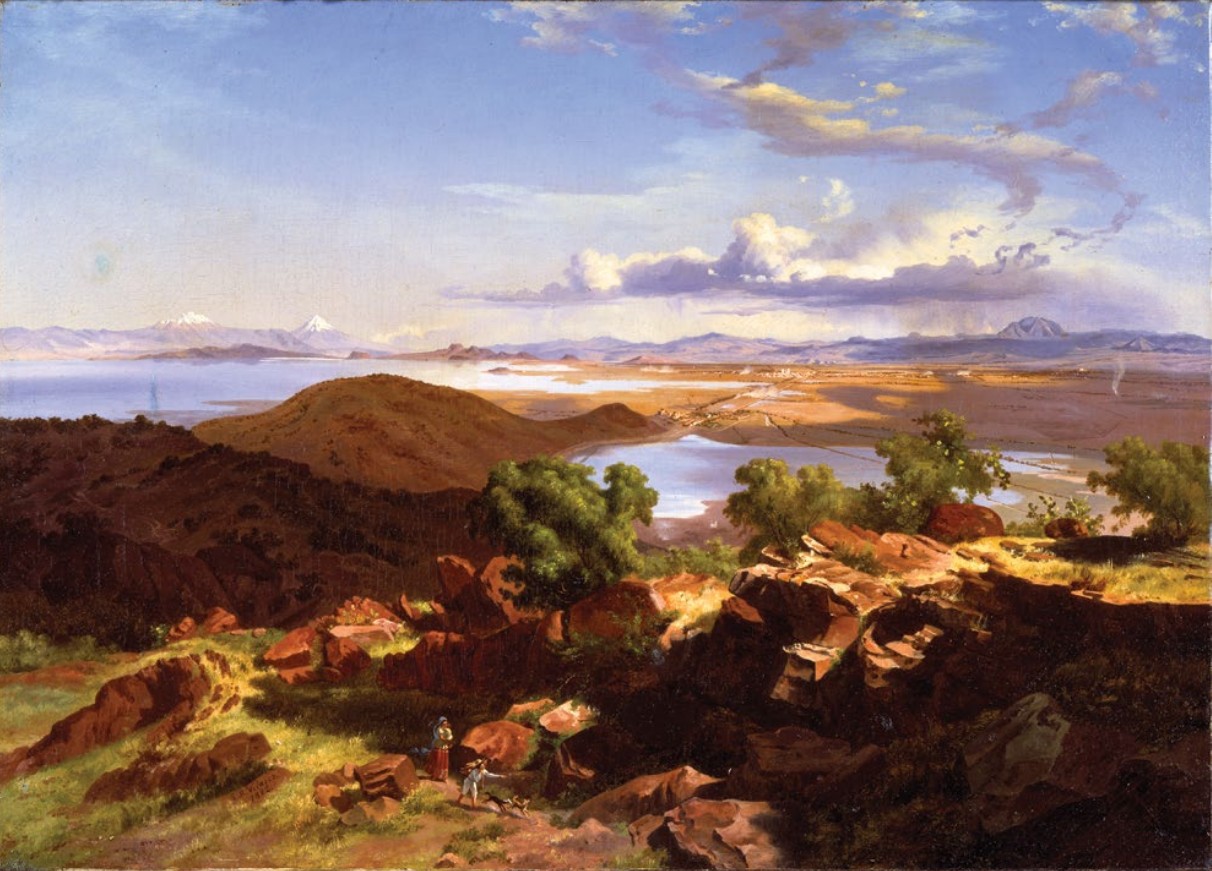
 El Valle de México desde el Cerro de Santa Isabel © Art Resource, NY
The Valley of Mexico from the Hillside of Santa Isabel
José María Velasco. 1882 C.E. Oil on canvas.
Curator Note
"A monumental landscape painting that serves as a symbol of Mexican national identity. Velasco depicts the sprawling Valley of Mexico with crystalline clarity, highlighting key landmarks from Aztec history (Tenochtitlan) and the modern era. It fuses European Romantic landscape traditions with a specifically Mexican geography and light."
Form
- Panoramic, wide-angle view.
- Atmospheric perspective (hazy mountains).
- Detailed realism in the foreground vegetation.
- Dramatic light and shadow playing across the valley.
- Classical composition (foreground figures, middle ground city, background mountains).
Function
- To celebrate the beauty and history of Mexico.
- To establish an independent Mexican artistic identity.
- To teach geography and history.
- To win awards at International Expositions (World's Fairs).
- To suggest the continuity from Aztec past to modern present.
Content
- Volcanoes (Popocatepetl and Iztaccihuatl): mythic symbols.
- Lake Texcoco: receding, showing the drying of the valley.
- Basilica of Guadalupe: religious center.
- Indigenous mother and child in foreground: connection to the land.
- The sprawling city of Mexico City in the distance.
Context
- Painted after Mexico gained independence.
- Velasco taught Diego Rivera.
- The Royal Academy of San Carlos followed European models.
- German Romanticism (Humboldt) influenced the appreciation of this landscape.
- Used to present Mexico as a civilized, modern nation abroad.