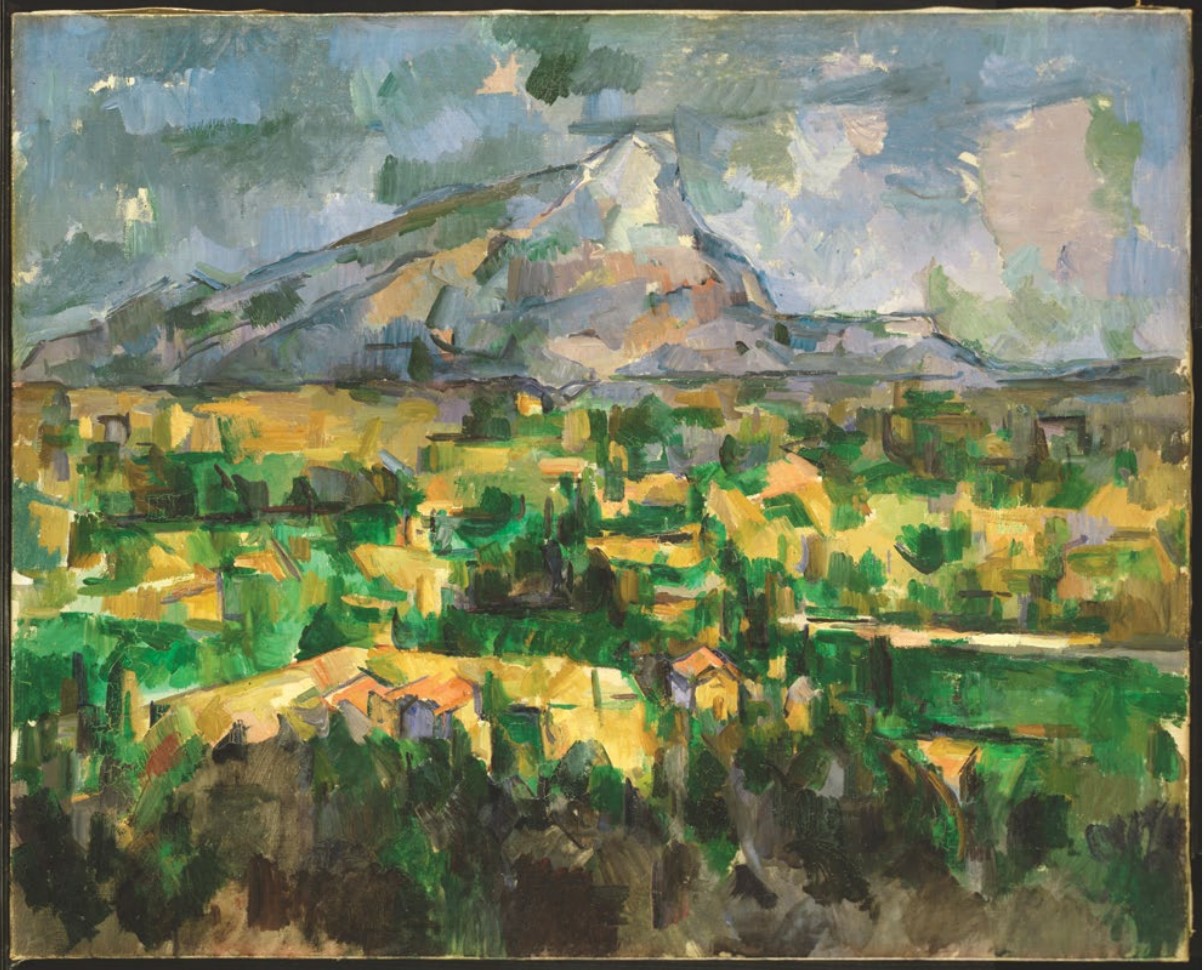
 Mont Sainte-Victoire © The Philadelphia Museum of Art/Art Resource, NY
Mont Sainte-Victoire
Paul Cézanne. 1902–1904 C.E. Oil on canvas.
Curator Note
"Cézanne painted this mountain over 30 times. In this late version, he breaks the landscape down into fractured, geometric planes of color. He explores the tension between the 2D surface of the canvas and the 3D depth of nature, paving the way for Cubism. He wanted to "make of Impressionism something solid and durable.""
Form
- Geometric, block-like brushstrokes ("taches").
- Warm colors approach (ochre); cool colors recede (blue).
- Fractured perspective.
- Lack of clear outlines.
- Unified surface pattern.
Function
- To analyze the structure of nature.
- To explore the relationship between color and depth.
- To depict the "sensation" of the landscape.
- To transition from perceptual art (Impressionism) to conceptual art (Cubism).
- To capture the timelessness of the mountain.
Content
- Mont Sainte-Victoire: dominating symbol of Provence.
- Pine tree: framing device (repoussoir).
- Patches of color: represent houses, fields, air.
- The underlying geometry (cylinder, sphere, cone).
- The integration of sky and earth.
Context
- Cézanne lived in Aix-en-Provence.
- He was rejected by the Salon and worked in isolation.
- Post-Impressionism.
- Picasso called him "the father of us all."
- He intellectualized painting.