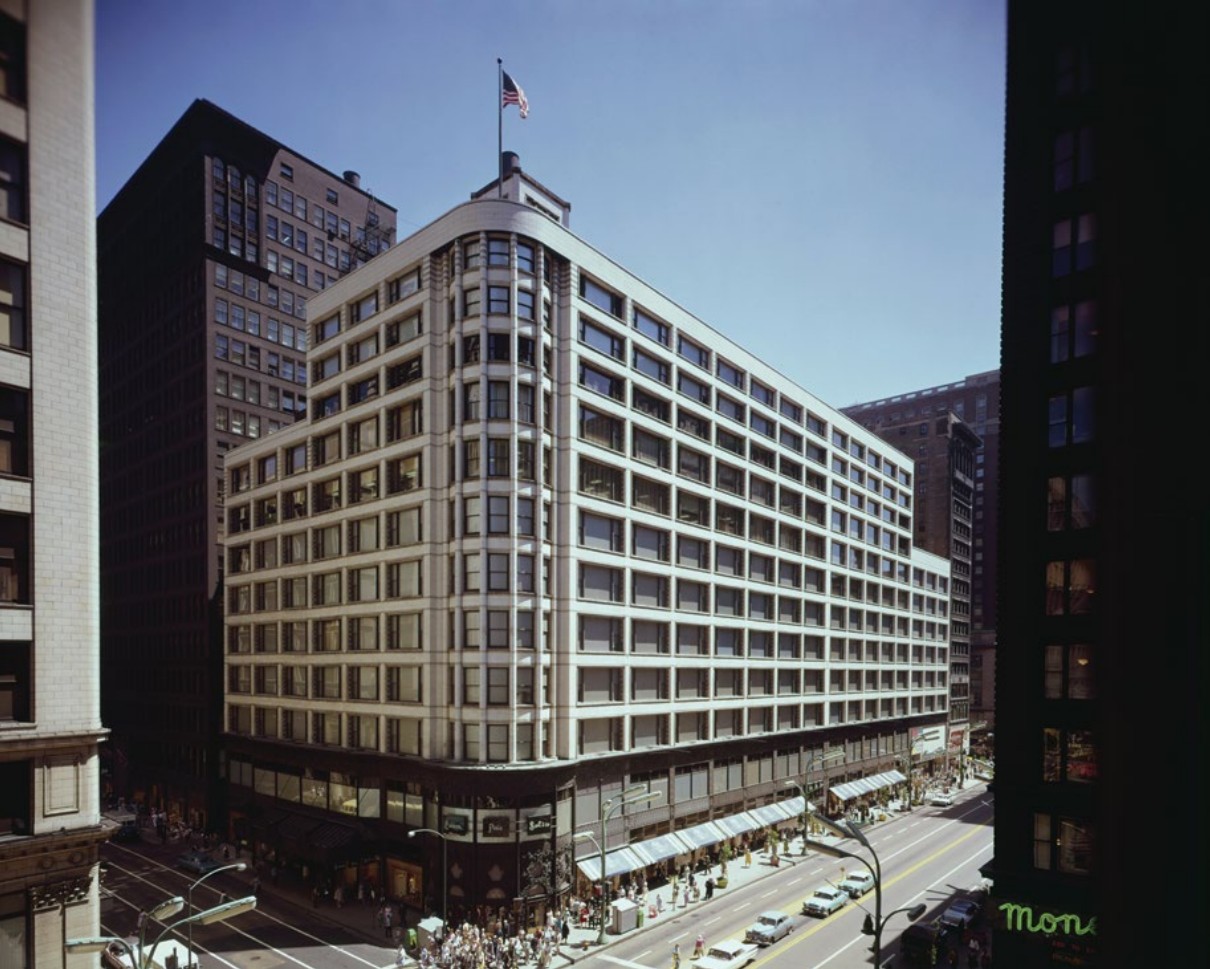
 Carson, Pirie, Scott Building © Hedrich Blessing Collection/Chicago History Museum/Getty Images
Carson, Pirie, Scott and Company Building
Chicago, Illinois, U.S. Louis Sullivan (architect). 1899–1903 C.E. Iron, steel, glass, and terra cotta.
Curator Note
"A masterpiece of the Chicago School skyscraper design. Sullivan, stating "form follows function," designed a steel-frame department store with a clear three-part structure. The base is ornately decorated to attract shoppers, while the upper floors are a uniform grid of windows to highlight the office function and the steel skeleton beneath."
Form
- Steel-frame skyscraper (Chicago School).
- Tripartite elevation: Base, Shaft, Capital (Attic).
- Horizontal emphasis ("Chicago windows").
- Elaborate Art Nouveau cast-iron ornamentation on the bottom two floors.
- Rounded corner entrance pavilion.
Function
- Department store (retail) on lower floors.
- Offices on upper floors.
- To attract customers with the beautiful entrance.
- To maximize natural light for displaying goods.
- To define the modern urban street corner.
Content
- The "Chicago Window": large fixed pane + two opening side sashes.
- Organic ornamentation (Celtic/Art Nouveau) contrasts with geometric grid.
- The "Skeleton": the exterior reflects the interior steel frame.
- The beauty of commerce.
- Verticality vs Horizontality.
Context
- Built after the Great Chicago Fire ignited a boom in steel construction.
- Sullivan is the "father of the skyscraper".
- Department stores were new urban centers of consumption.
- Shift from historicism to modernism.
- Frank Lloyd Wright worked for Sullivan.