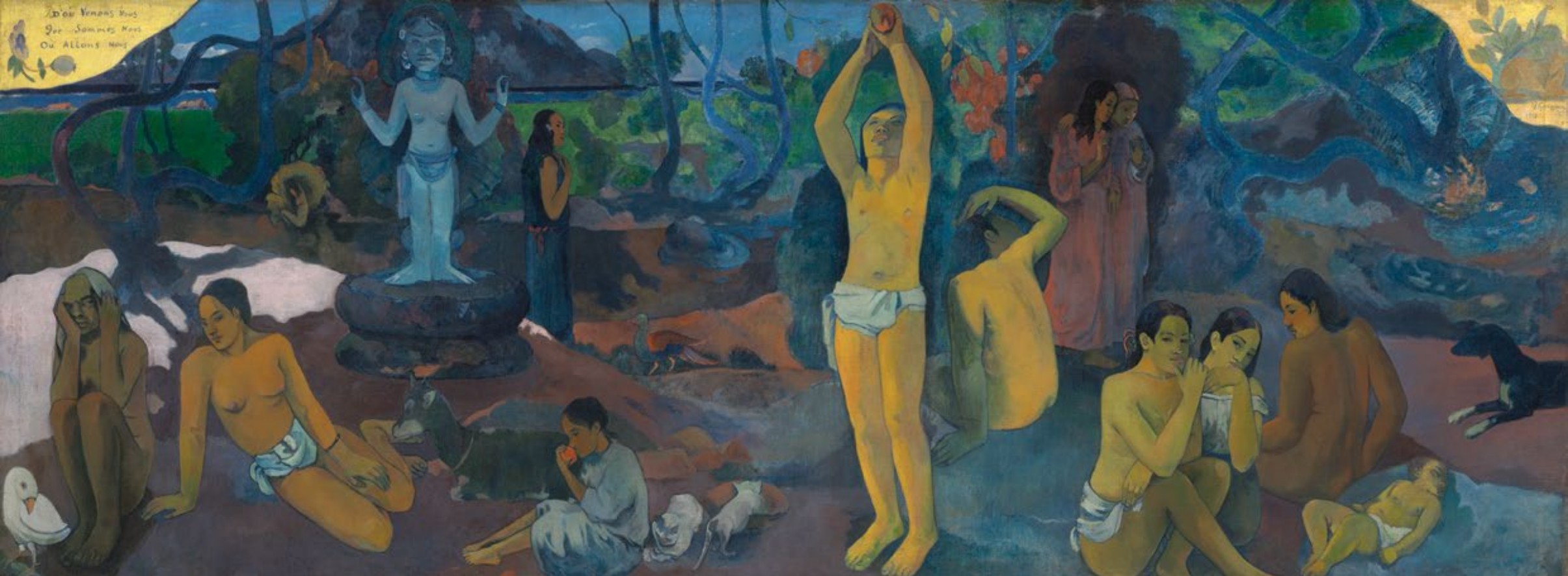
 Where Do We Come From? What Are We? Where Are We Going? Photograph © 2013 Museum of Fine Arts, Boston
Where Do We Come From? What Are We? Where Are We Going?
Paul Gauguin. 1897–1898 C.E. Oil on canvas.
Curator Note
"Gauguin’s massive philosophical masterpiece, painted in Tahiti. It reads from right to left, depicting the cycle of life from infancy to old age. Gauguin sought a "primitive" spirituality far from Western civilization, using symbolic, non-naturalistic color to explore the mystery of existence."
Form
- Large fresco-like scale.
- Reads right to left (Eastern tradition).
- Flat areas of bold, arbitrary color (yellow bodies, blue trees).
- Symbolist/Synthetist style.
- Dreamlike, non-perspective space.
Function
- To summarize Gauguin's artistic and spiritual journey.
- To answer the ultimate questions of existence.
- Intended to be his final testament before a suicide attempt.
- To portray a "lost paradise".
- To reject Western materialism.
Content
- Right (Where do we come from?): Infant and three women (birth).
- Center (What are we?): Figure plucking fruit (Polynesian Eve/Life).
- Left (Where are we going?): Old woman nearing death.
- Blue Idol: The Beyond/Moon Goddess.
- White bird with lizard: the futility of words.
Context
- Painted in Tahiti where Gauguin lived (colonial fantasy).
- He was sick, poor, and grieving his daughter.
- Combines Christian, Buddhist, and Polynesian imagery.
- Primitivism: fascination with non-Western cultures.
- Rejection of Impressionism for Symbolism.