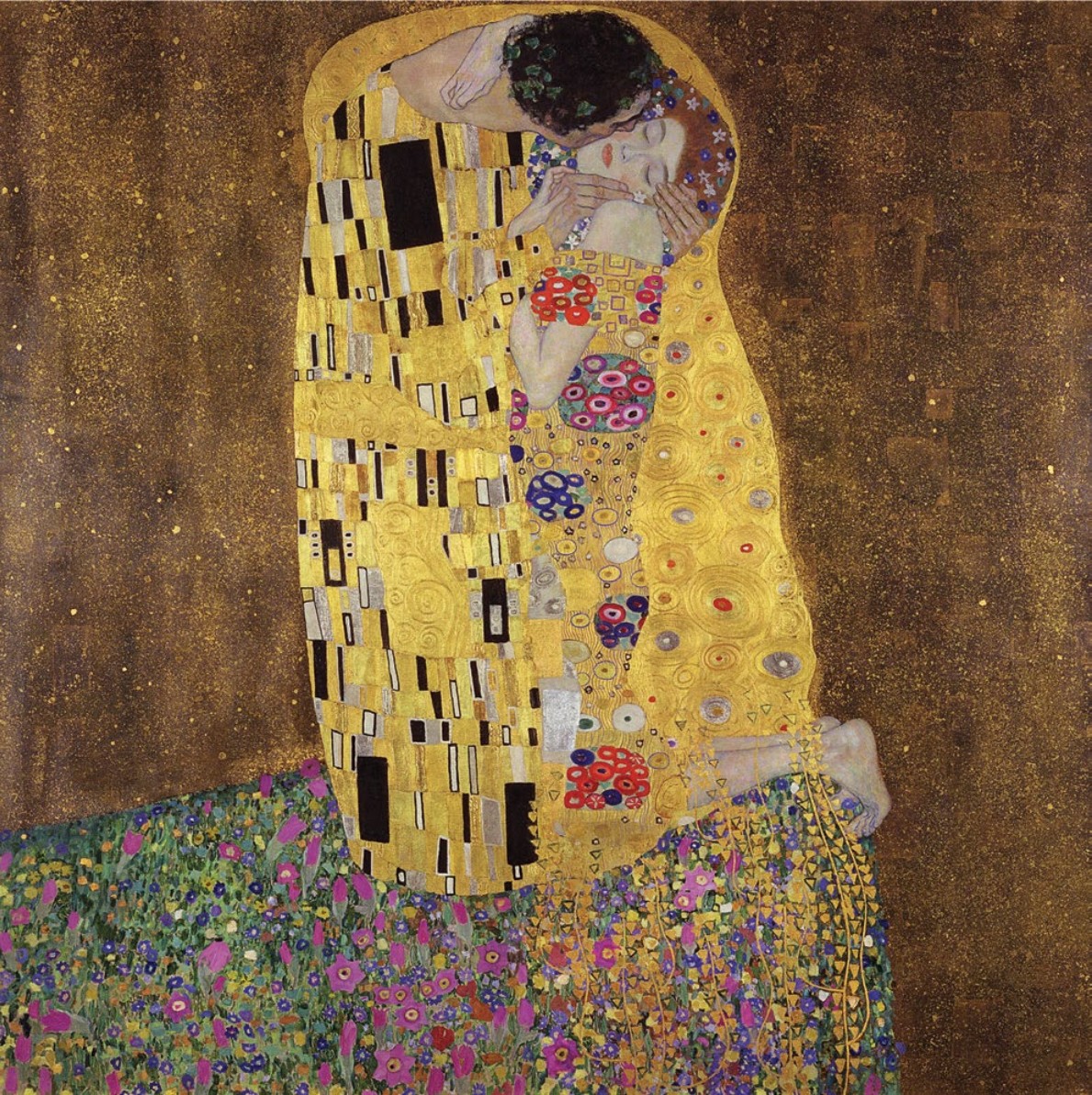
 The Kiss © The Gallery Collection/Corbis
The Kiss
Gustav Klimt. 1907–1908 C.E. Oil and gold leaf on canvas.
Curator Note
"The climax of Klimt's "Golden Phase." A couple embraces in a field of flowers, their bodies dissolving into elaborate, decorative geometric patterns. Klimt blends Art Nouveau eroticism with the spiritual aura of a Byzantine icon, creating a transcendent image of love where the figures merge into a single golden form."
Form
- Use of gold leaf (Byzantine influence).
- Decorative patterning: Rectangles (male) vs. Circles (female).
- Flattened space; figures float on a golden abyss.
- Realistic faces/hands contrast with abstract bodies.
- Square canvas format.
Function
- To celebrate erotic love as a spiritual experience.
- To decorate a modern interior.
- To fuse fine art and applied art (Vienna Secession).
- To create a timeless, universal symbol of union.
- To shock the conservative Vienna public.
Content
- The man: dominates, wearing rectangular, phallic patterns.
- The woman: yields, wearing circular, floral patterns.
- The meadow: infinite, terminating at a cliff edge.
- The golden halo: sanctifies the couple.
- Union of opposites.
Context
- Vienna Secession: artists breaking from the Academy.
- Klimt was influenced by Byzantine mosaics in Ravenna.
- Freud was working in Vienna (interest in sexuality).
- Reaction against industrial mass production.
- The "Fin de siècle" decadent style.