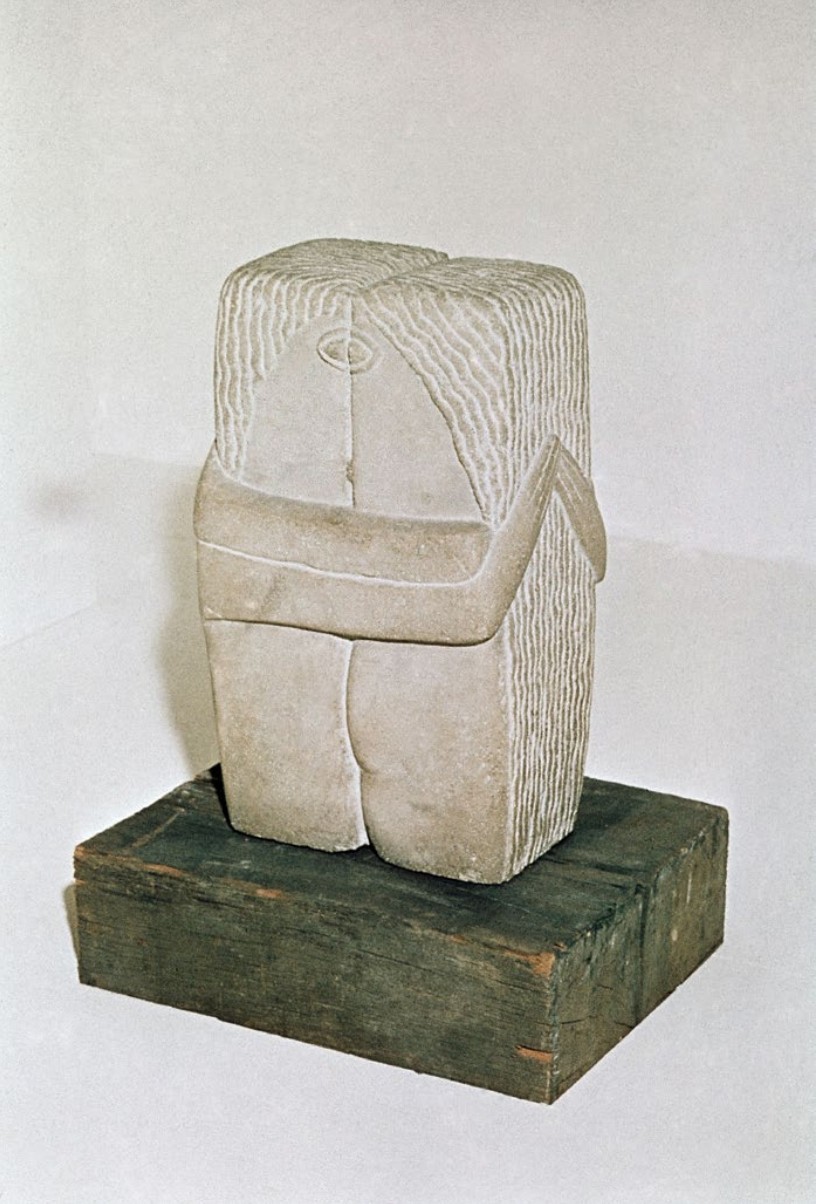
 The Kiss (1916 version) © Album/Art Resource, NY © 2013 Artists Rights Society (ARS), New York/ ADAGP, Paris
The Kiss
Constantin Brancusi. Original 1907–1908 C.E. Limestone.
Curator Note
"A proto-Cubist sculpture that reduces the embracing couple to a single, block-like form. Brancusi sought the "essence" of things, rejecting surface realism for archaic simplicity. The figures are barely differentiated from the stone block, emphasizing the material and the unity of the two lovers."
Form
- Direct carving into limestone (truth to materials).
- Geometric, block-like mass.
- Symmetry: the figures are mirror images.
- Rough, archaic texture.
- Minimalist details (eyes join to form one cyclopean eye).
Function
- To capture the essence of love/union.
- To reject the romantic realism of Rodin.
- To respect the original form of the stone block.
- To create a modern "totem".
- Commemorative (one version was a tombstone).
Content
- Two figures merging into one.
- Arms wrap around to form a continuous band.
- Hairline separates the two.
- Legs are not defined; rooted in the earth.
- Primitive, timeless quality.
Context
- Brancusi worked briefly for Rodin but left ("Nothing grows under big trees").
- Influence of "Primitive" art (Cycladic, African, Romanian folk).
- Multiple versions exist.
- Contrast with Klimt’s decorative Kiss.
- Precursor to Minimalism.