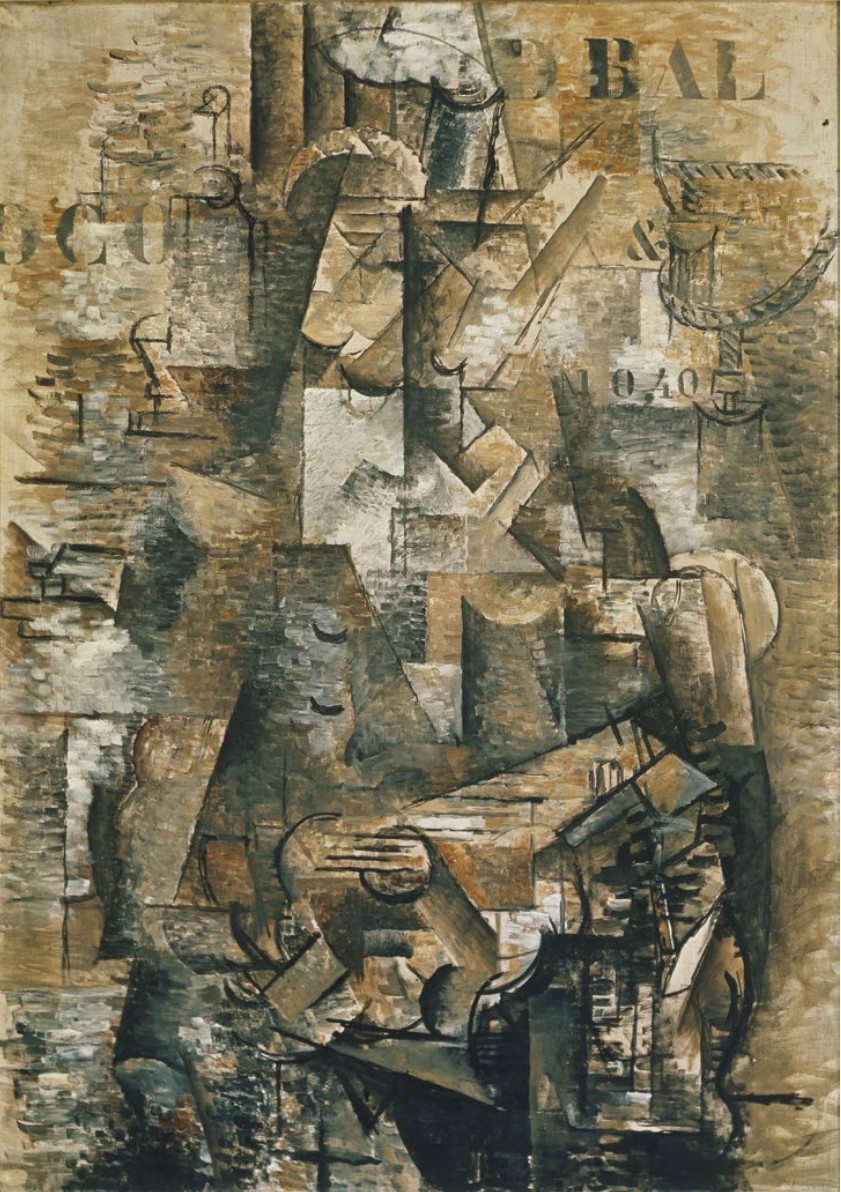
 The Portuguese Photo © Bridgeman-Giraudon/Art Resource, NY © 2013 Artists Rights Society (ARS), New York/ADAGP, Paris
The Portuguese
Georges Braque. 1911 C.E. Oil on canvas.
Curator Note
"A seminal example of Analytic Cubism. Braque disassembles a guitar player in a Portuguese bar into a complex grid of fractured planes. The figure and background are indistinguishable. He includes stenciled letters ("D BAL"), introducing text as a flat, real-world element that emphasizes the canvas surface, challenging the illusion window of Renaissance art."
Form
- Analytic Cubism: shattering form into geometric shards.
- Monochromatic palette (browns, grays) to focus on form.
- Grid-like structure.
- Stenciled letters/numbers flatten the space.
- Shallow depth; transparency of planes.
Function
- To analyze the object from multiple viewpoints simultaneously.
- To emphasize the 2D reality of the canvas.
- To dissect the process of perception.
- To depict the "fourth dimension" (time/movement).
- To break down the distinction between figure and ground.
Content
- A man playing a guitar (fragments of strings, sound hole).
- Dock/Harbor setting (rope, steps).
- Letters "D BAL": possibly "Grand Bal" or poster text.
- Numbers: purely graphic elements.
- The subject is secondary to the formal experiment.
Context
- Braque and Picasso worked together closely ("roped mountaineers").
- Reaction against the emotional color of Fauvism.
- Influenced by Cézanne’s passage.
- The first time text was used in fine art painting.
- Shift towards intellectual abstraction.