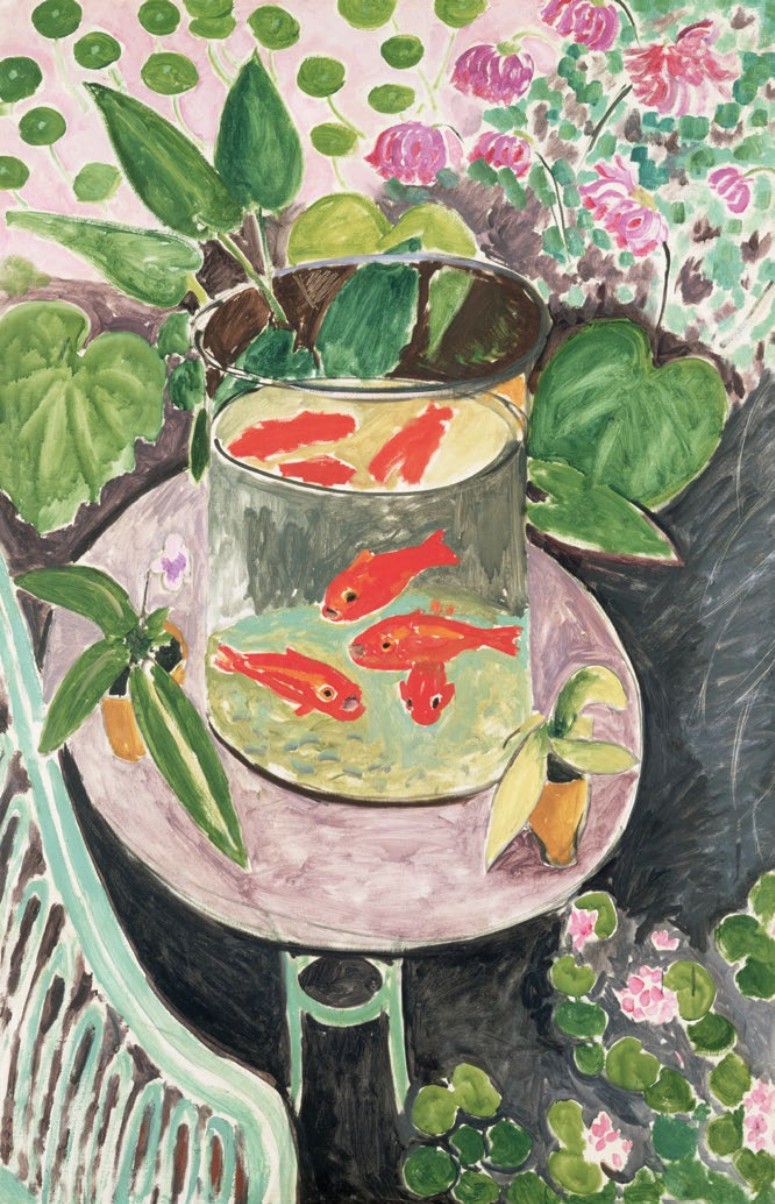
 Goldfish © Alexander Burkatovski/Corbis
Goldfish
Henri Matisse. 1912 C.E. Oil on canvas.
Curator Note
"Matisse uses vibrant, contrasting colors to depict goldfish swimming in a bowl. Influenced by his trip to Morocco where goldfish were objects of meditation, he creates a serene, decorative paradise. The skewed perspective and bold use of complementary colors (orange fish, blue water/background) prioritize expression and pleasure over realism."
Form
- Fauvism: bold, arbitrary, non-naturalistic color.
- Complementary contrast: Orange vs Blue, Pink vs Green.
- Flattened, tilted table top perspective.
- Loose, sketch-like brushwork.
- Decorative patterns (wallpaper/leaves).
Function
- To create "an art of balance, of purity and serenity" (armchair for the mind).
- To explore color relationships.
- To depict a meditative state.
- To reject the anxiety of modern life.
- To decorate.
Content
- Goldfish: symbols of paradise and tranquility.
- Plants: nature tamed for the domestic interior.
- The distortion of the fish (seen from side and top).
- The cylindrical bowl.
- Silence and stillness.
Context
- Painted after visiting Tangier, Morocco.
- Matisse was the leader of the Fauves ("Wild Beasts").
- Contrast with the intellectual rigor of Cubism.
- Goldfish became a recurring motif for Matisse.
- Influence of Islamic art (decorative patterns).