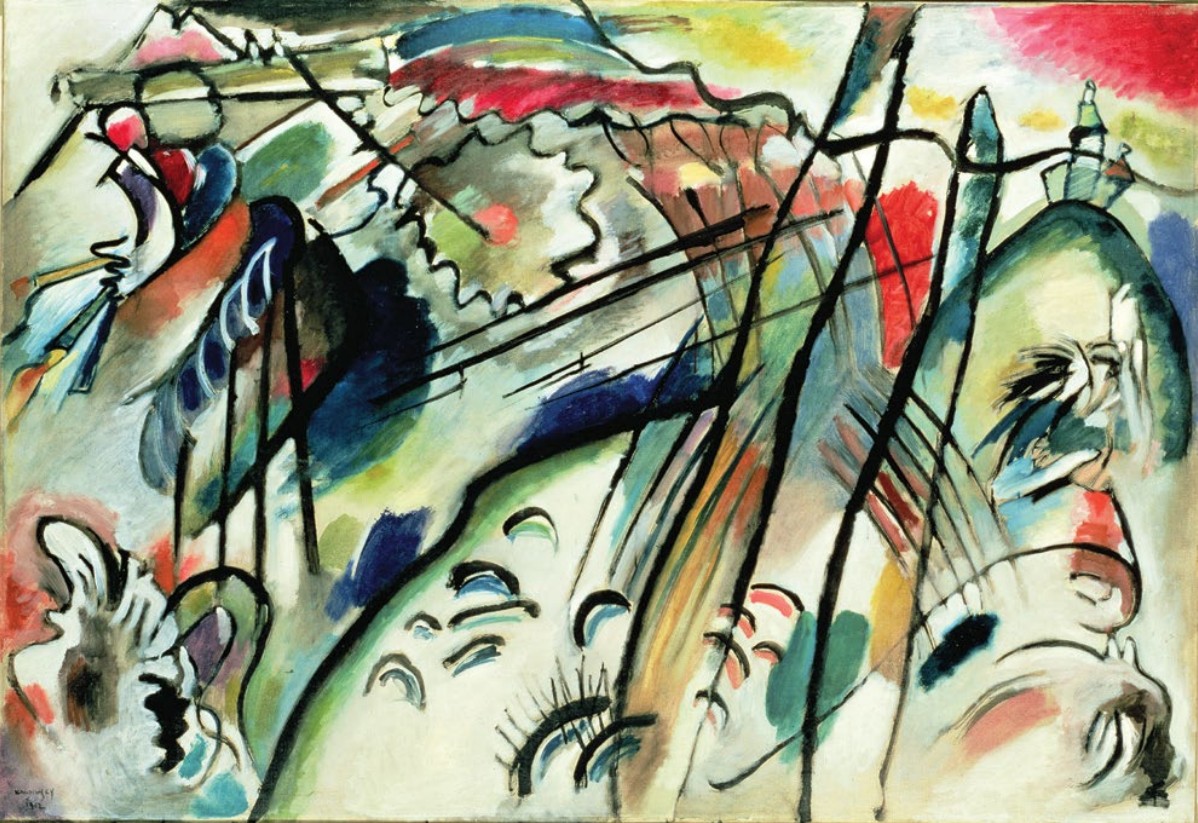
 Improvisation 28 (second version) Digital Image © The Bridgeman Art Library © 2013 Artists Rights Society (ARS), New York/ADAGP, Paris
Improvisation 28 (second version)
Vassily Kandinsky. 1912 C.E. Oil on canvas.
Curator Note
"One of the first truly abstract paintings. Kandinsky, who had synesthesia (hearing colors), sought to paint music ("Improvisation"). He used color and line to express spiritual vibrations, moving away from depicting the material world. While abstract, it contains veiled apocalyptic imagery (flood, canons, towers) referencing the coming war and spiritual rebirth."
Form
- Abstract Expressionism (Der Blaue Reiter).
- Bright, clashing colors.
- Dynamic, energetic black lines.
- Non-objective (no clear subject).
- Chaotic composition suggesting sound/cacophony.
Function
- To evoke a spiritual resonance in the viewer.
- To visualize music (synesthesia).
- To express the "internal necessity" of the artist.
- To depict the "apocalypse" and new age.
- To free art from the object.
Content
- Veiled imagery: Mountain/Citadel (heavenly city).
- Horses/Riders (The Blue Rider).
- Flood/Waves (Biblical deluge).
- Battlefield lines.
- A struggle between matter and spirit.
Context
- Kandinsky wrote "Concerning the Spiritual in Art".
- Member of Der Blaue Reiter (German Expressionism).
- Influenced by Schoenberg's atonal music.
- Pre-WWI anxiety.
- Theosophy influence.