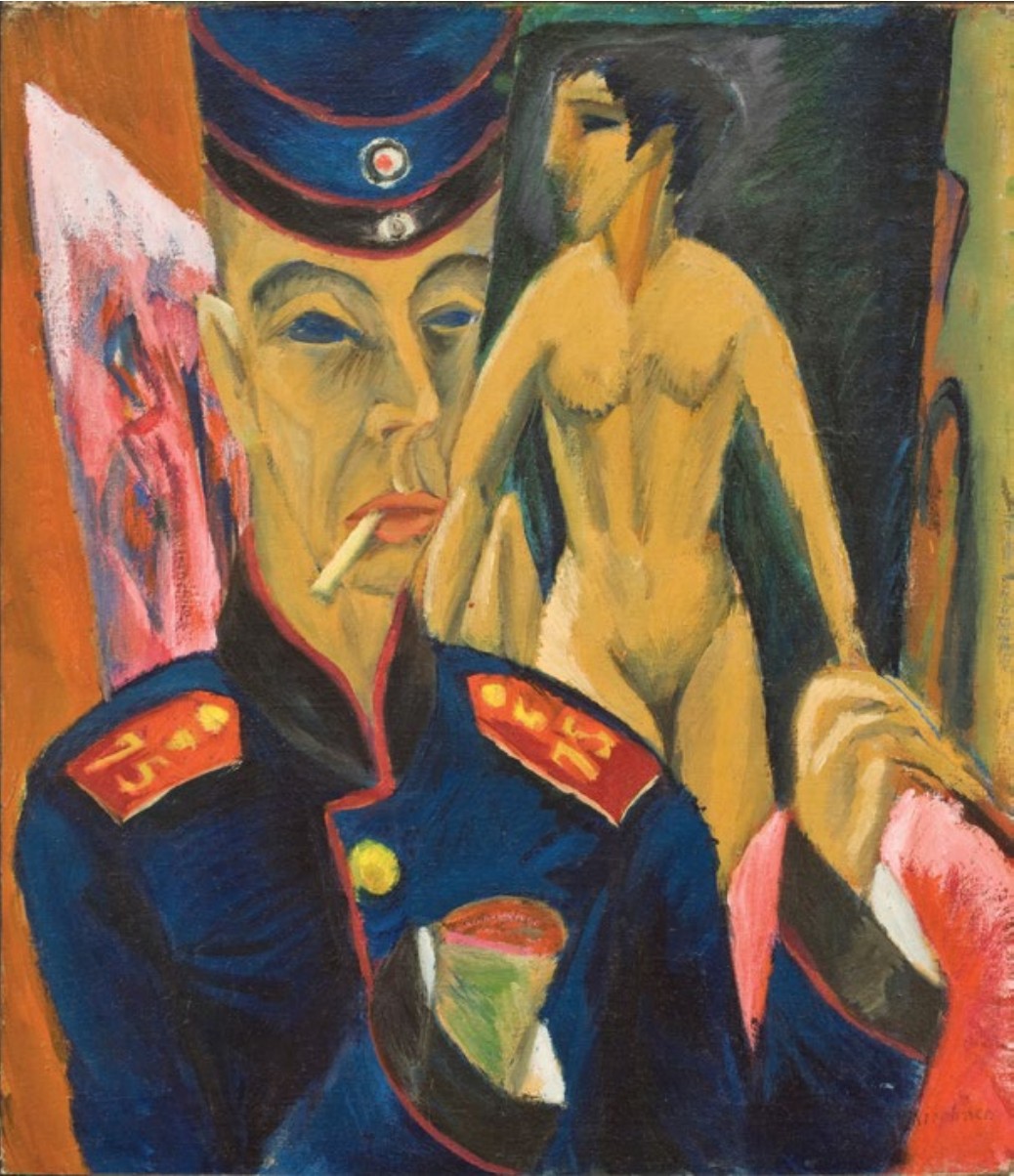
 Self-Portrait as a Soldier © Allen Memorial Art Museum, Oberlin College, Ohio, USA/Charles F. Olney Fund/The Bridgeman Art Library
Self-Portrait as a Soldier
Ernst Ludwig Kirchner. 1915 C.E. Oil on canvas.
Curator Note
"A psychological self-portrait painted after Kirchner was discharged from the army. He depicts himself in uniform with a severed right hand (his painting hand) and a nude model behind him. It is a metaphor for his artistic impotence and castration anxiety caused by the trauma of war. The jagged, angular style reflects his shattered mental state."
Form
- Die Brücke (German Expressionism).
- Angular, jagged lines.
- Acidic, sickly colors (green skin).
- Distorted perspective.
- Rough, aggressive brushwork.
Function
- To express personal and generational trauma.
- To protest the war.
- To visualize a mental breakdown.
- To mourn the loss of artistic creativity.
- To create an "ugly" truth.
Content
- Severed hand: clearly metaphorical (he didn't lose his hand), symbol of inability to paint.
- Soldier's uniform: symbol of restriction/service.
- Nude model: represents art/life, but he is turned away.
- Smoking cigarette: anxiety.
- Empty eyes: hollowness.
Context
- Kirchner "faked" mental illness to escape the trenches (or had a real breakdown).
- Die Brücke group admired "Primitive" art.
- The "degenerate" art label by Nazis later.
- Reflects the devastation of WWI on the individual.
- Nietzsche influence (The Bridge to the future).