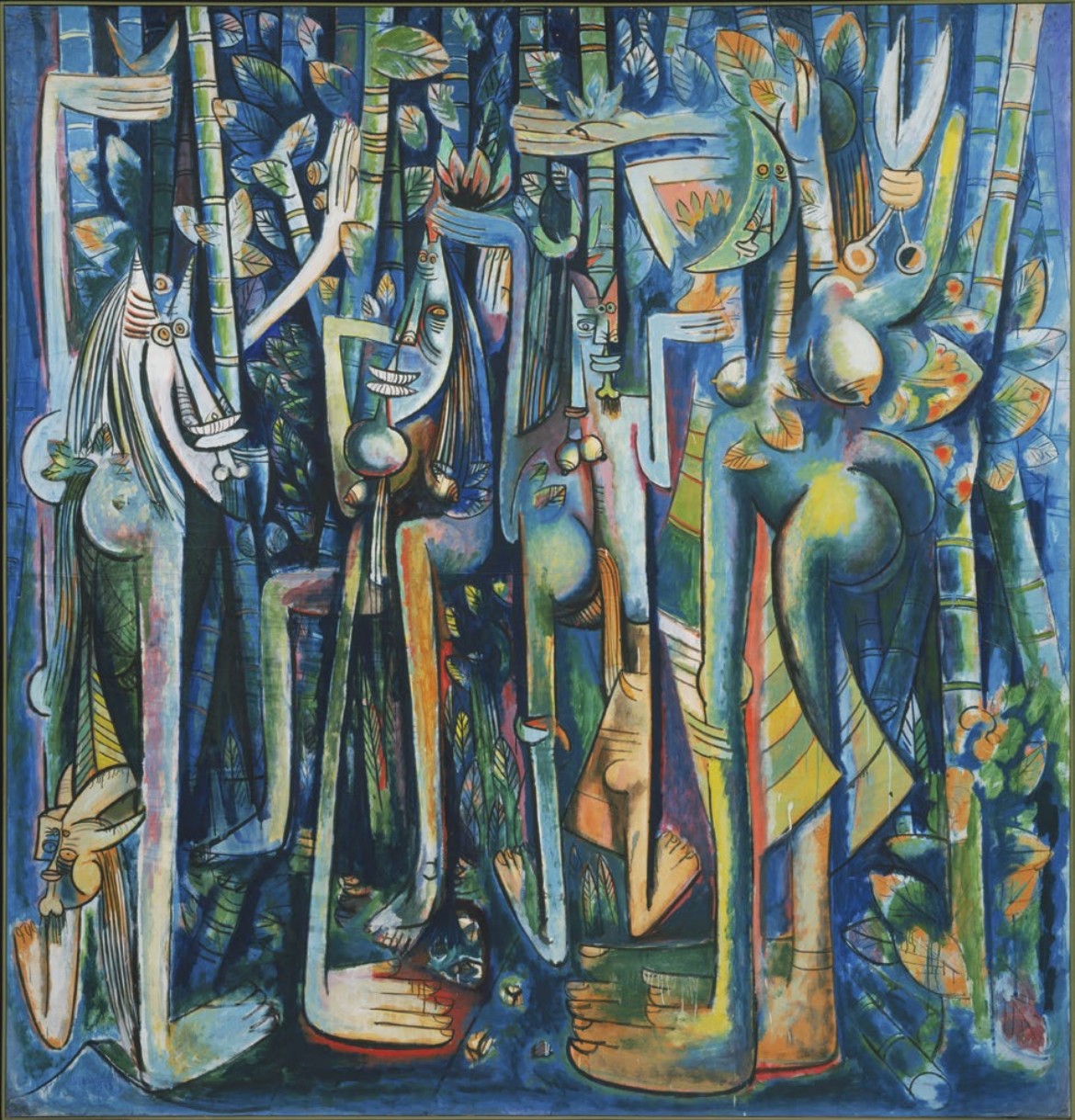
 The Jungle Photo © 2013 The Museum of Modern Art/Licensed by SCALA/Art Resource, NY © 2013 Artists Rights Society (ARS), New York/ADAGP, Paris
The Jungle
Wifredo Lam. 1943 C.E. Gouache on paper mounted on canvas.
Curator Note
"A surreal, dreamlike landscape blending Afro-Cuban Santería spirituality with Modernist styles (Cubism/Surrealism). Lam returned to Cuba to find his culture degraded by tourism. He painted this "psychic" jungle populated by hybrid figures (animal/human/plant) to reclaim Cuban identity and history from the colonial gaze of the "sugarcane tourist.""
Form
- Gouache (water-based opaque paint).
- Dense, crowded composition.
- Cool blue/green tones with flashes of yellow/white.
- Hybrid figures: Crescent moon faces, horse legs, tails.
- Verticality suggests sugarcane stalks or forest.
Function
- To reclaim Afro-Cuban culture.
- To communicate a "psychic state" rather than a landscape.
- To reflect the violence of colonial history.
- To merge Modernism with local tradition.
- To terrify/unsettle the viewer.
Content
- Figures: resemble Santería spirits (Orishas).
- Scissors: cutting the cane? or cutting the colonial bond?
- Sugarcane: the crop of slavery.
- Masks: influence of African art.
- Feet/Hands: exaggerated, grounded.
Context
- Lam was Afro-Chinese-Cuban.
- Worked with Picasso in Paris and Surrealists.
- Santería: syncretic religion (Yoruba + Catholicism).
- Painted in Cuba during WWII.
- Magic Realism in visual art.