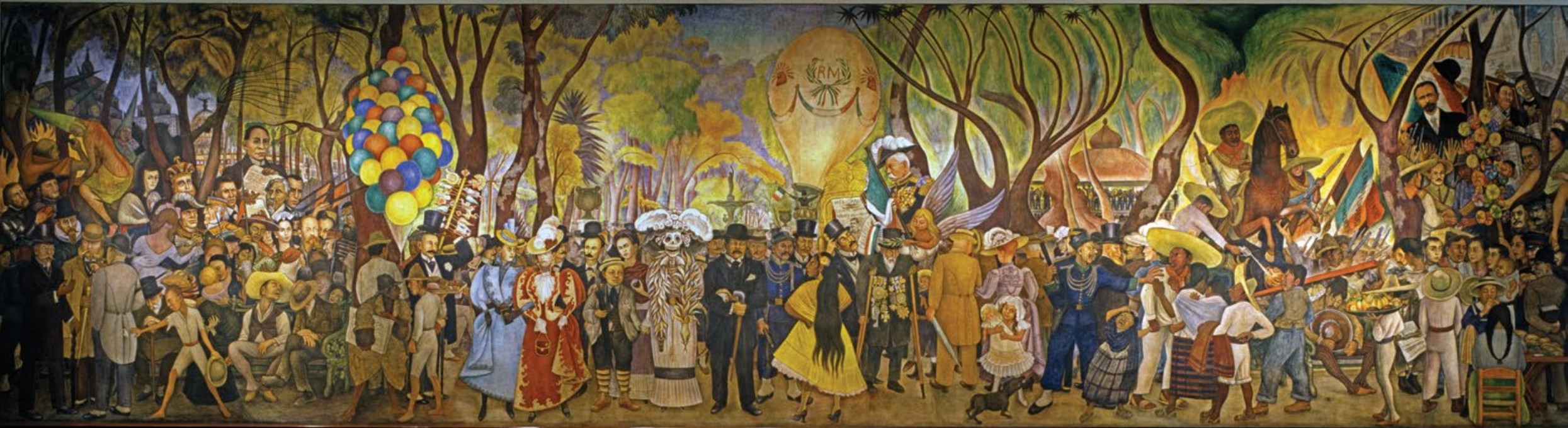
 Dream of a Sunday Afternoon in the Alameda Park © Alfredo Dagli Orti/Art Resource, NY © 2013 Banco de México Diego Rivera Frida Kahlo Museums Trust, Mexico, D.F./ Artists Rights Society (ARS), New York
Dream of a Sunday Afternoon in the Alameda Park
Diego Rivera. 1947–1948 C.E. Fresco.
Curator Note
"A massive mural compressing 400 years of Mexican history into a stroll in the park. Rivera places himself as a child holding hands with a skeleton (La Catrina), flanked by Frida Kahlo. It is a dense narrative of heroes and villains, exploring the complex Mexican identity (Mestizaje) and the cycle of life and death."
Form
- Fresco (wall painting).
- Horror vacui (fear of empty space) - packed with figures.
- Bright, festive colors.
- Surrealist juxtaposition of historical figures.
- Three sections: Conquest (left), Porfiriato/Dictatorship (center), Revolution (right).
Function
- To educate the public about Mexican history.
- To celebrate Mexican identity.
- To reclaim public space (Hotel del Prado lobby).
- To memorialize Rivera's life and loves.
- To criticize the elite and church.
Content
- Center: La Catrina (Skeleton in hat) holding arm of Posada (printmaker).
- Child Diego: has a toad in his pocket (symbol of himself).
- Frida Kahlo: holding a Yin-Yang (balance).
- Left: Cortes, Inquisition, Sor Juana.
- Right: Zapata, Workers, Police brutality.
Context
- Mexican Muralism movement.
- Rivera was a Marxist.
- La Catrina: invented by Posada to mock Mexicans acting European.
- Alameda Park: traditional promenade site (and former Aztec market/Inquisition burning site).
- Combines history and memory.