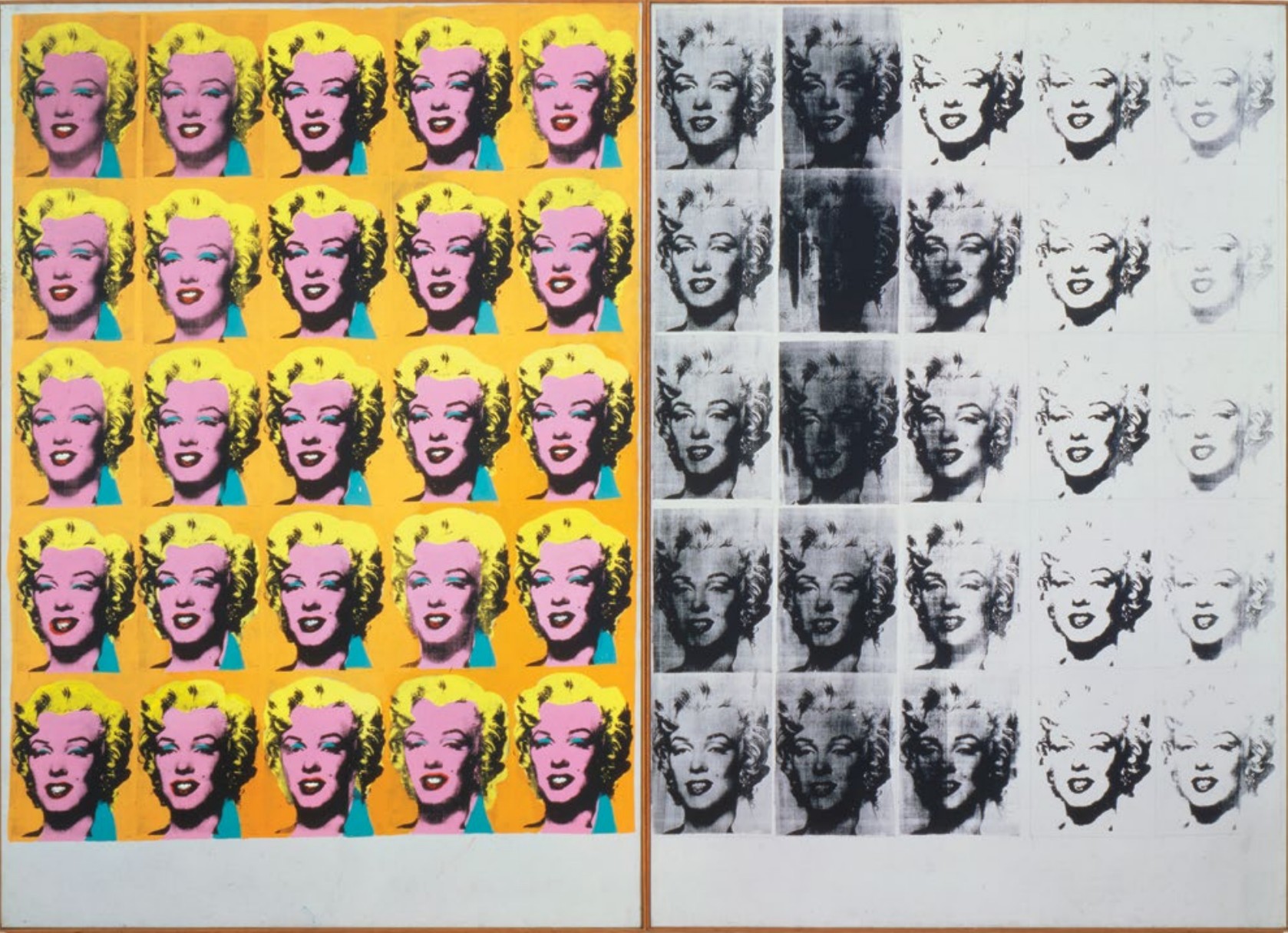
 Marilyn Diptych © Tate, London/Art Resource, NY © 2013 The Andy Warhol Foundation for the Visual Arts, Inc./Artists Rights Society (ARS), New York
Marilyn Diptych
Andy Warhol. 1962 C.E. Oil, acrylic, and silkscreen enamel on canvas.
Curator Note
"Warhol created this tribute shortly after Marilyn Monroe's suicide. By repeating her publicity photo 50 times (half in garish color, half in fading black and white), he explores her status as a mass-produced commodity and the desensitization to death. It turns the human being into an icon."
Form
- Diptych (two panels): religious format.
- Silkscreen printing: mechanical, reproducible.
- Grid composition (repetition).
- Left: Garish, artificial colors (flat).
- Right: Black and white, fading, smudged ink.
Function
- To critique consumer culture and celebrity worship.
- To remove the "artist's hand" (factory production).
- To memorialize Marilyn as a "saint" of pop culture.
- To explore the relationship between image and reality.
- To show the ubiquity of media.
Content
- Marilyn's face: a mask, not a person.
- Repetition: numbs the viewer, like seeing an ad repeatedly.
- Right side: suggests death, fading memory, the "ghost".
- Left side: the public, vibrant life.
- The "Plastic" quality of Hollywood.
Context
- Pop Art movement: taking low culture (ads) into high art.
- Warhol called his studio "The Factory".
- Marilyn had just died of an overdose.
- Religious undertones (Byzantine icons).
- Art as business.