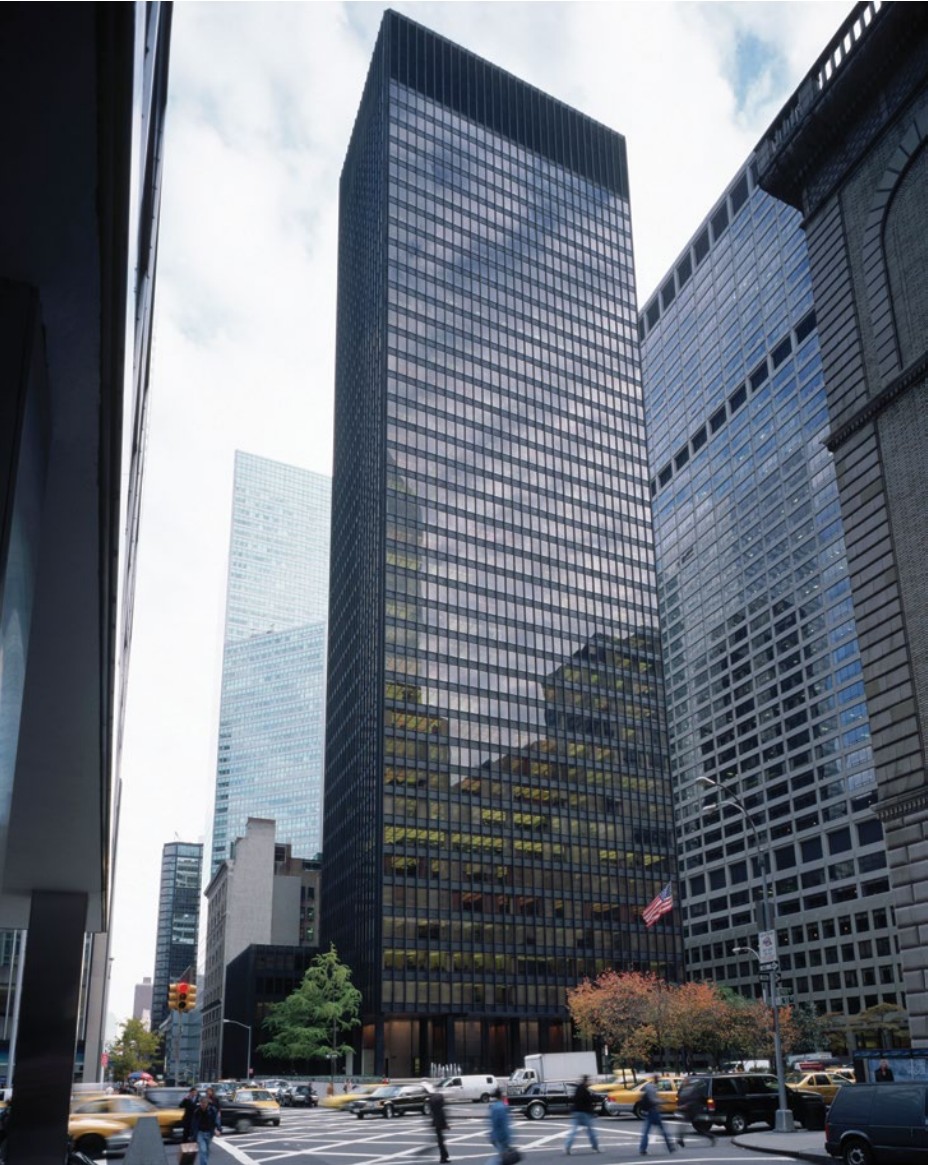
 Seagram Building © Angelo Hornak/Corbis
Seagram Building
New York City, U.S. Ludwig Mies van der Rohe and Philip Johnson (architects). 1954–1958 C.E. Steel frame with glass curtain wall and bronze.
Curator Note
"The epitome of the International Style corporate skyscraper ("Less is More"). Mies set the building back on a large plaza, sacrificing profitable land to create a public space and let the building "breathe." The bronze exterior and amber glass give it a classical elegance, treating the skyscraper as a monolithic column."
Form
- Steel frame with non-structural glass curtain wall.
- Bronze I-beams (mullions) applied to the exterior for verticality.
- Symmetrical, monolithic prism.
- Amber-tinted glass.
- Travertine plaza with reflecting pools.
Function
- Headquarters for Seagram (liquor company).
- To project corporate power and elegance.
- To create an open public space in dense NYC.
- To perfect the modern skyscraper.
- To demonstrate "God is in the details".
Content
- The Plaza: creates a threshold/stage.
- The decorative I-beams: visual logic (showing the structure even if fake).
- Bronze: expensive, classical material (like statues).
- Uniformity: blinds only have 3 positions (open, shut, half) to maintain order.
- Monumentality.
Context
- Mies was former Bauhaus director.
- International Style: universal, stripped of history.
- Phyllis Lambert (daughter of CEO) hired Mies.
- Changed NYC zoning laws (incentivizing plazas).
- Symbol of American capitalism.