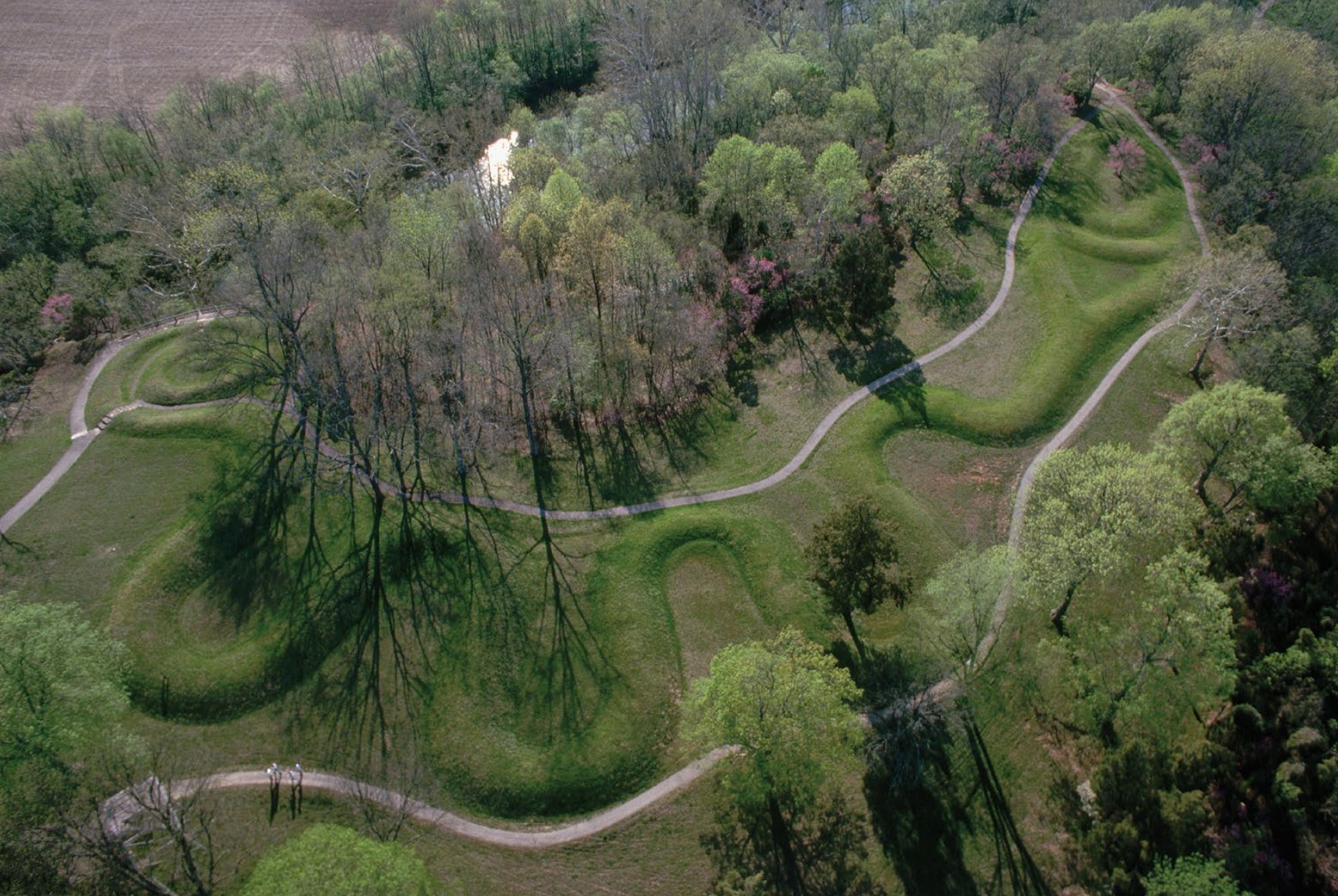
 Great Serpent Mound © Richard A. Cooke/Corbis
Great Serpent Mound
Adams County, southern Ohio. Mississippian (Eastern Woodlands). c. 1070 C.E. Earthwork/effigy mound.
Curator Note
"A massive 1,300-foot snake slithering across the Ohio landscape. Its head aligns with the summer solstice sunset, and some suggest it depicts a serpent swallowing an egg or a comet."
Form
- Effigy Mound: A raised earthwork sculpted in the shape of an animal (zoomorphic).
- Length: Approximately 1,300 feet long, undulating across the landscape.
- Construction: Layers of clay, ash, and stones covered with topsoil.
- No burials: Unlike conical mounds, this was not a tomb.
- Precise curvature: The snake's curves match the topography of the ridge.
Function
- Astronomical observatory: Used to track solar and maybe lunar events.
- Ritual site: Likely a place for community ceremonies or spiritual procession.
- Cosmological marker: Connected the earth to the celestial realm.
- Territorial marker or totem for the snake clan.
- To channel the spiritual power of the serpent (rebirth/fertility).
Content
- A massive serpent uncoiling towards the edge of a cliff.
- The head aligns with the summer solstice sunset.
- The tail coils in a spiral (symbol of infinity or cyclical time?).
- The oval shape at the mouth represents an egg, an eye, a frog, or Halley's Comet.
- Seven curves in the body may correspond to lunar phases.
Context
- Located in Ohio (Fort Ancient culture, c. 1070 C.E., influenced by Mississippian).
- Built on the site of an ancient meteorite impact crater (magnetic anomaly).
- Snakes were powerful symbols in Mississippian iconography (Underworld/Water).
- Preserved due to the efforts of Frederic Ward Putnam (Harvard) in 1887.
- Resembles the "horned serpent" of Native American mythology.