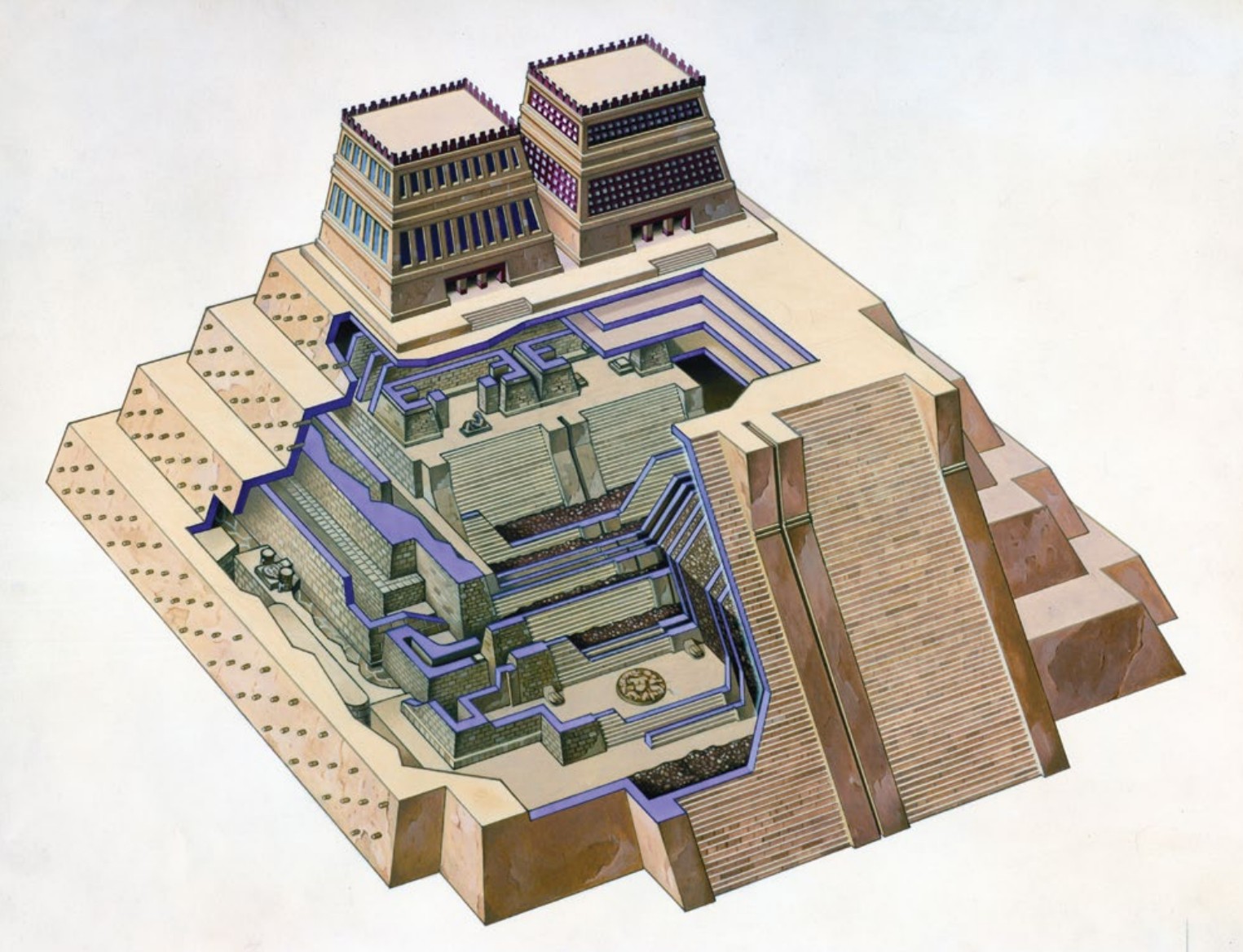
 Templo Mayor (reconstruction drawing) © Archives Larousse, Paris, France/Giraudon/The Bridgeman Art Library
Templo Mayor (Main Temple)
Tenochtitlan (modern Mexico City). Mexica (Aztec). 1375–1520 C.E. Stone (temple); volcanic stone (The Coyolxauhqui Stone); jadeite (Olmec-style mask); basalt (Calendar Stone).
Curator Note
"The exact center of the Aztec universe (Axis Mundi). Captives were sacrificed here and rolled down the steps to recreate the myth of the moon goddess Coyolxauhqui being dismembered by her brother Huitzilopochtli."
Form
- Twin pyramids atop a massive stepped platform (representing two mountains).
- Superimposed construction: Expanded 7 times like nesting dolls (onion layers).
- Materials: Volcanic stone, stucco, and paint.
- Steep staircases leading to two separate shrines at the summit.
- Coyolxauhqui Stone: Round, monolithic volcanic stone relief (11 ft diameter).
Function
- The Axis Mundi (Navel of the Universe) for the Aztec empire.
- Location of human sacrifice (heart extraction) to feed the sun god.
- Reenactment of the "Coatepec" (Snake Mountain) myth.
- Symbol of imperial power over conquered tributes.
- Calendar Stone and Olmec Mask were buried/placed here as offerings.
Content
- Temple of Tlaloc (North/Blue): God of Rain/Agriculture (Mountain of Water).
- Temple of Huitzilopochtli (South/Red): God of Sun/War (Mountain of Blood).
- Coyolxauhqui Stone: Depicts the naked, dismembered sister of Huitzilopochtli at the base of the stairs.
- Coatlicue (Mother Goddess): Represented by the earth.
- Chacmool figures: Reclining statues holding bowls for sacrificial hearts.
Context
- Tenochtitlan (modern Mexico City) was an island city in Lake Texcoco.
- Destruction: Cortez and the Spanish leveled the temple to build the Cathedral.
- Myth: Huitzilopochtli was born fully grown and killed his sister Coyolxauhqui, throwing her down the mountain.
- Sacrifice was viewed as a debt payment ("New Fire Ceremony") to keep the sun rising.
- Rediscovered in 1978 by electrical workers digging for cables.