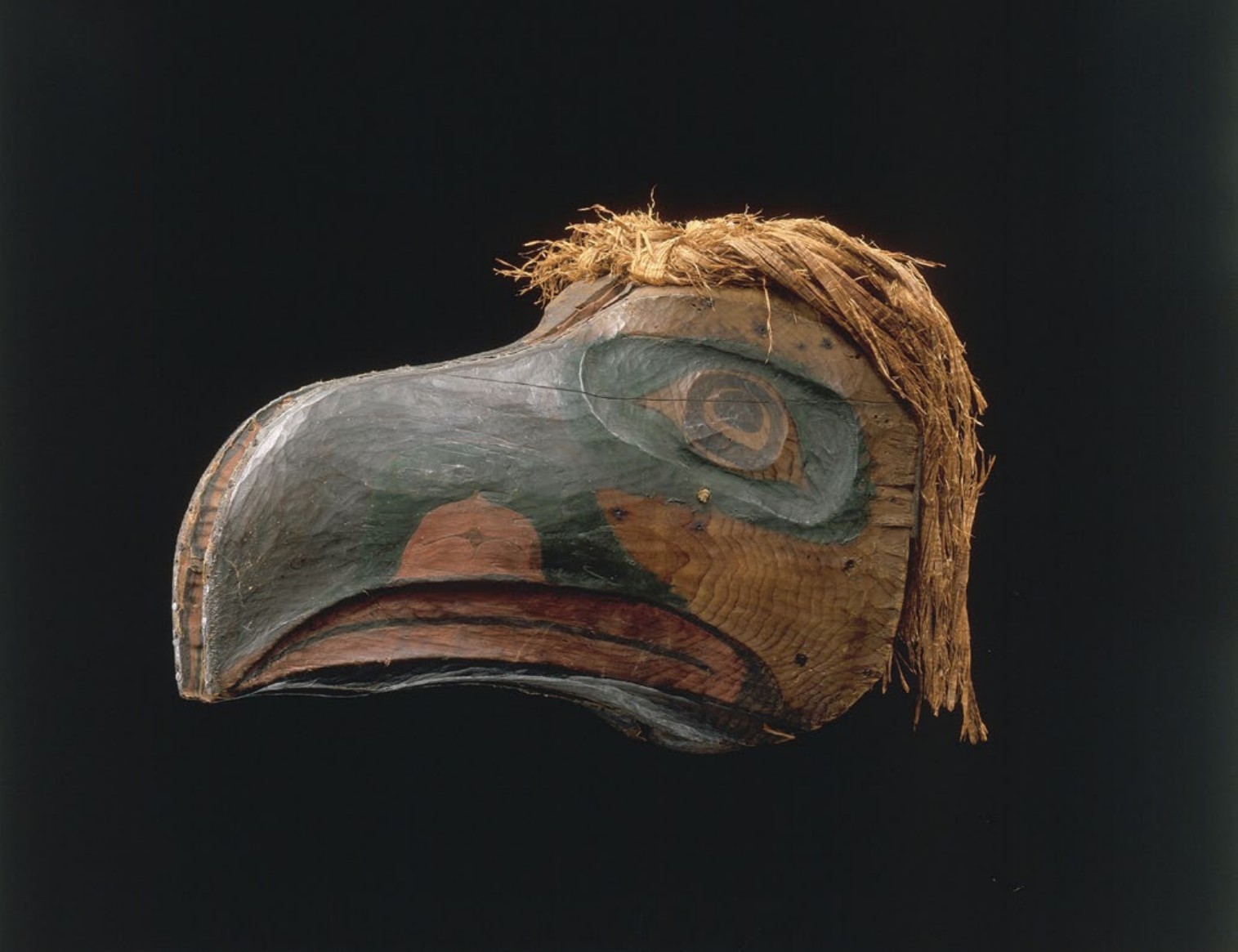
 Transformation mask, closed © Musée du Quai Branly/Scala/Art Resource, NY
Transformation Mask
Kwakwaka’wakw, Northwest Coast of Canada. Late 19th century C.E. Wood, paint, and string.
Curator Note
"A piece of performance art. At the height of the potlatch ceremony, the dancer pulls hidden strings, and the mask splits open—transforming from an eagle into the face of a human ancestor before the audience's eyes."
Form
- Materials: Red cedar wood carved, painted, and rigged with string.
- Formline Style: Characteristic Northwest Coast shapes (Ovoids, U-forms, S-forms).
- Kinetic Art: A mask with moving parts that opens/closes.
- Bilateral Symmetry: The outer mask splits down the center.
- Polychrome: Painted in red, blue-green, black, and white.
Function
- Ceremonial Performance: Worn by dancers during a Potlatch (winter ceremony).
- Theatrical storytelling: Revealed the "inner reality" or dual nature of the ancestor.
- Social Status: Displayed the wearer's clan crest (numayn) and rights.
- Genealogy: Validated the family's connection to a mythical animal ancestor.
- Spiritual channel: The dancer becomes the spirit during the performance.
Content
- Closed state: Represents an animal ancestor (Eagle, Thunderbird, Raven).
- Open state: Reveals a human face (the ancestor) inside, flanked by two profile faces.
- Sisiutl: Double-headed serpent motif often seen on the wings.
- Thunderbird: Mythical creature that hunts whales (symbol of power).
- The "clack" sound of the mask closing adds an auditory element.
Context
- Created by the Kwakwaka’wakw people (British Columbia) late 19th c.
- The Potlatch was a complex gift-giving feast banned by Canada (1885–1951).
- Masks were often confiscated ("The Potlatch Collection") and only returned recently.
- Reflects the belief that ancestors could shed their animal skins to become human.
- Carved by specialized artists (not necessarily the dancer).