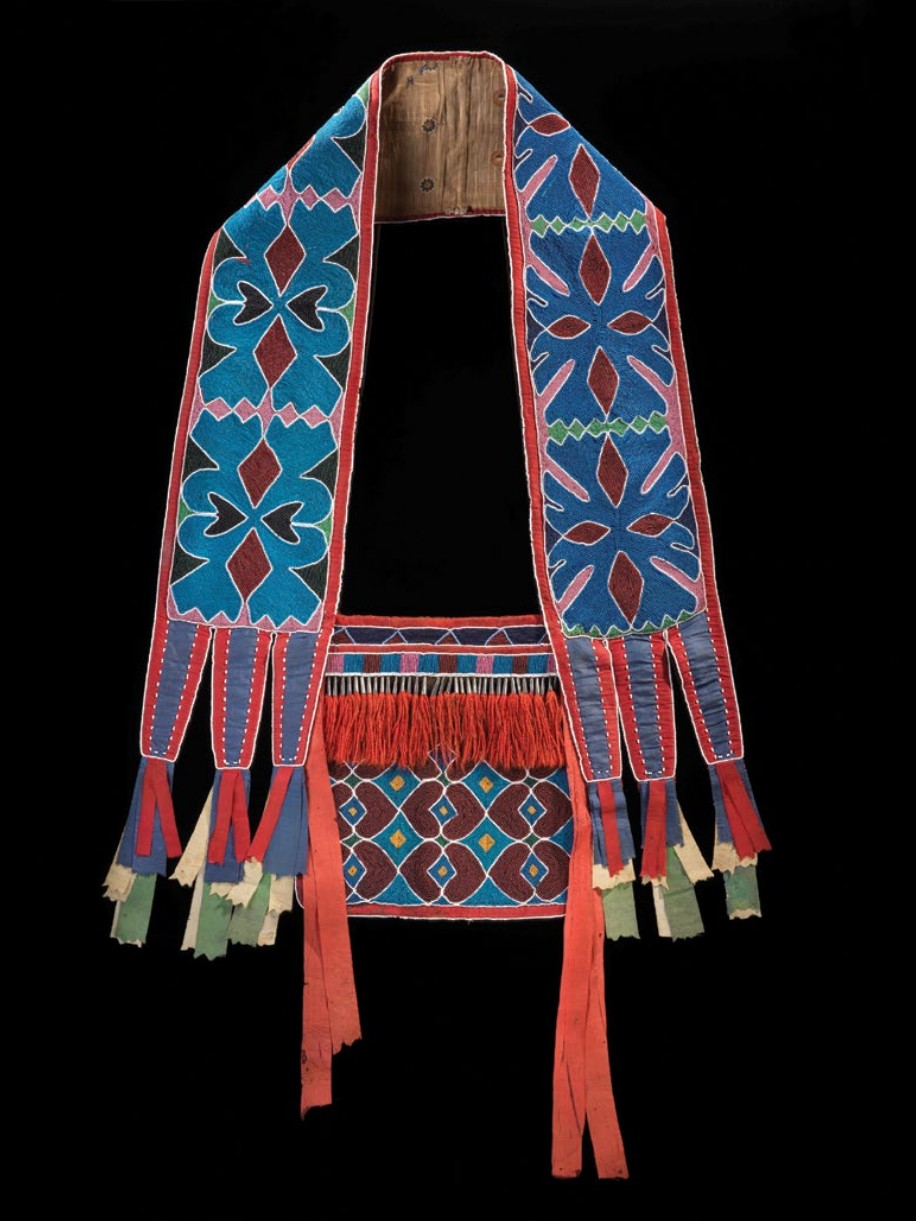
 Bandolier Bag Used by permission
Bandolier Bag
Lenape (Delaware tribe, Eastern Woodlands). c. 1850 C.E. Beadwork on leather.
Curator Note
"Inspired by the ammunition bags of European soldiers, but transformed into a symbol of indigenous identity. The thousands of tiny glass seed beads (traded from Europe) replaced traditional quillwork."
Form
- Materials: Thousands of tiny glass seed beads (European trade goods) on leather/cloth.
- Technique: Spot-stitch beadwork (curvilinear style).
- Composition: Large shoulder strap attached to a decorative pouch.
- Silk ribbons (European) used for fringe and texture.
- Contrast: Bright colors against a dark background.
Function
- Ceremonial Regalia: Worn by men during dances and special occasions.
- Status Symbol: Displayed the skill of the female maker and the wealth of the wearer.
- Cultural Adaptation: Based on European soldier ammunition bags but repurposed for art.
- Identity marker: Distinctive style of the Lenape/Delaware peoples.
- Not utilitarian: The "pocket" often had no opening; it was purely decorative.
Content
- Prairie Style: Abstracted floral patterns (flowers/leaves) arranged asymmetrically.
- Four-fold symmetry usually suggesting the four cardinal directions.
- Colors: White beads act as outlines for pinks, blues, and reds.
- Two distinct zones: The strap (broad) and the bag (rectangular).
Context
- Created by the Lenape (Delaware) tribe c. 1850 C.E.
- Reflects the "forced migration" period (Trail of Tears era) where tribes mixed styles.
- Women were the artists (beadworkers); Men were the wearers.
- Shows the resilience of culture: Adapting new materials (beads/silk) to maintain tradition.
- Replaced older quillwork (porcupine quills) which was harder to do.