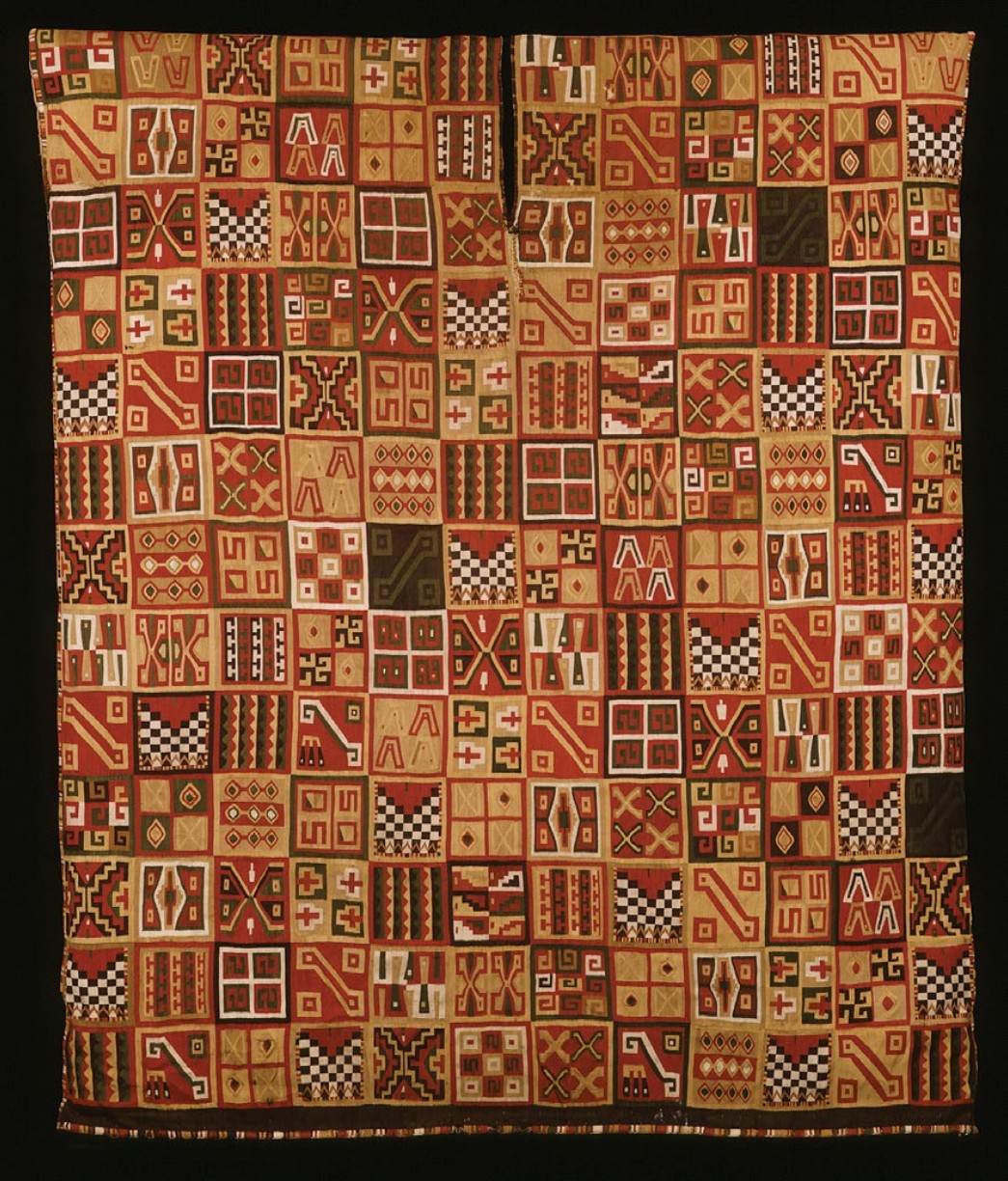
 All-T'oqapu tunic © Dumbarton Oaks, Washington, DC
All-T'oqapu Tunic
Inka. 1450–1540 C.E. Camelid fiber and cotton.
Curator Note
"A garment that reads like a map of the empire. Each square geometric pattern (t'oqapu) represents a specific lineage, rank, or role. Wearing all of them meant the Sapa Inka controlled everything and everyone."
Form
- Unku (Tunic): A rectangular garment woven from a single piece of cloth (slit for head).
- Material: Camelid fiber (Alpaca/Vicuña) and cotton; dyed with cochineal (red) and indigo (blue).
- Technique: Backstrap loom weaving with an incredibly high thread count (100+ threads/inch).
- Composition: Covered entirely in T'oqapu (square geometric motifs).
- Abstraction: No figural representation, purely symbolic geometry.
Function
- Royal Regalia: Worn exclusively by the Sapa Inka (King).
- Political Statement: Wearing all possible t'oqapu showed he controlled all peoples/ranks.
- Warmth and protection in the high Andes.
- Gift giving: High-status textiles were gifted to loyal generals and governors.
- To manifest the order of the cosmos on the king's body.
Content
- T'oqapu: Small square designs, each representing a specific family, rank, or role.
- Black and White Checkerboard: Represents the Inka army/military strength.
- Solid colors and specific patterns act as a language/code (now partially lost).
- Qompi: The name for this highest quality of cloth.
- The sheer quantity of patterns implies the unity of the empire.
Context
- Textiles were valued more than gold in the Inka economy.
- Woven by the Acllas ("Chosen Women") who lived in seclusion weaving for the state.
- The Spanish destroyed many textiles, fearing their communicative power.
- Preserves the "visual language" of a culture that had no written script (quipu was for numbers).
- Demonstrates the highly stratified and organized nature of Inka society.