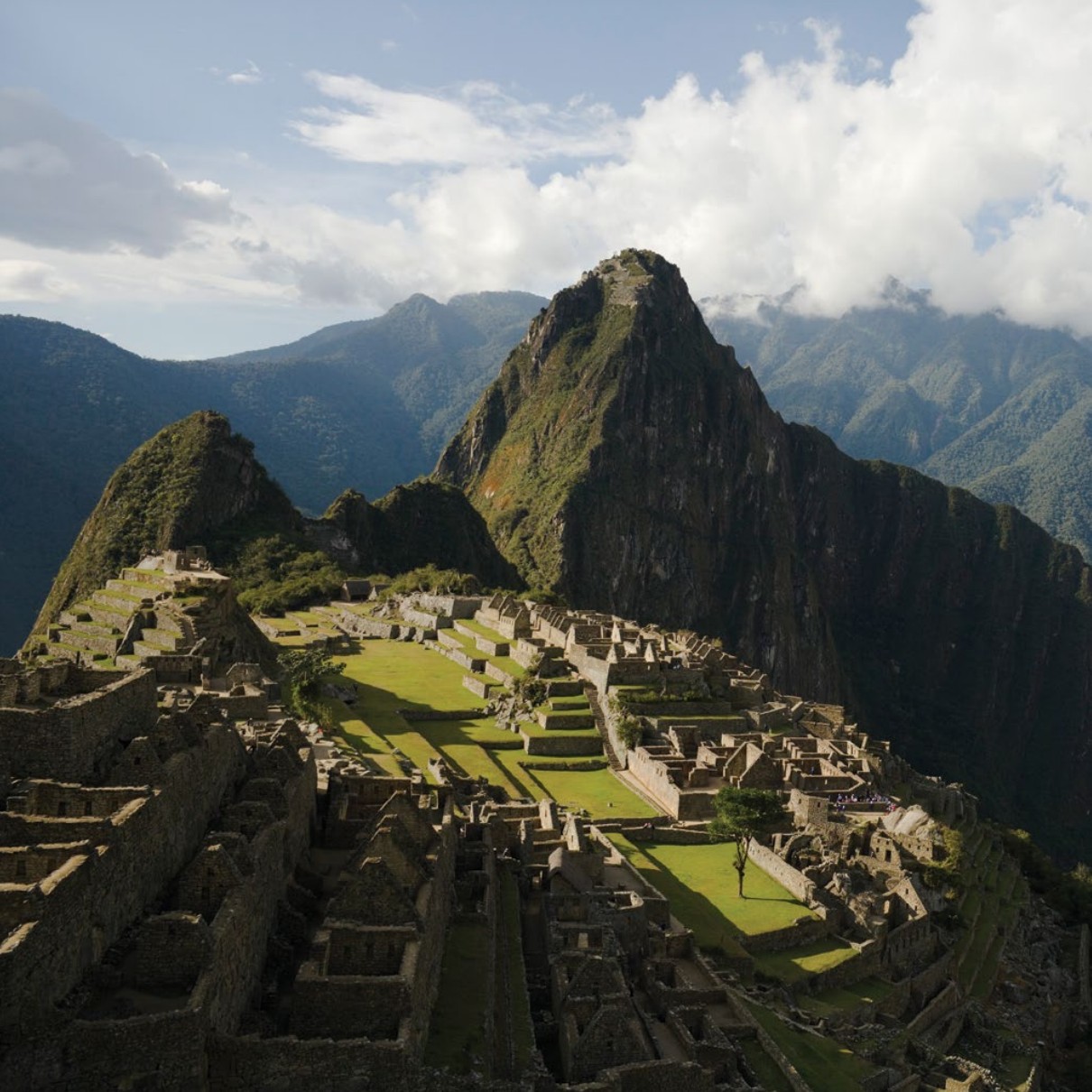
 City of Machu Picchu © Hugh Sitton/Corbis
City of Machu Picchu
Central highlands, Peru. Inka. c. 1450–1540 C.E. Granite (architectural complex).
Curator Note
"The "Lost City" in the clouds. Likely a royal retreat for the first Inka emperor, Pachacuti. The Intihuatana stone ("Hitching Post of the Sun") was used to track the sun's passage during the winter solstice."
Form
- Located on a saddle between two jagged peaks (Machu Picchu and Huayna Picchu).
- Terracing: Agricultural steppes reinforced with stone to prevent erosion and create land.
- Water management: Sophisticated stone channels and fountains (16 fountains total).
- Integration: Buildings are made of local granite and seem to grow out of the rock.
- Inka Masonry: Smooth, seamless walls for elite buildings; rougher stone for common areas.
Function
- Royal Estate: A winter retreat or country palace for Emperor Pachacuti.
- Diplomatic center: A place to host feasts and negotiate with local leaders.
- Astronomical observatory: Tracking the solstices and stars.
- Religious pilgrimage site (near sacred peaks/apus).
- Not a military fortress (despite its walls) nor a lost city (locals knew it).
Content
- Intihuatana Stone ("Hitching Post of the Sun"): Carved boulder aligned with the solstices.
- Temple of the Sun: Curved tower built on a rock with a cave underneath.
- Observatory (Room of the 3 Windows): Views the sunrise.
- Residential sector vs. farming sector.
- Thatched roofs (originally) made of ichu grass.
Context
- Built c. 1450-1540 C.E. (height of empire) and abandoned after the Spanish conquest.
- Its remote location saved it from destruction by the Spanish (they never found it).
- "Rediscovered" scientifically by Hiram Bingham (Yale) in 1911.
- Illustrates Inka mastery over the harsh Andean environment.
- Labor was provided by the Yanacona (retainers) and Mitimaes (colonists).