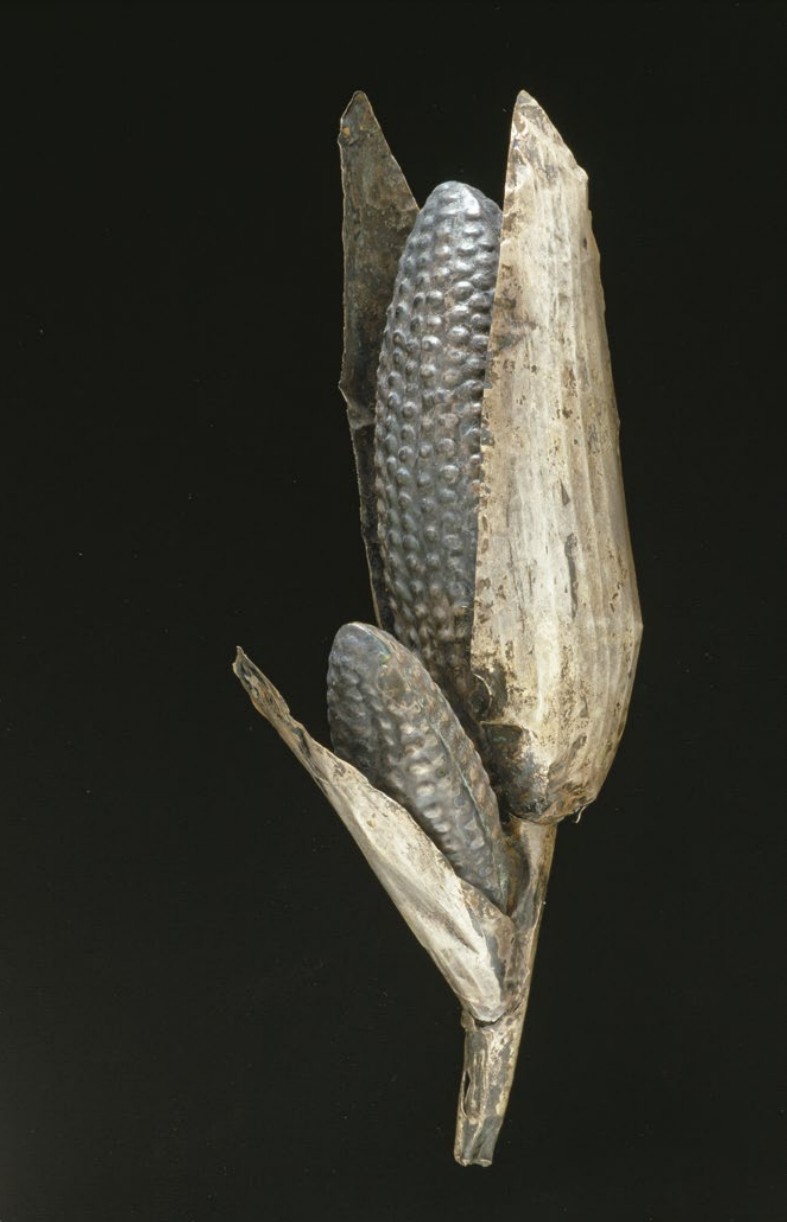
 Maize cobs © bpk, Berlin/Ethnologisches Museum, Staatliche Museen/Claudia Obrocki/Art Resource, NY
Maize Cobs
Inka. c. 1440–1533 C.E. Sheet metal/repoussé, metal alloys.
Curator Note
"From the golden garden of the Qorikancha. The Inka placed life-sized metal replicas of corn, llamas, and shepherds in the temple courtyard to ensure agricultural fertility and honor the sun god."
Form
- Repoussé technique: Metal hammered from the back to create relief.
- Materials: Sheet metal (gold and silver alloys) folded to mimic delicate leaves.
- Naturalism: Life-sized and accurate realistic depiction of corn.
- Technique: Joining sheets of metal without soldering.
- Contrast: Silver used for the kernels, gold used for the sheath (symbolic duality).
Function
- Ritual offering: Placed in the Qorikancha garden to thank the Sun God (Inti).
- Sympathetic Magic: To ensure a successful harvest and agricultural fertility.
- Status Display: Demonstrated the Inka's control over vast metal resources.
- Divine decoration: Part of a life-sized garden of metal llamas, shepherds, and plants.
- Celebrate the maize plant, the most essential food source in the Andes.
Content
- Three cobs of ripe maize ready to be harvested.
- The husks are pulled back to reveal the kernels (silver).
- Symbolizes the sun's generative power trapped in the earth.
- Represents the complete ecosystem (plants, animals, people) ordered by the Inka.
Context
- Qorikancha (Temple of the Sun) in Cusco was the most sacred site.
- Spanish Looting: Charles V ordered all such objects melted down for bullion.
- Only a few examples survive (mostly sent to Europe as curiosities).
- Inka metallurgy was decorative/ritual, unlike European metallurgy (weaponry).
- Maize was used to make Chicha (corn beer) for religious festivals.