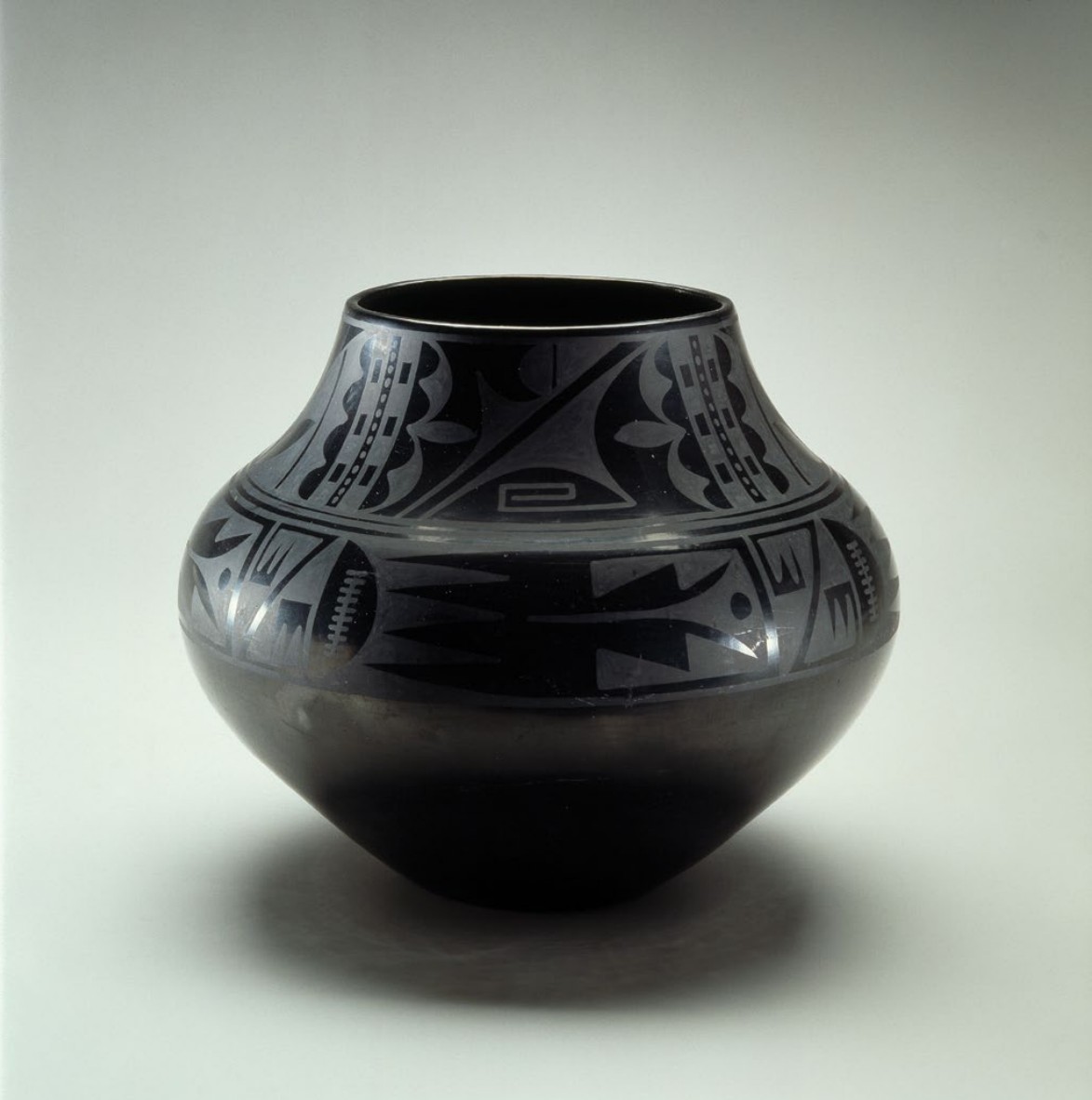
 Black-on-black ceramic vessel © Barbara Gonzales, Great Granddaughter of Maria and Julian Martinez
Black-on-Black Ceramic Vessel
Tewa, Puebloan, San Ildefonso Pueblo, New Mexico. c. mid-20th century C.E. Blackware ceramic.
Curator Note
"Maria Martinez reinvented an ancient Neolithic blackware technique using manure smothering. Her pots put Native American ceramics on the fine art map, transforming a utilitarian craft into high-status sculpture."
Form
- Material: Local clay mixed with temper (sherds of broken pots).
- Technique: Coil method (hand-built, no potter's wheel).
- Surface: Black-on-Black style created by polishing (burnishing) some areas and leaving others matte.
- Firing: Reduction firing (smothering the fire with manure) turns the red clay black.
- Shape: Symmetrical, round, thin-walled ollas (jars).
Function
- Fine Art: Transformed utilitarian pottery into sculpture for the art market.
- Decor: Intended for display (too porous to hold water comfortably).
- Economic Engine: Revitalized the economy of San Ildefonso Pueblo.
- Cultural Pride: Reasserted the value of Native American craft.
- Community activity: Led to a "pottery revival" involving the whole village.
Content
- Abstract geometric designs based on ancient pottery sherds and Art Deco influence.
- Avanyu: The horned water serpent (prayer for rain) depicted in matte black.
- Elements of the sky (clouds, rain, feathers) stylized into patterns.
- The contrast between the shiny (polished) and dull (matte) creates the image.
- Signature: Signed "Maria + Julian" (collaboration).
Context
- Created by Maria Martinez (shape) and Julian Martinez (paint), c. mid-20th century.
- Based on excavations of Neolithic pottery; Maria reinvented the lost blackware technique.
- Maria became a celebrity artist, signing pots representing the community.
- Intersected with the craze for Art Deco and "Primitivism" in the US.
- Example of how tradition evolves to survive in a modern world.