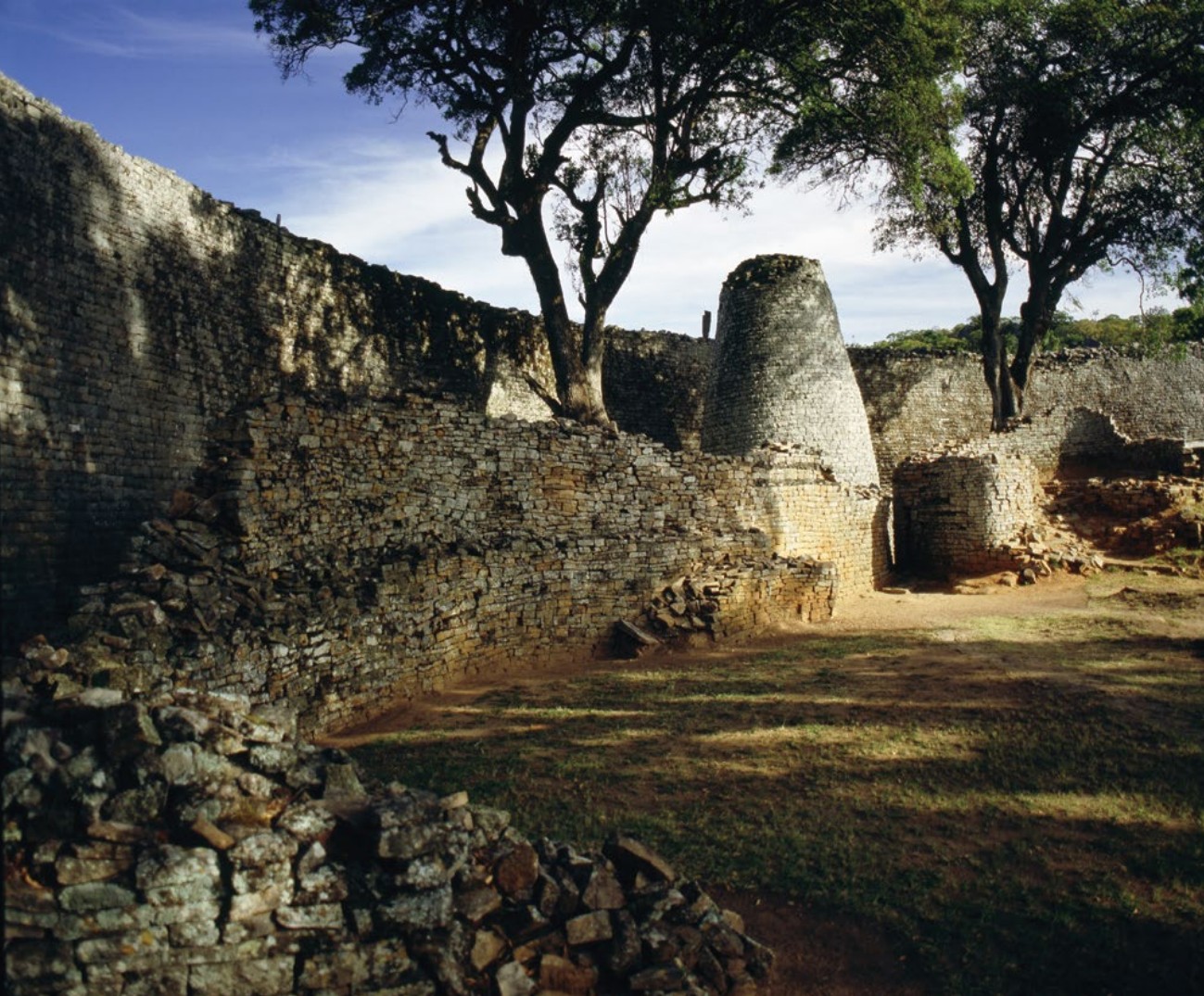
 Conical tower © Werner Forman Archive/The Bridgeman Art Library
Conical tower and circular wall of Great Zimbabwe
Shona peoples (Southeastern Zimbabwe). c. 1000–1400 ce. Coursed granite blocks.
Curator Note
"A massive stone city built without mortar. Early European explorers refused to believe Africans built it, inventing racist theories about Queen of Sheba. The conical tower, shaped like a grain silo, symbolized the king's power to feed his people."
Form
- Coursed granite blocks: Stones were heated and cooled to crack them into uniform shapes.
- Ashlar masonry: Constructed without mortar (dry-stone), relying on gravity and precise fit.
- Curvilinear walls: The walls flow with the landscape, avoiding straight lines and sharp angles.
- Batter: Walls slope inward toward the top for structural stability.
- Decorative patterns: Chevron designs near the top symbolize the eagle (lightning) and rain.
Function
- Royal residence: Housed the King and the elite of the Shona society.
- Symbol of authority: The massive walls separated the royals from the commoners in the valley.
- Granary symbolism: The conical tower represents a grain bin, signifying the king's generosity and provision.
- Ritual center: Used for religious ceremonies connecting the living to ancestral spirits.
- Trade hub: A center for the gold and ivory trade linking to the Indian Ocean (Swahili Coast).
Content
- Great Enclosure: The largest pre-colonial structure in sub-Saharan Africa.
- Conical Tower: Solid stone structure (no interior) shaped like a harvest silo.
- Chevron pattern: Represents the lightning snake and the eagle (messengers to God).
- Passageways: Narrow, tall corridors forced visitors to walk single file (submission).
- Soapstone birds: Eight birds found here represent royal ancestors (now the national symbol of Zimbabwe).
Context
- Built by the Shona peoples between 1000–1400 C.E. at the height of their power.
- Zimbabwe means "House of Stone" (Dzimba dza mabwe).
- Colonial erasure: Early archaeologists (Rhodesia) destroyed evidence to deny African authorship.
- Abandoned around 1450 C.E. likely due to exhaustion of resources (firewood/grazing).
- Demonstrates a highly organized society capable of mobilizing massive labor forces.