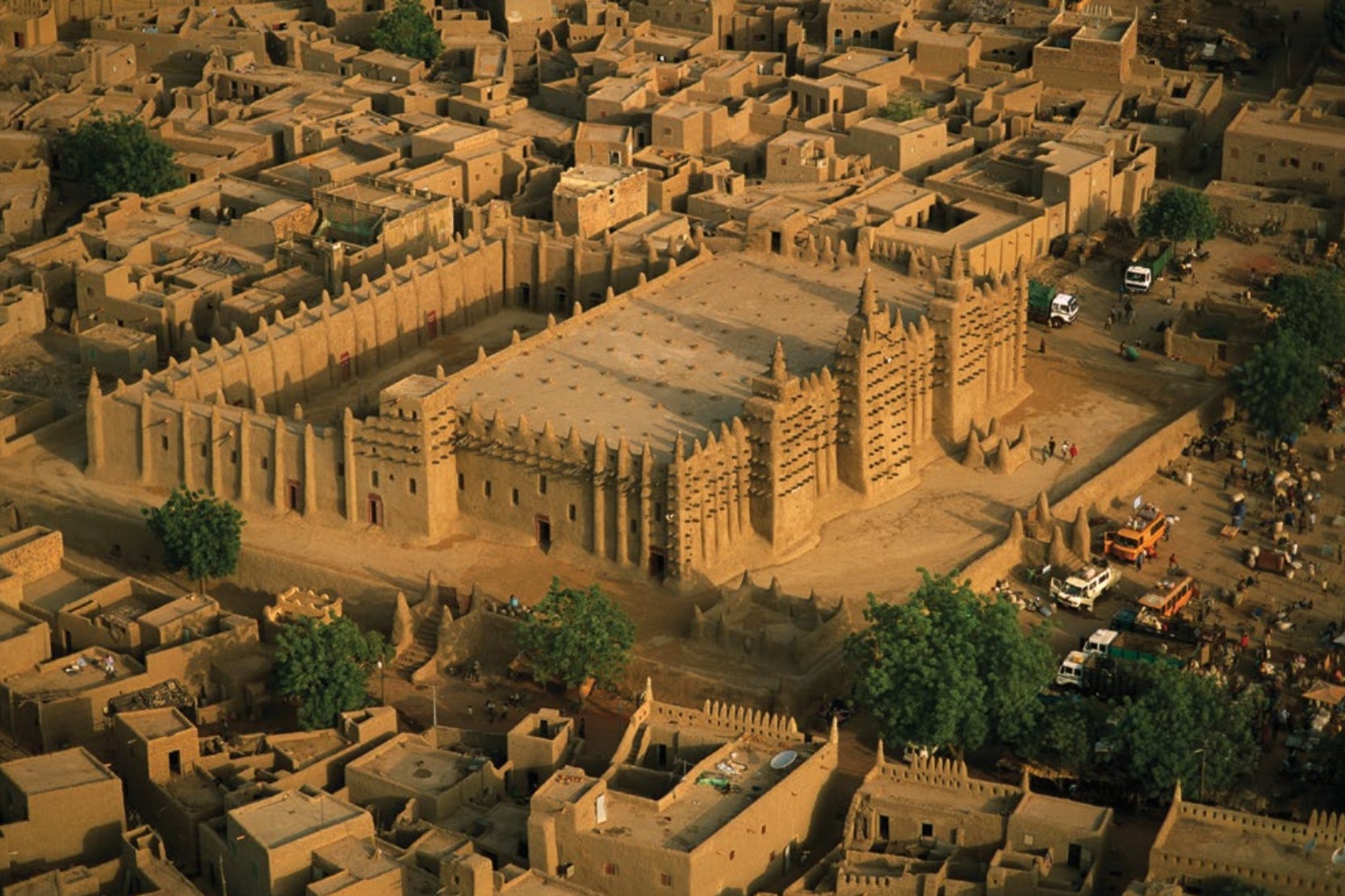
 Great Mosque of Djenné © George Steinmetz/Corbis
Great Mosque of Djenné
Mali. Founded c. 1200 C.E.; rebuilt 1906–1907. Adobe.
Curator Note
"The largest mud-brick structure in the world. It survives because the entire community gathers once a year for the "Crepissage" festival to re-plaster the walls with fresh mud, turning maintenance into a joyous celebration of unity."
Form
- Adobe Architecture: Sun-dried mud bricks and mud plaster (banco).
- Torons: Wooden beams projecting from the walls serve as permanent scaffolding.
- Verticality: Vertical buttresses and pilasters emphasize height and reach toward heaven.
- Ostrich eggs: Conical pillars are topped with eggs, symbolizing fertility and purity.
- Sudano-Sahelian style: Distinctive regional blend of Islamic and indigenous African forms.
Function
- Religious center: The Friday Mosque (Jami) for the entire city of Djenné.
- Community hub: The marketplace sits directly in front of the mosque.
- Symbol of Islam: Demonstrates the adoption and adaptation of Islam in West Africa.
- Social cohesion: The annual re-plastering festival unites the community.
- Political statement: Rebuilt in 1907 under French rule to appease the Muslim population.
Content
- Hypostyle hall: The interior acts as a forest of pillars supporting the roof.
- Qibla wall: Faces Mecca, marked by three main minarets.
- Mihrab: Niches in the Qibla wall indicating the direction of prayer.
- Roof vents: Ceramic caps on the roof can be opened to release hot air.
- Spires and Pinnacles: Decorative elements that also add structural weight to the walls.
Context
- Djenné was a major trading city on the trans-Saharan gold/salt route.
- First mosque built in the 13th century by King Koi Konboro (first Muslim sultan).
- The current structure is the third iteration, built during the French colonial period.
- The "Crepissage" (Plastering of the Mosque) is a UNESCO Intangible Heritage event.
- Reflects the syncretism of Islam with local materials and culture.