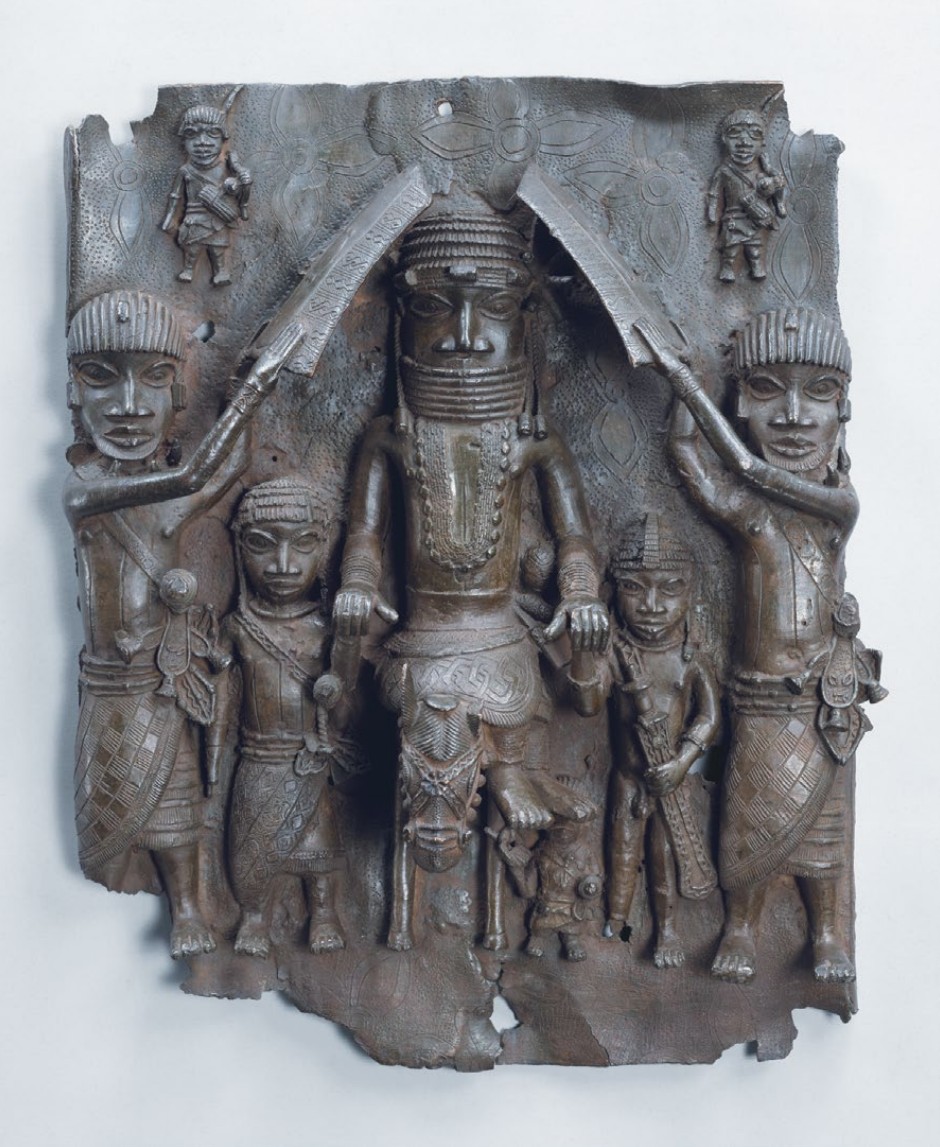
 Wall plaque, from Oba’s palace Image © The Metropolitan Museum of Art/Image source © Art Resource, NY
Wall plaque, from Oba’s palace
Edo peoples, Kingdom of Benin (Nigeria). 16th century ce. Cast brass.
Curator Note
"A "book" of brass. These plaques once covered the wooden pillars of the Oba's palace, telling the history of the Benin Kingdom. They were ripped off and looted by the British in the violent "Punitive Expedition" of 1897."
Form
- Lost-wax casting: Highly advanced technique using beeswax and clay molds.
- High relief: Figures project strongly from the background.
- Hierarchical scale: The Oba (king) is largest, central, and most detailed.
- Stylized realism: Heads are disproportionately large ("seat of wisdom").
- Patterning: Background typically features rosettes (river leaf markings).
Function
- Historical record: Documented dynastic history, battles, and court rituals.
- Architectural decoration: Nailed to the wooden pillars of the royal palace.
- Propaganda: Reinforced the divine power and authority of the Oba.
- Intimidation: Impressed visitors with the wealth (brass/trade) of the kingdom.
- Ritual connection: Brass is shiny and red, resisting corrosion (spiritually charged).
Content
- The Oba: Central figure, wearing coral bead regalia and a high collar.
- Attendants: Soldiers or priests shielding the Oba (he must be protected from the sun).
- Coral Beads: Symbols of the Oba's power, obtained from the god Olokun (sea god).
- Rosettes: Four-petaled flowers represent the "River Leaf" and the sun.
- European influence: Material (brass manillas) likely came from trade with Portuguese.
Context
- Kingdom of Benin (Nigeria) was a powerful, wealthy state in the 16th century.
- Oba Esigie initiated the golden age of brass casting.
- Trade with Portugal provided the metal (manillas) used to melt down for plaques.
- 1897 Punitive Expedition: British burned the city and looted 4,000+ "Benin Bronzes."
- Current debate: Nigeria is demanding the repatriation of these looted artifacts.