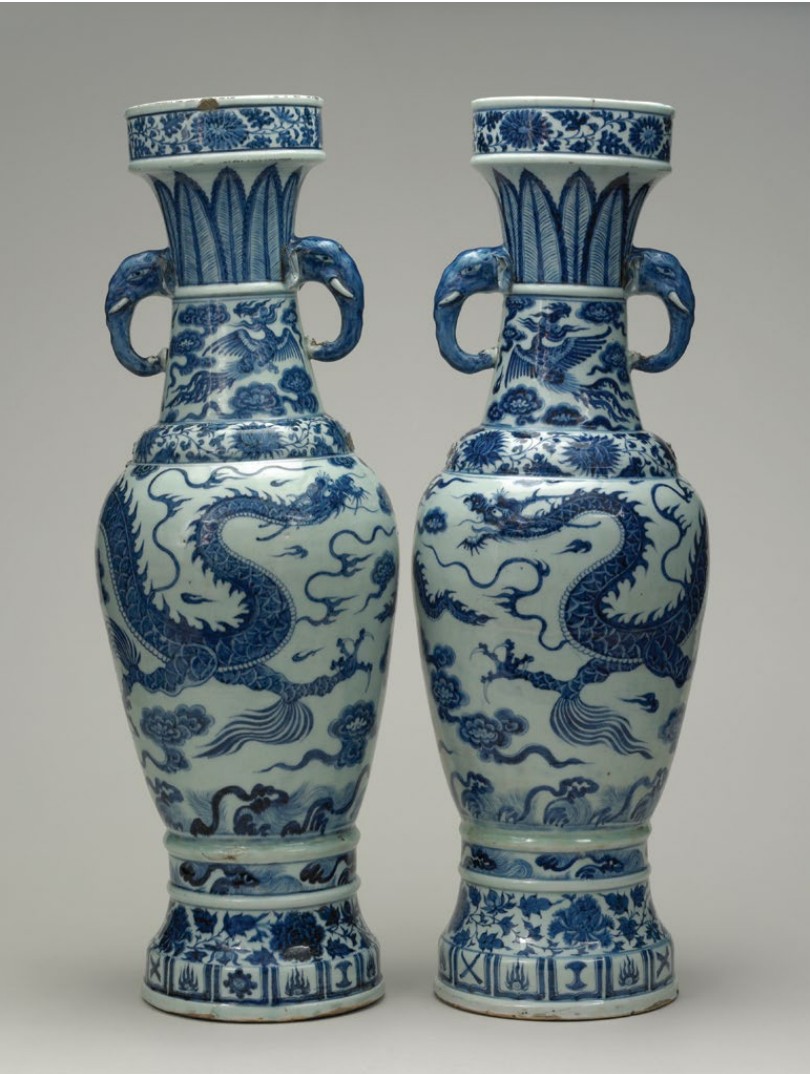
 The David Vases © The Trustees of the British Museum/Art Resource, NY
The David Vases
Yuan Dynasty, China. 1351 C.E. White porcelain with cobalt-blue underglaze.
Curator Note
"The birth of "Blue and White." These vases are the "Rosetta Stone" of Chinese porcelain because they have a specific date written on the neck (1351). Created under Mongol rule, they combine Chinese clay, Iranian blue pigment, and Mongol taste, revolutionizing global ceramics forever."
Form
- Material: Kaolin clay (porcelain) fired at high temp.
- Glaze: Cobalt-blue underglaze (from Iran) with clear overglaze.
- Shape: Bronze altar vessel shape (elephant-head handles).
- Technique: Wheel-thrown in sections and luted together.
- Condition: Excellent, though handles have some wear.
Function
- Religious: Dedicated to a Daoist temple in honor of a general who became a god.
- Offering: Praying for peace and protection.
- Dating Tool: The inscription provides the exact date (May 13, 1351).
- Display: Intended for an altar, not for flowers.
- Status: High-quality commission.
Content
- Dragons: 5-clawed dragons (imperial symbol, though commoner used here).
- Phoenixes: Flying amidst clouds.
- Inscription: Long dedication by Zhang Wenjin.
- Motifs: Peonies, banana leaves, waves.
- Handles: Elephant heads holding rings.
Context
- Yuan Dynasty: Mongol rule (Kublai Khan) opened trade (Pax Mongolica).
- Global Trade: Cobalt came from Persia; Porcelain went to Europe/Middle East.
- Jingdezhen: The "Porcelain Capital" where these were made.
- Sir Percival David: The collector who bought them (reunited the pair).
- Impact: Led to Ming vases and eventually Delftware/Willow pattern.