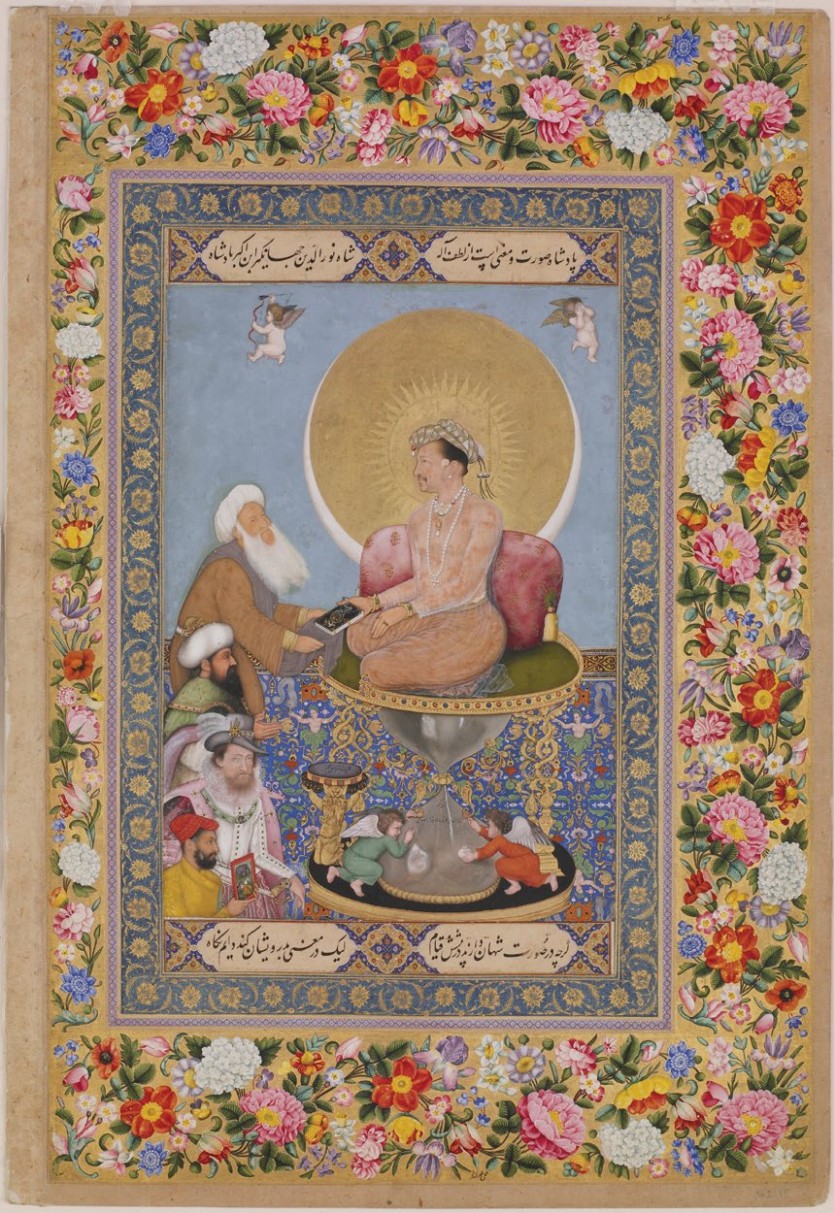
 Jahangir Preferring a Sufi Shaikh to Kings © Freer Gallery of Art, Smithsonian Institution, Washington, D.C.
Jahangir Preferring a Sufi Shaikh
Bichitr. c. 1620 C.E. Watercolor, gold, and ink on paper.
Curator Note
"Spiritual power over worldly power. The Mughal Emperor Jahangir sits on an hourglass throne. Four men wait for his attention: a Sultan, a King (James I of England!), and a painter. But Jahangir ignores the kings to hand a book to a humble Sufi mystic. It's a bold claim: "I am so powerful, I value only the spirit.""
Form
- Medium: Opaque watercolor (gouache), gold, ink on paper (Miniature).
- Style: Fusion of Persian (patterns), Indian (colors), and European (realism/angels).
- Composition: Hieratic scale (Jahangir is biggest/brightest).
- Symbolism: Complex allegory (Sun/Moon halo, hourglass).
- Details: Incredible precision (hands, jewelry).
Function
- Muraqqa: Part of an album made for private viewing by the Emperor.
- Propaganda: Justifying his rule as divinely ordained.
- Self-Portrait: The artist Bichitr inserts himself to show humility and skill.
- Diplomacy: Shows knowledge of Western monarchs (James I).
- Legacy: Secures his image as a "World Seizer" (Jahangir).
Content
- The Sufi: Receives the gift; doesn't touch the Emperor (uses a cloth).
- King James I: Copied from a European painting; looks uneasy.
- Bichitr (Artist): Holding a painting of himself bowing.
- Hourglass: "Time is running out", so focus on the eternal.
- Putti (Angels): European motifs crying and breaking Cupid's bow.
Context
- Mughal Empire: Islamic rulers of India; wealthy and cosmopolitan.
- Akbar: Jahangir's father was secular; Jahangir was more complex.
- Sufism: Mystical Islam emphasized the connection to saints.
- European Contact: Jesuits brought art/prints which Mughals copied.
- Bichitr: Known for his European influence and formal portraiture.