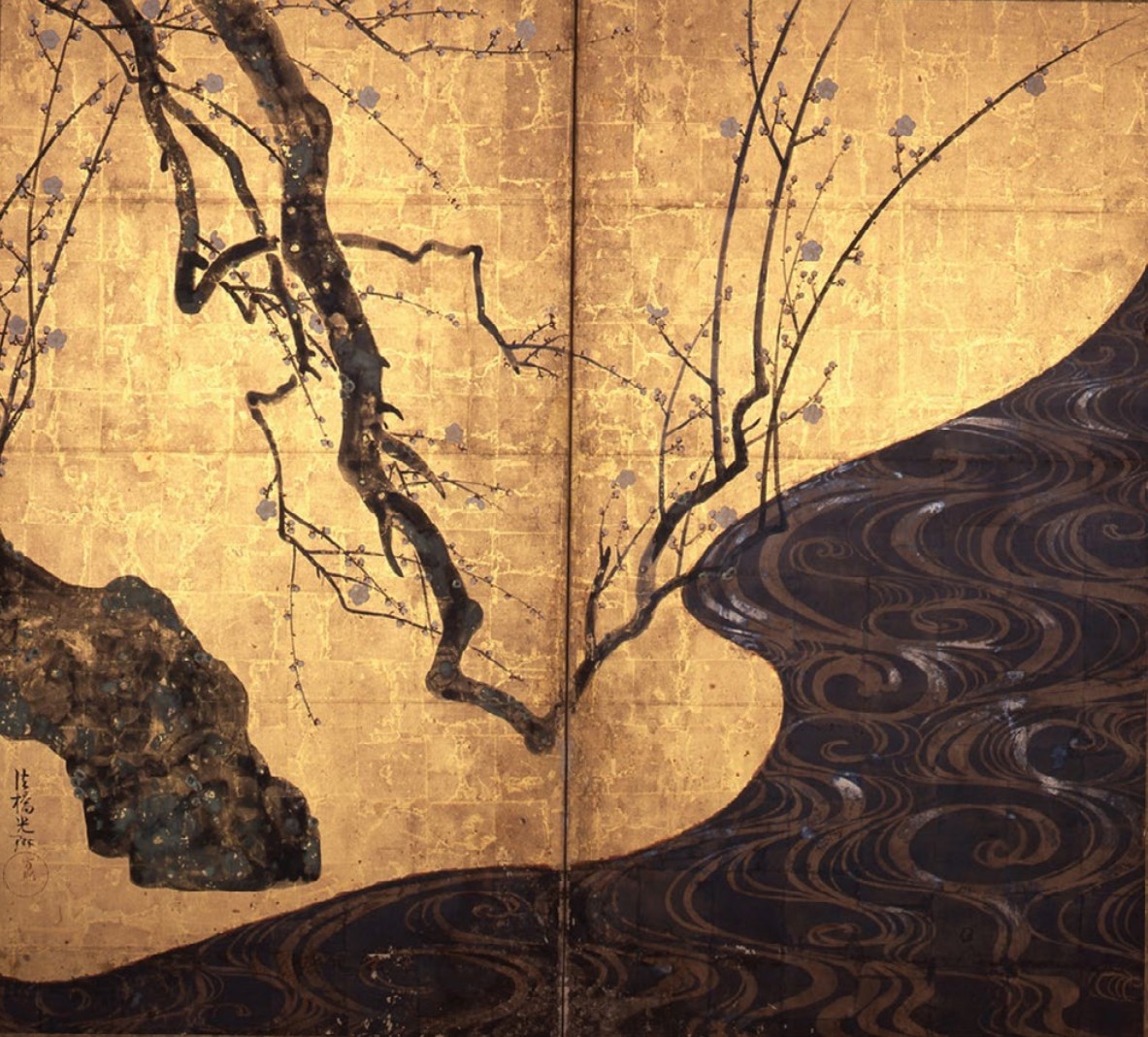
 White and Red Plum Blossoms © MOA Museum of Art
White and Red Plum Blossoms
Ogata Korin. c. 1710–1716 C.E. Ink, watercolor, and gold leaf on paper.
Curator Note
"The river of dreams. Ogata Korin was a bad boy of the merchant class who squandered his inheritance but founded the Rinpa school. This screen contrasts the gnarled, realistic trees with a flat, abstract, metallic river swirling in the center. It's a masterpiece of design and decorative abstraction."
Form
- Format: Pair of two-fold folding screens (Byobu).
- Composition: The stream cuts through the center, separating the trees.
- Abstract/Realism: Trees are naturalistic (tarashikomi); River is abstract pattern.
- Material: Ink, pigment, and gold leaf on paper.
- Technique: Tarashikomi (dripping wet paint into wet paint) creates the tree bark texture.
Function
- Room Divider: Used to divide space in a Japanese home.
- Atmosphere: The gold leaf would reflect candlelight, illuminating the room.
- Aesthetics: Example of Rinpa style (decorative, bold).
- Symbolism: Spring (rebirth, youth vs. age).
- Legacy: Influenced Klimt and Art Nouveau.
Content
- Red Plum Tree: Youthful, energetic branches shooting up.
- White Plum Tree: Old, gnarled trunk bowing down.
- Stream: Stylized swirls in silver/indigo (creates movement).
- Gold background: Defines the space as ethereal/timeless.
- No ground plane: The trees float in gold.
Context
- Edo Period: A time of peace and rise of the merchant class (Chonin).
- Rinpa School: Named after Korin ("Rin" + "Pa" = School of Korin).
- Luxury: Art for the wealthy merchants, not just samurai.
- Ogata Korin: A textile designer background influenced his bold patterns.
- Transformation: The image changes as you fold the screens.