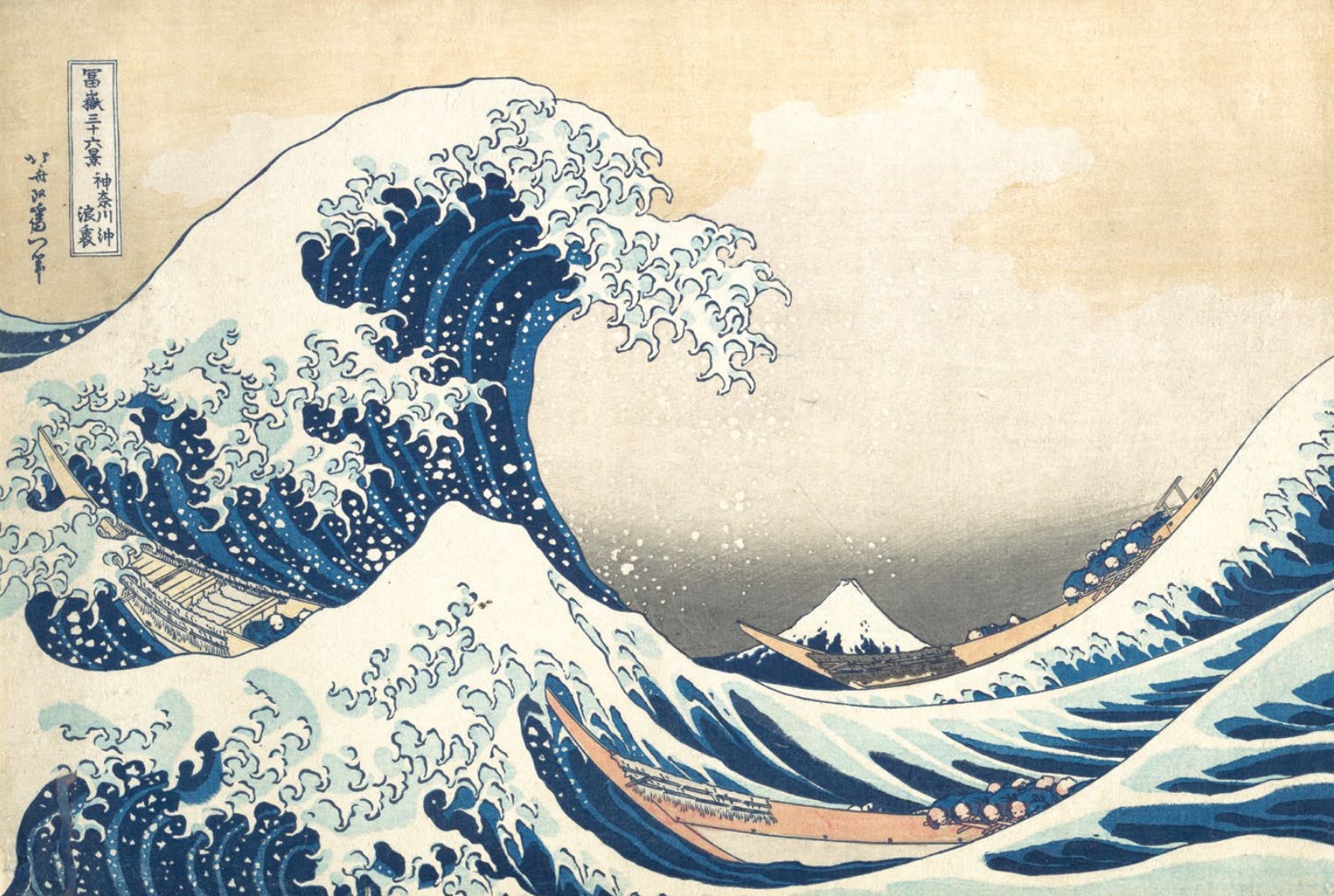
 Kanagawa oki nami uraImage © The Metropolitan Museum of Art/Image Source © Art Resource, NY
Under the Wave off Kanagawa (The Great Wave)
Katsushika Hokusai. 1830–1833 C.E. Polychrome woodblock print; ink and color on paper.
Curator Note
"The most famous wave in the world. It’s not just a wave; it’s a lesson on perspective. The sacred Mt. Fuji—usually huge—is tiny, framed by the crushing claw of the water. Hokusai captures the terror of nature and the fragility of the humans in the boats, using the new "Prussian Blue" ink."
Form
- Medium: Ukiyo-e woodblock print (Polychrome).
- Perspective: Low horizon line (Western influence).
- Color: Heavy use of Prussian Blue (imported synthetic dye).
- Composition: Dynamic curves vs. static triangle (Fuji).
- Line: Graphic, claw-like foam.
Function
- Commercial Art: Mass-produced for the tourist market / pilgrims.
- Series: Part of "Thirty-Six Views of Mount Fuji".
- Souvenir: Cheap art for the common people.
- Devotion: Celebrating the sacred mountain.
- Export: Became iconic in the West (Japonisme).
Content
- The Wave: Has "claws", threatening to crash.
- Mt. Fuji: Small, stable, eternal in the background.
- Boats (Oshiokuri-bune): Fast cargo boats delivering fish to Edo.
- Men: Huddled, faceless, submitting to nature's power.
- Spray: Looks like falling snow on the mountain.
Context
- Edo Period: Japan was closed (Sakoku) but Dutch trade brought blue dye.
- Hokusai: Obsessed with immortality and geometry; "Old Man Mad About Painting".
- Ukiyo-e: "Pictures of the Floating World" (pleasure, nature, travel).
- Influence: Inspired Debussy's La Mer and Van Gogh.
- Nature: Shinto reverence for the power of nature (Kami).