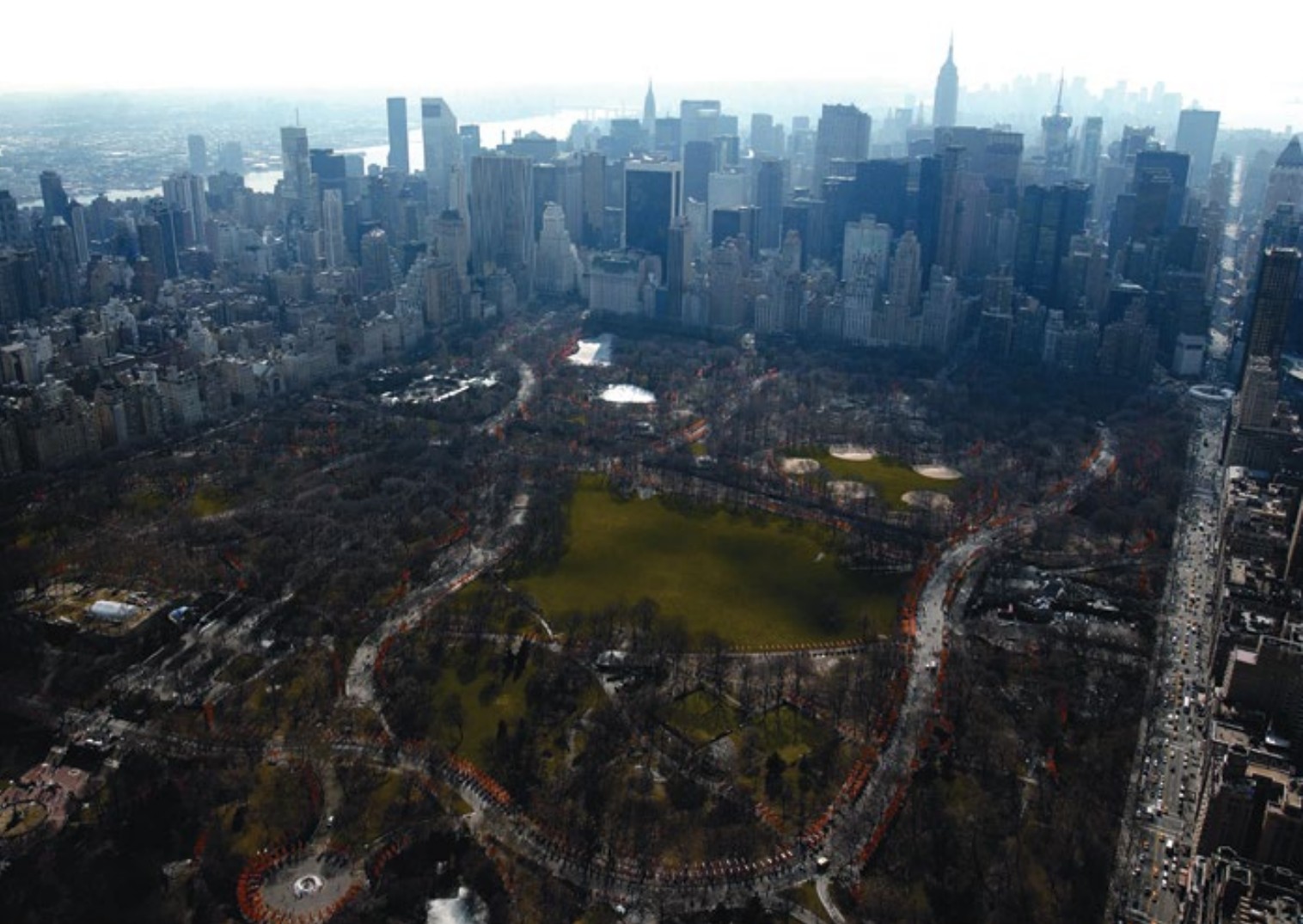
 The Gates © Chip East/Reuters/Corbis
The Gates
New York City, U.S. Christo and Jeanne-Claude. 1979–2005 C.E. Mixed-media installation
Curator Note
"A temporary installation of 7,503 saffron-colored gates in Central Park, The Gates was a localized intervention that transformed the winter landscape. The project took decades of negotiation to realize, highlighting the artists’ perseverance and the bureaucratic nature of public art. It was entirely self-funded, rejecting sponsorship to maintain artistic freedom, and was dismantled after 16 days, leaving no trace but memories and media."
Form
- Composed of 7,503 vinyl gates with saffron-colored nylon fabric panels.
- Spanned 23 miles of pathways within Central Park, New York City.
- Rectilinear rigid vinyl frames contrasted with the organic, flowing fabric.
- The warm saffron color created a visual complementary contrast to the blue winter sky and white snow.
- The scale was monumental yet intimate, as the gates were designed to be walked through.
Function
- To encourage pedestrians to re-explore and experience Central Park in a new way.
- To create a temporary "golden river" visible from the skyscrapers above.
- To highlight the organic design of the park against the city grid.
- To challenge traditional concepts of permanent public monuments.
- To create a communal, shared aesthetic experience for the public free of charge.
Content
- The gates mimic the form of Japanese shinto torii gates, marking a transition to sacred space.
- The color represents warmth, energy, and continuity in a bleak winter landscape.
- The temporary nature emphasizes the fleeting quality of joy and beauty.
- The swaying fabric introduces movement and sound, engaging multiple senses.
- No deeper political message; the artists insisted it was purely for aesthetic joy.
Context
- Created by the husband-and-wife team Christo and Jeanne-Claude, known for wrapping large structures.
- Conceived in 1979 but rejected by city officials until the Bloomberg administration approved it in 2003.
- Reflects the "Global Contemporary" focus on site-specific, temporary, and participatory art.
- Interacts with the history of Central Park as a man-made naturalistic environment by Olmsted and Vaux.
- The project generated significant tourism and economic benefit for NYC post-9/11.