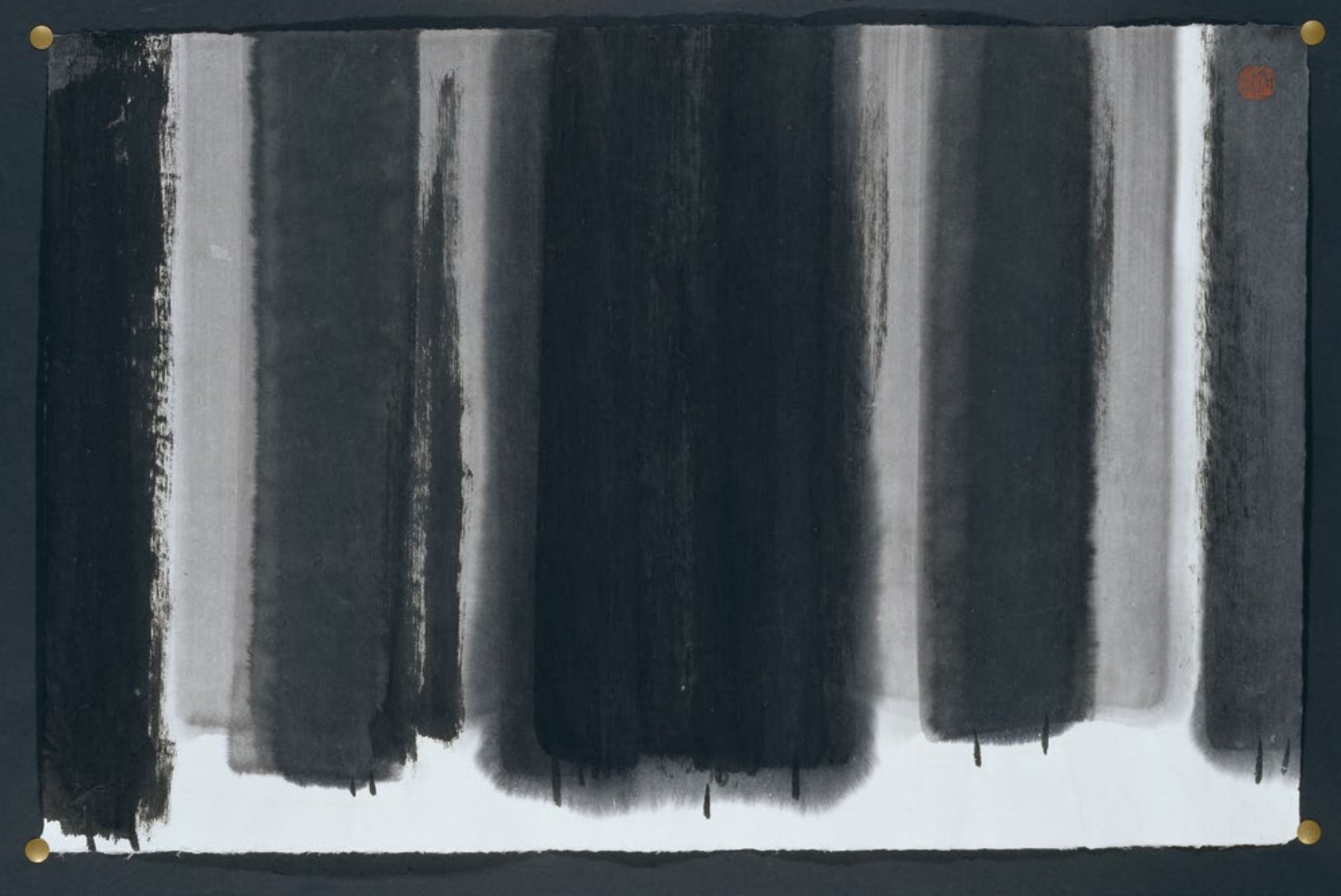
 Summer Trees © The Trustees of the British Museum
Summer Trees
Song Su-nam. 1983 C.E. Ink on paper
Curator Note
"A modern interpretation of traditional Korean ink wash painting, Summer Trees bridges the gap between Eastern tradition and Western abstraction. As a leader of the "Sumukhwa" (Oriental Ink) movement, Song Su-nam sought to recover a specifically Korean identity in the face of rapid westernization. The vertical strokes evoke a gathering of trees, symbolizing resilience and moral integrity."
Form
- Broad, vertical, parallel brushstrokes of black and gray ink.
- Ink wash technique (sumukhwa) on paper, allowing for bleed and tonal variation.
- Abstract, all-over composition with a strong sense of verticality.
- High contrast between the darkest blacks and the untouched white paper.
- Scale is relatively large, immersing the viewer in the "forest".
Function
- To revitalize traditional Korean ink painting in a modern context.
- To express a sense of Korean national identity and cultural continuity.
- To create a meditative, contemplative visual experience.
- To balance the influence of Western abstraction (like Color Field) with Eastern materials.
- To symbolize the strength and upright character of the "literati" scholar.
Content
- A group of trees, which traditionally represent a gathering of friends or scholars.
- Trees symbolize resilience, uprightness, and steadfastness in Asian art.
- The lack of specific detail pushes the imagery towards pure abstraction.
- The gathering suggests community and collective strength.
- The negative space serves as the "breath" of the painting, balancing the mass.
Context
- Created during a period of rapid modernization and westernization in South Korea.
- Song Su-nam co-founded the Sumukhwa movement to preserve Korean traditions.
- Reflects the tension between global contemporary art trends and local heritage.
- Resonates with the 11th-century Chinese tradition of literati painting.
- Shows influence of Western Abstract Expressionism (like Morris Louis) in the pour/stroke technique.