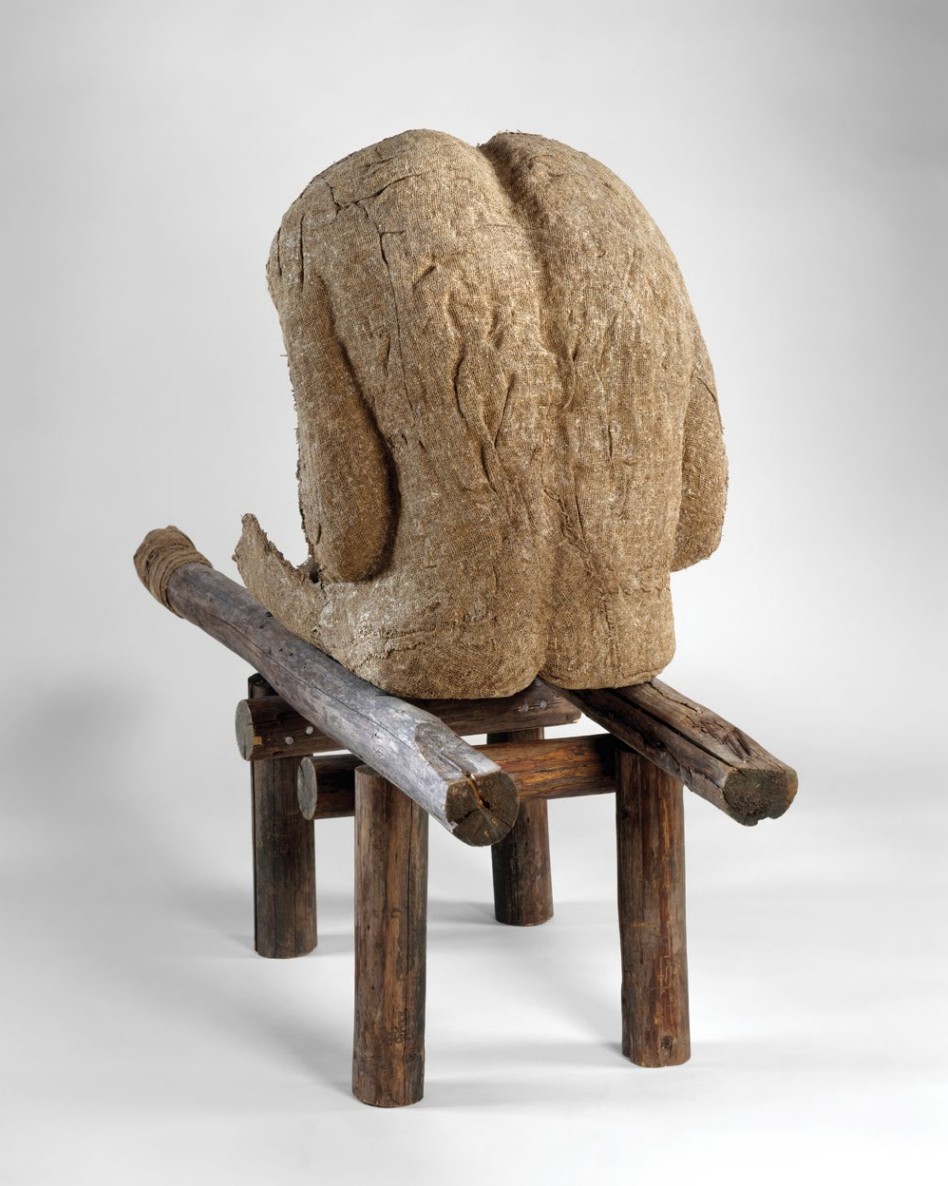
 Androgyne III © Magdalena Abakanowicz, Courtesy Marlborough Gallery, New York/Image © The Metropolitan Museum of Art/Image Source © Art Resource, NY
Androgyne III
Magdalena Abakanowicz. 1985 C.E. Burlap, resin, wood, nails, and string
Curator Note
"A hollow, headless, shell-like torso made of hardened burlap, seated on low stretchers. Abakanowicz, growing up in war-torn Poland, created figures that speak to human vulnerability, dehumanization, and resilience. The repetition of these hollow forms in her larger body of work suggests the anonymity of the individual within a totalitarian crowd."
Form
- Fragmented, headless human torso without arms or legs.
- Cast from a mold using burlap dipped in resin, creating a rough, wrinkled texture.
- Hollow interior visible from the back, emphasizing emptiness.
- Mounted on a simple, low wooden structure resembling a stretcher or hospital cot.
- Earth tones match the natural materials and suggest organic decay.
Function
- To express the physical and spiritual condition of humanity in the 20th century.
- To evoke feelings of hollowness, trauma, and loss.
- To challenge the traditional heroic sculptural form of the human body.
- To suggest the anonymity and indistinguishability of individuals in mass society.
- To prompt reflection on suffering, endurance, and the body as a vessel.
Content
- The androgenous form de-emphasizes gender, focusing on universal humanity.
- The "shell" suggests a husk or outer layer, questioning where the "person" resides.
- The stretcher implies illness, injury, or death camps.
- The wrinkled skin-like texture alludes to the earth and the body's fragility.
- The headless state removes individual identity and intellect, leaving only the suffering body.
Context
- Abakanowicz lived through the Nazi invasion of Poland and subsequent Soviet occupation.
- Her family lost their aristocratic status and property during the Communist regime.
- Reflects the trauma of WWII and the dehumanization under totalitarianism.
- The use of cheap, non-traditional materials (burlap) was necessitated by scarcity and choice.
- Fits into the Global Contemporary theme of using materials to convey political and personal history.