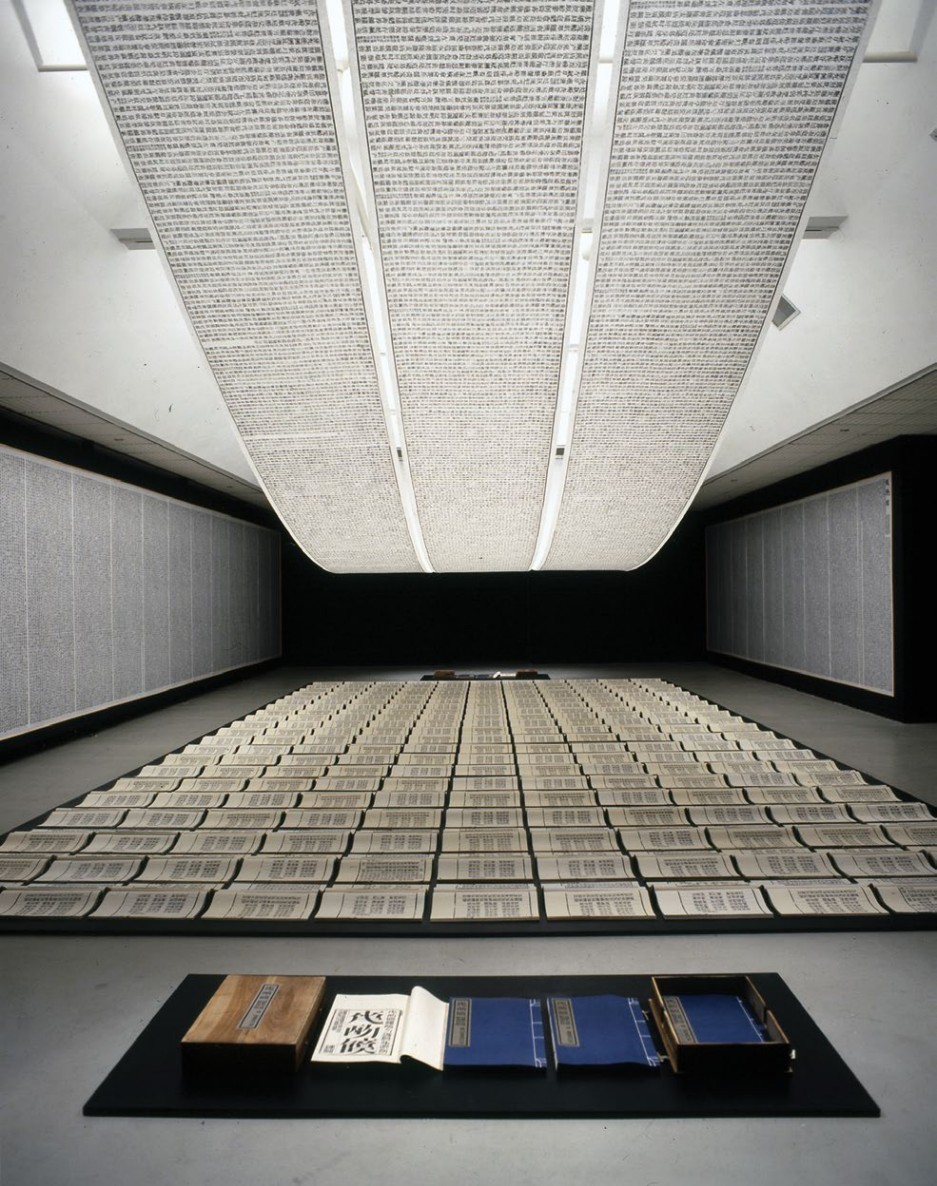
 A Book from the Sky Used by Permission
A Book from the Sky
Xu Bing. 1987–1991 C.E. Mixed-media installation
Curator Note
"An immersive installation consisting of books, scrolls, and wall panels printed with thousands of "false" Chinese characters. Xu Bing hand-carved movable type blocks to create characters that look authentic but are completely meaningless. Ideally, this work frustrates the viewer’s desire to read and understand, critiquing the hollowness of state propaganda and the unreliability of language."
Form
- Large installation filling a room with books on the floor, scrolls on the ceiling, and panels on walls.
- Uses traditional Chinese woodblock printing techniques and binding.
- Contains approximately 4,000 invented characters that follow the rules of Chinese calligraphy.
- The arrangement evokes a "sea of text" or a temple of knowledge.
- Stark black characters on white paper, creating a formal, authoritative aesthetic.
Function
- To challenge the authority of the written word and culture.
- To create a sense of cultural alienation even for native speakers.
- To critique the abuse of language in political propaganda (e.g., during the Cultural Revolution).
- To bridge the gap between traditional craft and conceptual art.
- To provoke a crisis of meaning in the viewer.
Content
- The characters are "empty" signifiers; they signify nothing.
- The vast quantity of text suggests wisdom, history, and bureaucracy.
- The "sky" (ceiling scrolls) and "ground" (floor books) envelop the viewer in meaninglessness.
- The title implies a divine text that is indecipherable to humans.
- Represents the destruction of culture and the futility of communication.
Context
- Completed in the aftermath of the Cultural Revolution in China.
- Xu Bing was sent to the countryside during the revolution and forced to make propaganda posters.
- Reflects the "New Wave" art movement in post-Mao China.
- Originally praised, it was later criticized by the government as "bourgeois liberalization".
- Resonates with Western post-structuralist theories about the instability of language.