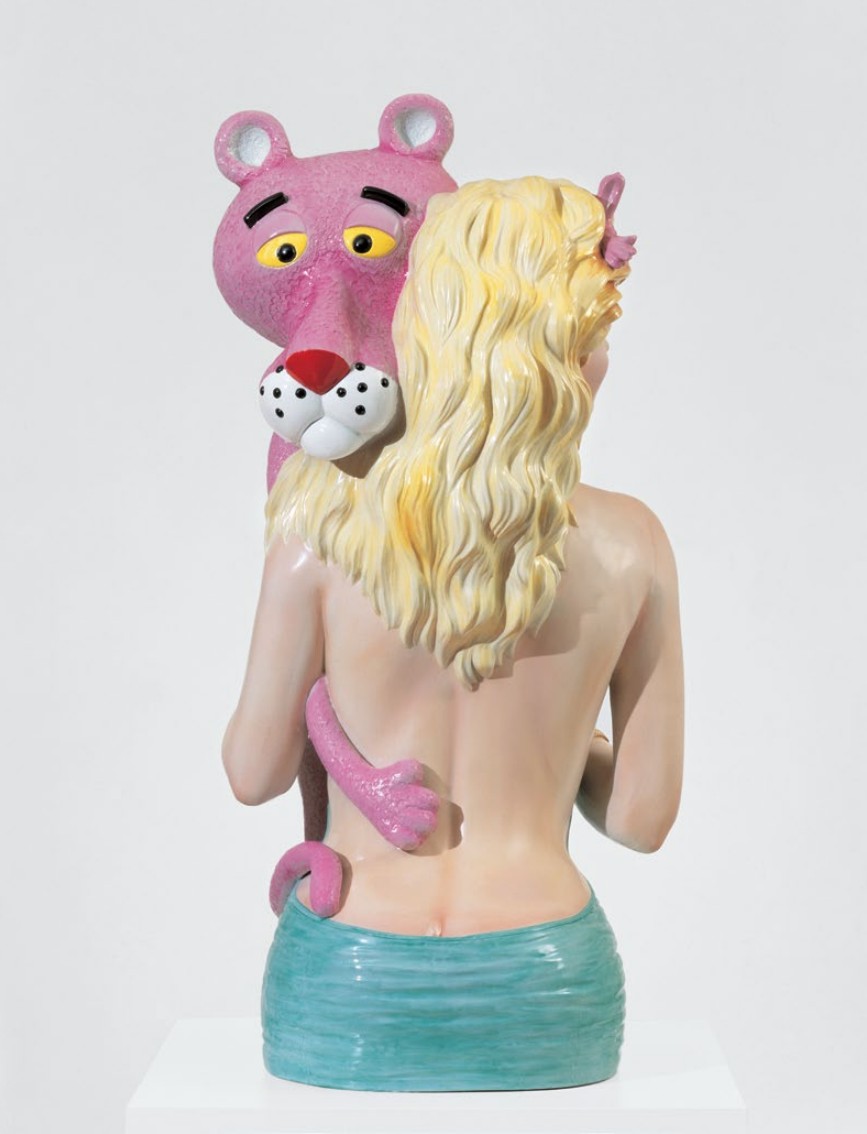
 Pink Panther Permission of the Artist © The Museum of Modern Art/Licensed by SCALA/Art Resource, NY
Pink Panther
Jeff Koons. 1988 C.E. Glazed porcelain
Curator Note
"Part of Koons' "Banality" series, this porcelain sculpture depicts a topless 1960s B-movie star, Jayne Mansfield, embracing the cartoon character Pink Panther. Koons embraces "kitsch"—mass-produced, sentimental, or garish objects—elevating them to high art. Ideally, the work challenges the distinction between good and bad taste, inviting the viewer to accept their own guilty pleasures without shame."
Form
- Life-size sculpture made of highly polished, glazed porcelain.
- Uses a pastel, candy-colored palette (pink, mint green, blonde).
- Smooth, glossy texture gives it a plastic, artificial look.
- Composition is somewhat stiff and posed, like a cheap souvenir figurine.
- Expertly crafted by traditional European ceramic artisans, hiding the artist's hand.
Function
- To critique the hierarchy of "high art" vs. "low culture" (kitsch).
- To challenge the modernist demand for serious, difficult art.
- To appeal to the mass market and consumer desire.
- To celebrate banality and the ordinary pleasures of popular culture.
- To provoke the art establishment by presenting "bad taste" as fine art.
Content
- Jayne Mansfield, a sex symbol, represents mass media celebrity.
- The Pink Panther represents childhood entertainment and commercial cartoons.
- The embrace suggests a strange intimacy between a human and a pop culture icon.
- The exposed breast alludes to eroticism in a commodified, non-threatening way.
- Looks like a magnified knick-knack or Hummel figurine.
Context
- Created during the 1980s boom in the art market and consumer culture.
- Koons worked as a commodities broker before becoming an artist.
- Relates to Duchamp’s readymades and Warhol’s Pop Art.
- The "Banality" show was a media spectacle, advertised in art magazines with photos of Koons.
- Institutional Critique: questions what museums collect and what viewers value.