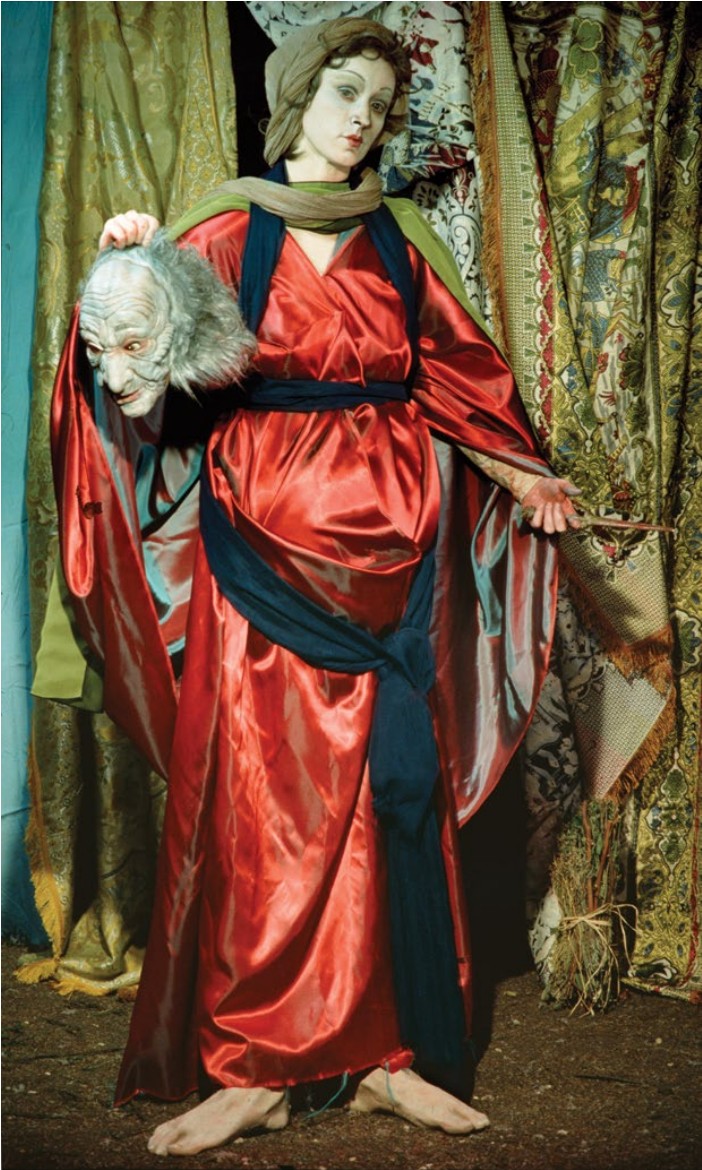
 Untitled #228 Courtesy of the Artist and Metro Pictures
Untitled (#228), from the History Portraits series
Cindy Sherman. 1990 C.E. Photograph
Curator Note
"In this photograph, Cindy Sherman disguises herself as the biblical heroine Judith, holding the head of Holofernes. Unlike a traditional Renaissance painting, the makeup is heavy, the props (the head) look cheap and plastic, and the feet are overly large. Sherman deconstructs the "Old Master" painting tradition, highlighting the artifice of representation and the male gaze in art history."
Form
- Large-format color photograph (7 feet tall).
- Sherman uses makeup, prosthetics, costumes, and props to transform herself.
- Rich, saturated colors (reds, golds, blues) mimicking oil painting.
- The composition mimics Baroque painting (e.g., Botticelli or Caravaggio).
- Deliberately artificial lighting and flatness reveal it is a photo, not a painting.
Function
- To deconstruct and critique the history of Western painting.
- To explore the fluidity of identity and the role of the camera.
- To question the portrayal of women as objects or archetypes in art history.
- To highlight the element of performance and artifice in all representation.
- To reclaim the female image from the traditional male artist's gaze.
Content
- Sherman appears as Judith, a biblical widow who saved her people by beheading the general Holofernes.
- The head of Holofernes is a grotesque, comedic mask.
- Judith looks somewhat bored or vacant, undercutting the dramatic narrative.
- The red drapery suggests blood, passion, and Renaissance fashion.
- The large feet break the illusion, reminding us of the artist posing.
Context
- Part of the "History Portraits" series where Sherman lived in Rome.
- Sherman serves as model, director, makeup artist, and photographer.
- Influenced by feminist art and postmodern theory regarding the "gaze".
- Reflects the Global Contemporary interest in identity and the reconstruction of history.
- Challenges the idea of the "original" genius masterpiece by creating a copy/pastiche.