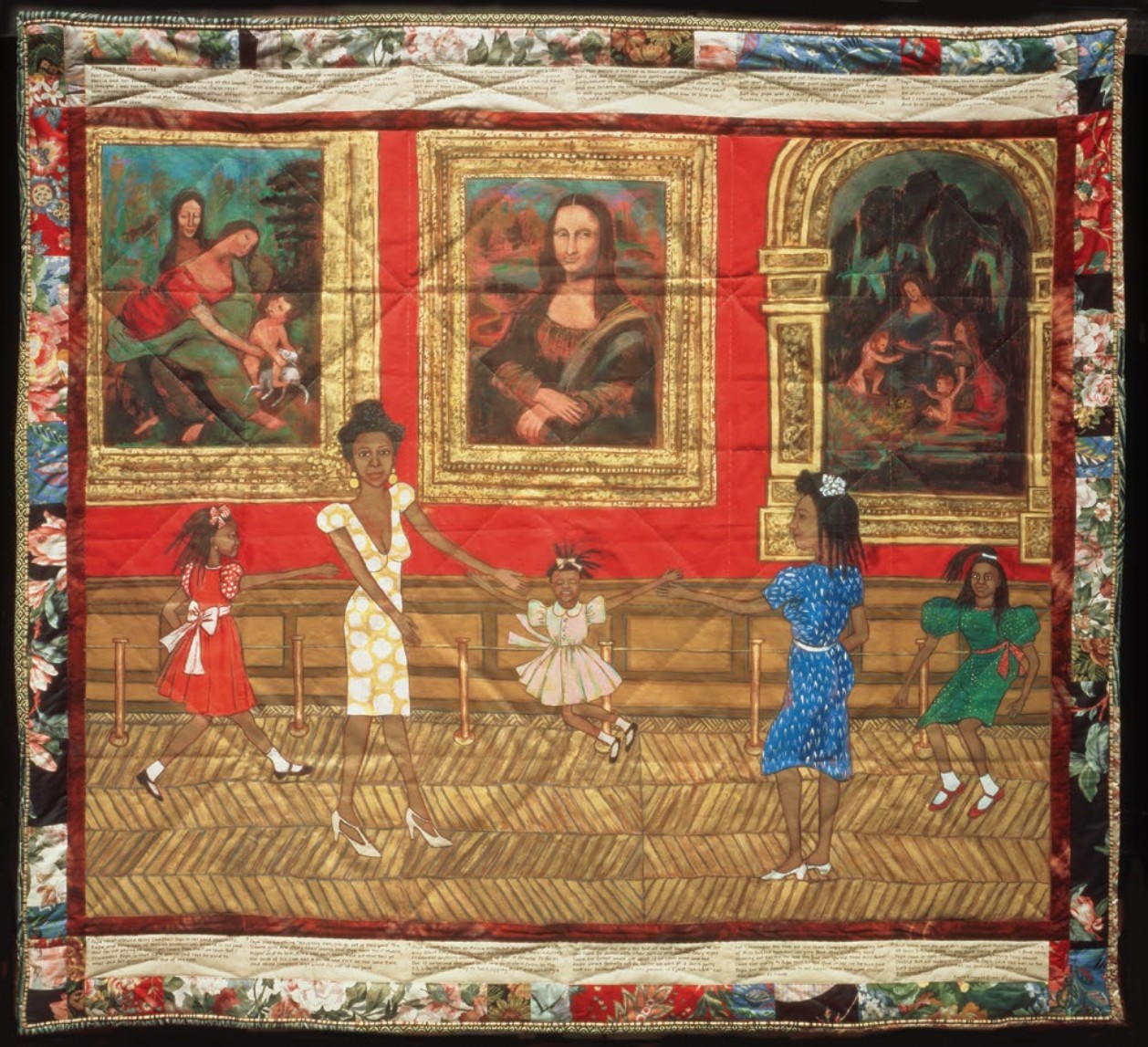
 Dancing at the Louvre, from the series The French Collection, Part I; #1 Faith Ringgold © 1991
Dancing at the Louvre
Faith Ringgold. 1991 C.E. Acrylic on canvas, tie-dyed, pieced fabric border
Curator Note
"Part of "The French Collection," this story-quilt depicts Ringgold’s fictional alter-ego, Willia Marie Simone, dancing with her daughters in the Louvre Museum in Paris. By combining the "low art" of quilting (associated with women and domesticity) with the "high art" of oil painting, Ringgold rewrites art history to include black women in spaces from which they were traditionally excluded."
Form
- Central image painted in acrylic on canvas.
- Surrounded by a border of pieced, tie-dyed fabric (quilting technique).
- Includes handwritten text in the margins narrating the story.
- Bright, flat colors and lack of strict perspective evoke folk art styles.
- Combines traditional craft (quilting) with fine art (painting).
Function
- To revise history and insert African American women into the Western canon.
- To challenging the hierarchy that places painting above craft/quilting.
- To tell a narrative story about freedom, family, and artistic ambition.
- To break the rules of museum etiquette (dancing in the Louvre).
- To celebrate the heritage of African American quilting and storytelling.
Content
- Willia Marie Simone and her three daughters dancing joyfully in front of da Vinci paintings.
- Famous masterpieces (Mona Lisa, Virgin of the Rocks) are in the background.
- The text tells Willia Marie's story of moving to Paris to become an artist.
- Represents a claim to space and ownership of cultural heritage.
- The quilt format links the work to the Underground Railroad and enslaved women’s history.
Context
- Ringgold began making story quilts to have her voice heard when no one would publish her autobiography.
- Reflects the Feminist art movement’s embrace of "domestic" crafts.
- Commentary on the lack of diversity in major museums like the Louvre.
- "The French Collection" series reimagines the lives of black women in 1920s Paris.
- Addresses issues of race, gender, and the politics of exhibition.